
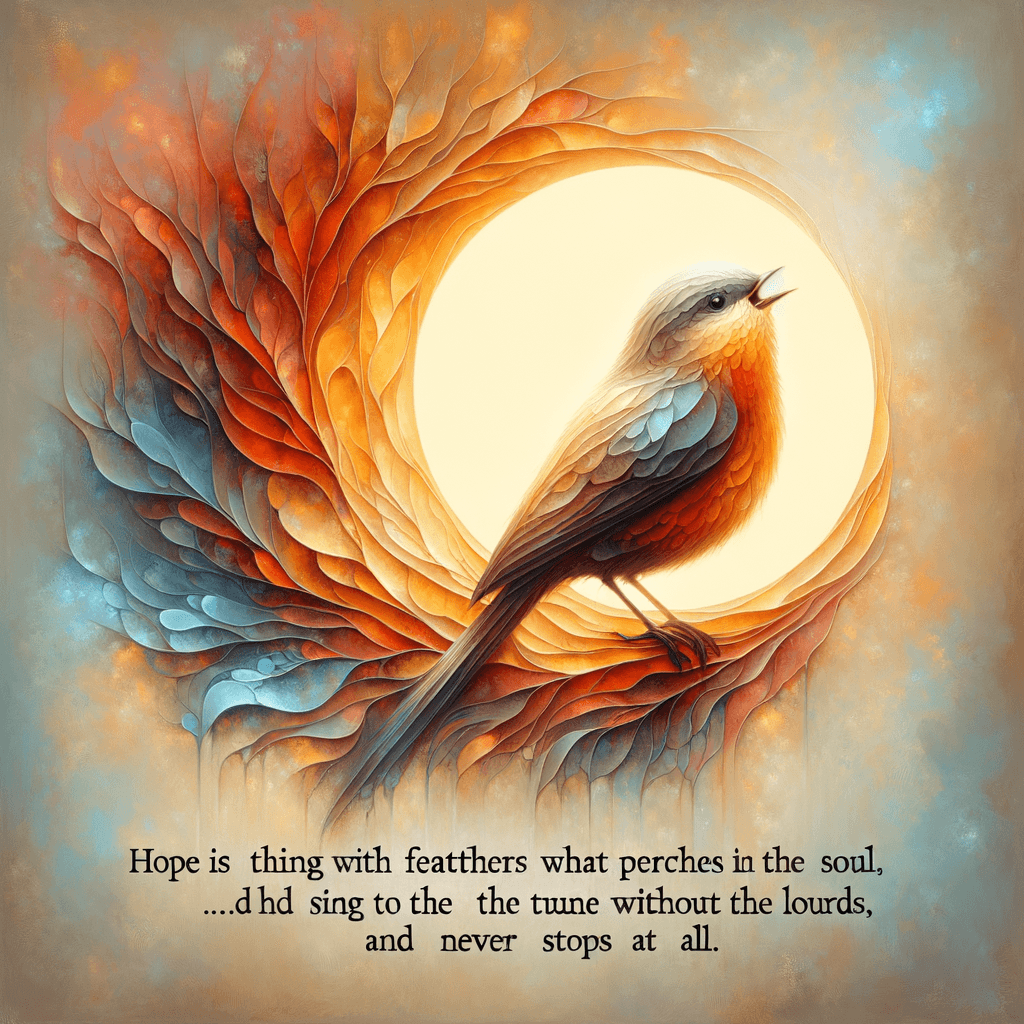
Hope is the thing with feathers that perches in the soul, and sings the tune without the words, and never stops at all. - Emily Dickinson
—What lingers after this line?
Metaphor of Hope
Emily Dickinson personifies hope as a bird with feathers that resides within the soul. This metaphor captures the delicate yet persistent nature of hope.
Resilience of Hope
The phrase 'never stops at all' highlights hope's unwavering and relentless existence, suggesting that it continues to inspire and uplift regardless of circumstances.
Hope as Comforting
The image of a bird singing continuously without words indicates that hope provides a sense of comfort and optimism, even in the absence of concrete solutions or explanations.
Inherent Presence
The description of hope as something that 'perches in the soul' implies that it is an inherent part of the human spirit, always present and ready to provide solace.
Emily Dickinson's Style
Dickinson’s poetic style often uses simple yet profound imagery to explore complex themes. Her metaphorical approach allows readers to relate to abstract concepts like hope on a personal level.
One-minute reflection
What's one small action this suggests?
Related Quotes
6 selectedHope is the thing with feathers that perches in the soul - and sings the tunes without the words - and never stops - at all. - Emily Dickinson
Emily Dickinson
Emily Dickinson uses the metaphor of a bird to represent hope. The 'thing with feathers' suggests that hope is light, delicate, but also persistent.
Read full interpretation →Push past ease; that's where shape and strength form. — Emily Dickinson
Emily Dickinson
Emily Dickinson’s line, “Push past ease; that's where shape and strength form,” distills a timeless challenge: do not settle for what feels effortless. Rather than praising struggle for its own sake, she points toward th...
Read full interpretation →When I hear somebody sigh, 'Life is hard,' I am always tempted to ask, 'Compared to what?' — Sydney J. Harris
Sydney J. Harris
Sydney J. Harris’s remark begins with an ordinary expression of fatigue: “Life is hard.” Yet his response, “Compared to what?” quietly turns complaint into inquiry.
Read full interpretation →Don't fight the challenges. Just find a new way to stand. — Germany Kent
Germany Kent
Germany Kent’s words begin with a quiet reversal of instinct: instead of treating every challenge as an enemy to defeat, she invites us to reconsider our posture toward difficulty. The emphasis is not on surrender, but o...
Read full interpretation →Optimist: someone who figures that taking a step backward after taking a step forward is not a disaster, it's more like a cha-cha. — Robert Brault
Robert Brault
Robert Brault’s line begins with a witty redefinition: an optimist is not someone who denies backward motion, but someone who interprets it differently. Instead of treating a setback as proof of failure, the optimist see...
Read full interpretation →A mind grows by staying with difficulty long enough for the experience to change it. — Mary Catherine Bateson
Mary Catherine Bateson
Mary Catherine Bateson’s observation begins with a quiet but demanding truth: the mind does not grow merely by encountering difficulty, but by remaining with it. Challenge becomes transformative only when we resist the u...
Read full interpretation →More From Author
More from Emily Dickinson →I know nothing in the world that has as much power as a word. Sometimes I write one, and I look at it, until it begins to shine. — Emily Dickinson
Emily Dickinson’s statement begins with a bold claim: among worldly things, few rival the power of a word. Rather than treating language as a neutral tool, she presents it as an active force that can move thought, alter...
Read full interpretation →The soul should always stand ajar, ready to welcome the roving experience. — Emily Dickinson
Emily Dickinson’s image of the soul standing “ajar” transforms inner life into a threshold rather than a fortress. Instead of sealing ourselves against surprise, she suggests that wisdom begins with a kind of deliberate...
Read full interpretation →Plant a question, harvest a path — Emily Dickinson
Emily Dickinson’s line, “Plant a question, harvest a path,” turns curiosity into agriculture: inquiry becomes a seed placed deliberately into the soil of experience. The image implies patience and faith, because planting...
Read full interpretation →Write the day you want to live into existence through honest action. — Emily Dickinson
Emily Dickinson’s line treats “the day you want to live” not as a wish but as something you can author. The verb “write” makes the future feel like a page that responds to a steady hand—shaped by choices, drafts, and rev...
Read full interpretation →