
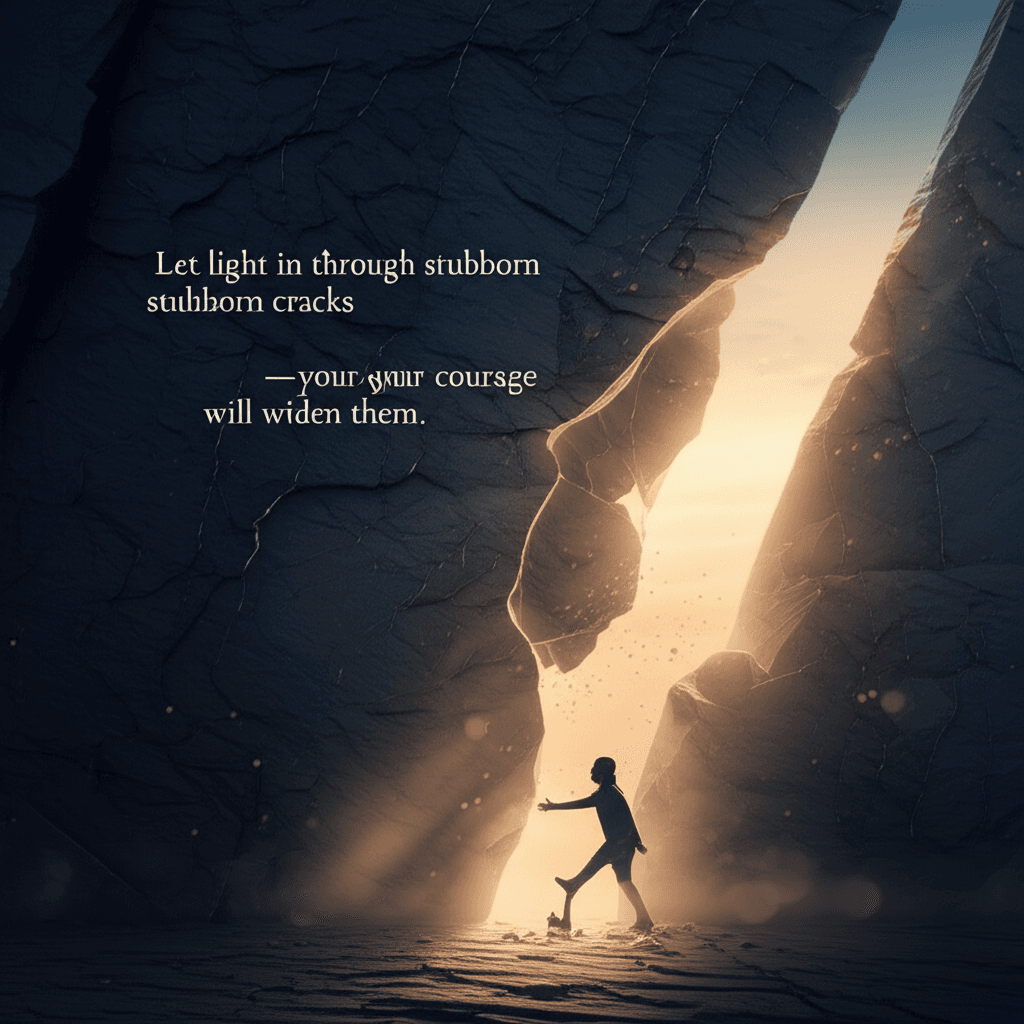
Let light in through stubborn cracks — your courage will widen them. — Helen Keller
—What lingers after this line?
Keller’s Metaphor of Light
At the outset, Helen Keller’s line distills a lifetime of turning constraint into possibility. Light, in her writing, often signifies knowledge and connection, while the “stubborn cracks” evoke the thin fault lines that exist in even the most daunting barriers. In The Story of My Life (1903), she repeatedly frames understanding as illumination—an image made poignant by her deafblind experience. Thus the quote suggests that obstacles are rarely monoliths; they are already fissured. Courage does not magically create openings but rather presses patiently where reality has begun to yield. In this view, bravery is a wedge: not a reckless battering ram, but deliberate pressure that enlarges what the world, or our own hearts, have already started to offer.
How Courage Works Psychologically
Building on this metaphor, courage is less the absence of fear than purposeful action beside it. Aristotle’s Nicomachean Ethics (Book III) frames courage as a mean between rashness and cowardice—precisely the steady force Keller implies. Modern psychology echoes this: exposure therapy shows that graded contact with what we fear lowers arousal over time, reshaping our threat maps (Foa & Kozak, 1986, Psychological Bulletin). When we face a worry in small, repeatable steps, our nervous system learns that catastrophe does not follow. In other words, each attempt widens the crack: the light of corrective experience enters, and the dark certainty of avoidance weakens. Courage, then, is both moral stance and biological training.
Small Steps, Big Openings
In practical terms, those widening movements are often tiny. Keller’s breakthrough at the water pump—when Anne Sullivan spelled “w-a-t-e-r” into her hand—was not a grand finale but a first gleam that made later literacy possible (The Story of My Life, 1903). Likewise, growth mindset research indicates that ability expands with effort-rich, feedback-driven practice (Dweck, Mindset, 2006). A single email sent, a brief conversation initiated, a short walk taken—these are not heroic acts in isolation. Yet, as they recur, they accumulate into durable pathways where we once saw only walls. The crack becomes a seam; the seam, a doorway. Progress, Keller’s image reminds us, is momentum multiplied by patience.
From Personal to Public Light
Extending outward, Keller argued that courage must also contest societal barriers. In Out of the Dark (1913), she connects disability rights, labor justice, and women’s suffrage, suggesting that systems, like individuals, contain stress lines that collective bravery can widen. History bears this out: Brown v. Board of Education (1954) opened a judicial crack that citizens widened through organized action, from classroom integration to the Montgomery Bus Boycott (1955–56). Each petition, march, and conversation functions like a steady wedge, letting ethical light infiltrate entrenched norms. The private discipline of facing fear thus scales to public courage: we practice on our own walls to better challenge our shared ones.
Repairing With the Gold of Experience
Analogies from art reinforce the point that cracks need not be hidden. In kintsugi, fractured pottery is repaired with lacquer dusted in gold, rendering the break the piece’s most beautiful feature. Similarly, Leonard Cohen’s “Anthem” (1992) insists, “There is a crack in everything—that’s how the light gets in.” Keller’s phrasing complements both: courage does more than disclose weakness; it transforms it into structure. Once illuminated, the fracture lines guide how we mend, turning fragility into form. Thus, imperfection is not merely tolerated; it becomes the map of resilience, teaching where to reinforce and where to open further.
Sustaining Courage Day by Day
Finally, sustaining this widening requires rhythms that keep fear from reclaiming the gaps. Behavioral activation research shows that action preceding motivation can lift inertia and mood (Jacobson et al., 1996, Journal of Consulting and Clinical Psychology). Meaning, too, steadies courage: Viktor Frankl’s Man’s Search for Meaning (1946) suggests that purpose allows us to bear the unavoidable while changing what we can. In practice, that means choosing one manageable step, repeating it until familiar, and then nudging the edge again. Over time, the stubborn crack becomes a bright threshold. And as the room fills with light, we see not just what was barricaded—but what is now possible.
Recommended Reading
As an Amazon Associate, we earn from qualifying purchases.
One-minute reflection
What's one small action this suggests?
Related Quotes
6 selectedReach toward light even when shadows stretch long; that reach becomes strength. — Helen Keller
Helen Keller
Helen Keller’s line begins with a simple but vivid contrast: light and shadows. Light suggests hope, clarity, and possibility, while long shadows signal fear, doubt, and hardship.
Read full interpretation →Set your fear aside and give the world your answer — Helen Keller
Helen Keller
Helen Keller’s line begins by naming what most often stops people from contributing: fear. It’s not merely fear of danger, but fear of judgment, failure, misunderstanding, or being “not enough.” By putting fear first, sh...
Read full interpretation →Turn the page of fear and write the chapter you imagine. — Helen Keller
Helen Keller
At first glance, Keller’s line fuses two decisive acts: turning a page and writing a chapter. The first is a quiet refusal to reread the same lines of anxiety; the second is an assertion of authorship over what comes nex...
Read full interpretation →It takes a lot of courage to show your dreams to someone else. — Erma Bombeck
Erma Bombeck
Erma Bombeck’s insight begins with a simple truth: dreams feel precious because they expose what we most deeply want. To share them is not merely to state a goal, but to reveal hope, insecurity, and the possibility of fa...
Read full interpretation →You do not have to be fearless to be brave. You only need to be present enough to take the next deliberate action. — Pema Chödrön
Pema Chödrön
At first glance, Pema Chödrön’s quote gently overturns a common misconception: that bravery belongs only to people untouched by fear. Instead, she presents courage as something far more accessible.
Read full interpretation →The most radical act of courage is to be truly seen, to step out from behind our carefully curated walls and offer our authentic selves to the world. — Glennon Doyle
Glennon Doyle
Glennon Doyle’s quote reframes courage not as conquest or spectacle, but as the quiet, risky decision to be known. At its core, it suggests that the bravest act is not hiding our flaws behind polished identities, but all...
Read full interpretation →More From Author
More from Helen Keller →I long to accomplish a great and noble task; but it is my chief duty to accomplish small tasks as if they were great and noble. — Helen Keller
Helen Keller’s words open with a familiar human desire: the longing to do something magnificent. Yet she immediately redirects that ambition toward duty, reminding us that life is rarely built from grand gestures alone.
Read full interpretation →Everything has its wonders, even darkness and silence, and I learn, whatever state I may be in, therein to be content. — Helen Keller
Helen Keller’s line begins by widening the definition of “wonder.” Rather than reserving amazement for bright, dramatic, or easily celebrated experiences, she insists that every aspect of existence contains something wor...
Read full interpretation →Reach with both hands for what you imagine; momentum answers effort. — Helen Keller
Helen Keller’s phrase, “Reach with both hands,” turns imagination into something physical: a posture of full commitment rather than a halfhearted try. Instead of treating a goal as a distant wish, she frames it as someth...
Read full interpretation →Hands that persist sculpt destiny out of raw days. — Helen Keller
Helen Keller’s line begins with a concrete image: hands. Rather than treating destiny as a distant, abstract force, she locates power in what we can do—touch, build, practice, and return to a task again.
Read full interpretation →