
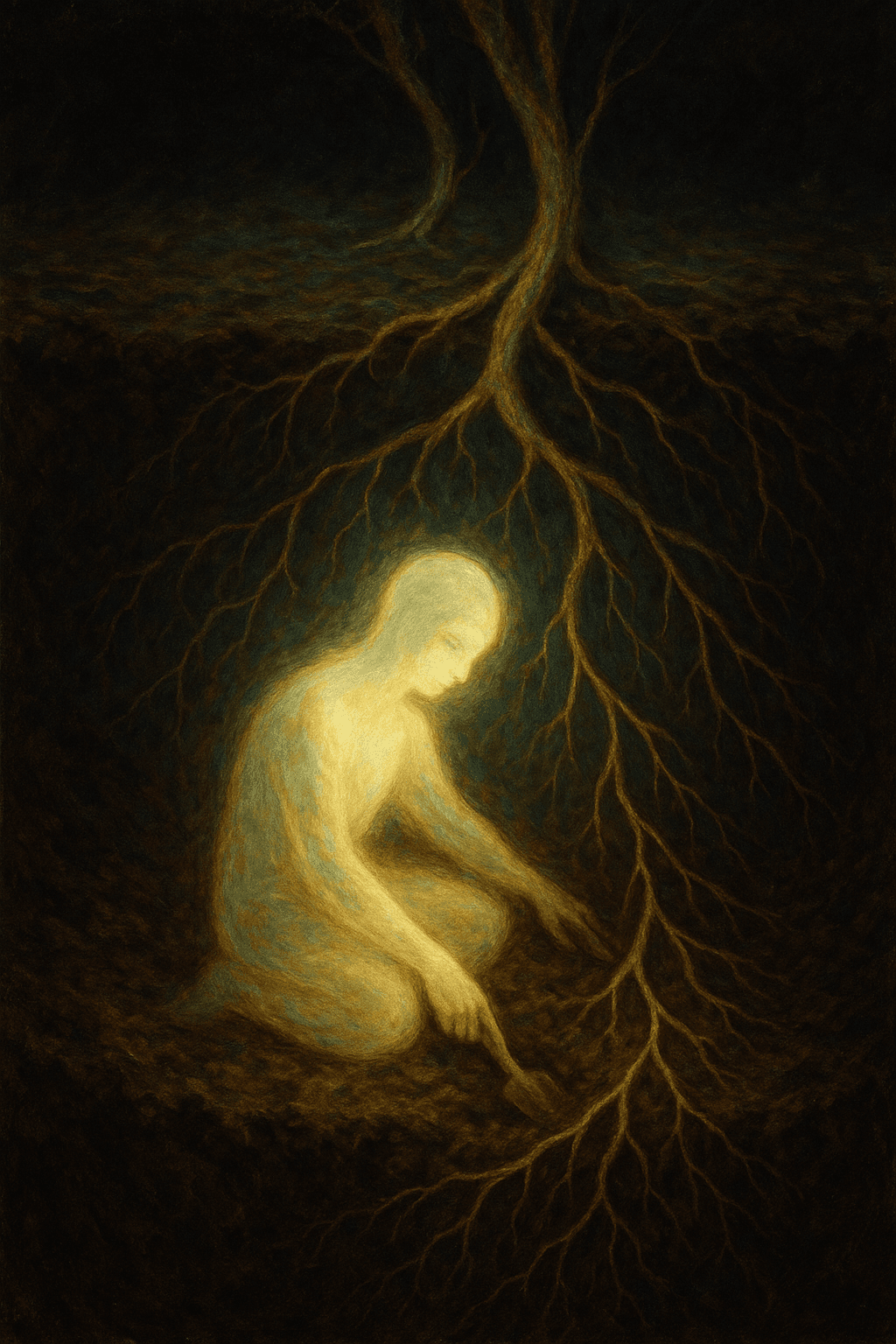
When the soul is deep in the dirt, it is digging for roots to rise again. — Rumi
—What lingers after this line?
The Image of the Soul in the Dirt
Rumi’s evocative metaphor of the soul being ‘deep in the dirt’ immediately conjures images of struggle and despair. Rather than viewing hardship as a mere setback, this phrase reframes difficulty as an essential part of the human experience. Just as a seed must be buried before it can sprout, Rumi suggests that our lowest moments possess transformative potential hidden beneath the surface.
Digging for Roots: Rediscovering Strength
Transitioning from darkness, Rumi introduces the idea of ‘digging for roots’—a process emblematic of seeking inner strength and connection. Roots symbolize foundational values, sources of nourishment, and anchors against adversity. This perspective echoes psychological theories of resilience, where individuals in crisis often return to core beliefs and relationships to rebuild. Viktor Frankl’s experiences in *Man’s Search for Meaning* (1946) similarly affirm that the search for meaning can begin in life’s lowest pits.
Rising Again: The Cycle of Renewal
After digging deep, the soul’s purpose is clear: to rise again. Rumi’s wisdom reinforces the cyclical nature of growth, wherein descent precedes ascent. Nature itself mirrors this truth—from trees that weather winter to bloom in spring, to butterflies emerging from the darkness of a chrysalis. This motif is found in countless traditions; for instance, the Christian concept of resurrection exemplifies how renewal is born from loss.
Transforming Suffering into Growth
Furthermore, Rumi encourages us to reimagine suffering not as pointless agony, but as a catalyst for evolution. Like compost enriching the earth, hardships can fertilize our growth if we accept them as part of an unfolding journey. Modern research into post-traumatic growth demonstrates that individuals often emerge from adversity with increased wisdom, empathy, and courage, echoing the spirit of Rumi’s words.
Cultivating Hope Amidst Hardship
Ultimately, Rumi’s message is one of hope. By recognizing that our darkest times serve a purpose—helping us ‘dig for roots’—we cultivate the patience and resolve to endure. In the context of spiritual traditions and everyday challenges alike, this outlook invites us to trust in the hidden possibilities within our struggles, confident that, as Rumi assures, the soul can always rise again.
One-minute reflection
Where does this idea show up in your life right now?
Related Quotes
6 selectedResilience is not just enduring the storm; it is learning to harvest the rain to nourish the roots you've already planted. — Elizabeth Edwards
Elizabeth Edwards
At first glance, Elizabeth Edwards rejects the common image of resilience as simple endurance. To ‘endure the storm’ suggests gritting one’s teeth and waiting for suffering to pass, yet her metaphor quickly moves further...
Read full interpretation →Be like a tree and let the dead leaves drop. - Rumi
Rumi
This quote suggests the importance of letting go of past hurts and emotional baggage. Just as trees shed dead leaves, individuals should release negative emotions and experiences to promote personal growth and healing.
Read full interpretation →Don't fight the challenges. Just find a new way to stand. — Germany Kent
Germany Kent
Germany Kent’s words begin with a quiet reversal of instinct: instead of treating every challenge as an enemy to defeat, she invites us to reconsider our posture toward difficulty. The emphasis is not on surrender, but o...
Read full interpretation →Optimist: someone who figures that taking a step backward after taking a step forward is not a disaster, it's more like a cha-cha. — Robert Brault
Robert Brault
Robert Brault’s line begins with a witty redefinition: an optimist is not someone who denies backward motion, but someone who interprets it differently. Instead of treating a setback as proof of failure, the optimist see...
Read full interpretation →A mind grows by staying with difficulty long enough for the experience to change it. — Mary Catherine Bateson
Mary Catherine Bateson
Mary Catherine Bateson’s observation begins with a quiet but demanding truth: the mind does not grow merely by encountering difficulty, but by remaining with it. Challenge becomes transformative only when we resist the u...
Read full interpretation →When you are friends with your storm, you dance, instead of getting blown away. — Michael Bassey Johnson
Michael Bassey Johnson
Michael Bassey Johnson’s line begins with a striking reversal: the storm is not merely an enemy to survive, but a force one can learn to understand. In this sense, the storm may represent grief, fear, conflict, uncertain...
Read full interpretation →More From Author
More from Rumi →Everything that happens is a form of instruction if you choose to listen. — Rumi
At its core, Rumi’s line reframes ordinary experience as a living classroom. Nothing is merely random noise if one approaches it with attention; instead, each success, disappointment, encounter, or delay carries the poss...
Read full interpretation →Do not mistake movement for progress; a spinning top stays in one place, while a seed grows by staying rooted in the dark. — Rumi
Rumi’s image draws an immediate contrast between busyness and true development. A spinning top dazzles with speed and motion, yet it remains fixed in essentially the same place.
Read full interpretation →You don't need to escape the chaos to find peace—it's already inside you, waiting to be remembered. — Rumi
At first glance, Rumi’s line overturns a common assumption: that peace must be found by fleeing noise, conflict, or uncertainty. Instead, he suggests that peace is not an external destination but an inner condition alrea...
Read full interpretation →Confidence is silent. Insecurities are loud. Do not feel the need to broadcast your worth to a world that doesn't understand your path. — Rumi
At its core, this saying contrasts two very different emotional states: confidence, which rests quietly within, and insecurity, which seeks constant outward expression. The point is not that confident people never speak,...
Read full interpretation →