
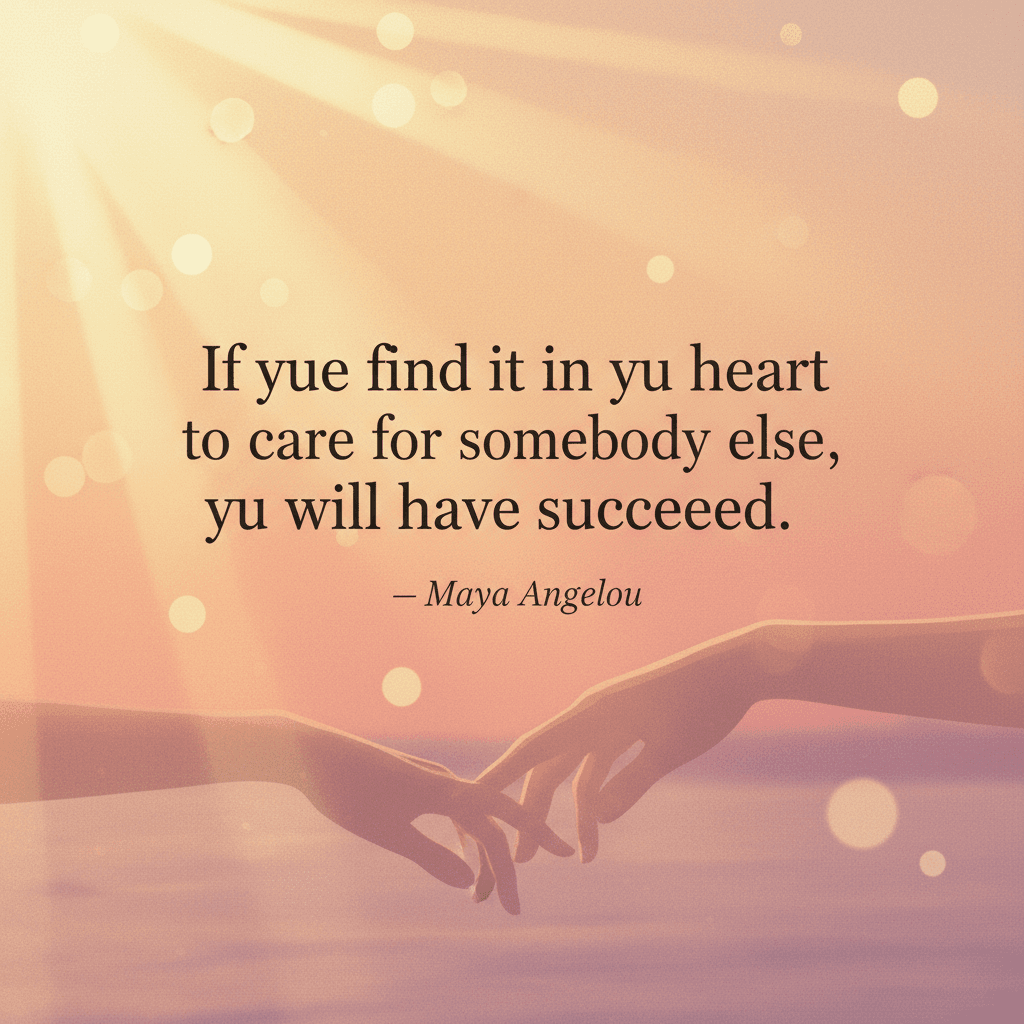
If you find it in your heart to care for somebody else, you will have succeeded. — Maya Angelou
—What lingers after this line?
Redefining What Success Really Means
At the outset, Angelou’s sentence turns the usual definition of success on its head. Rather than trophies, titles, or bank balances, she points to a heart trained toward others as the ultimate measure. This reframing doesn’t deny ambition; it relocates achievement from outcomes to orientation. By centering care, she suggests that success is less a destination than a disposition—one that transforms both giver and receiver.
Angelou’s Life as Living Proof
In Angelou’s own life, care was neither abstraction nor ornament. As a civil rights organizer with the Southern Christian Leadership Conference and a voice for dignity in I Know Why the Caged Bird Sings (1969), she practiced solidarity that healed as it told the truth. Even her poem “Human Family” (1990) insists, “We are more alike, my friends, than we are unalike,” signaling that care grows from recognizing shared humanity. From activism to artistry, she embodied the success she defined.
Echoes Across Philosophy and Faith
Moreover, her claim resonates with older wisdom. Aristotle’s Nicomachean Ethics (c. 350 BC) frames flourishing as a life of practiced virtue, where generosity and friendship are central to eudaimonia. Similarly, the African ethic of Ubuntu—“I am because we are”—is articulated by Desmond Tutu in No Future Without Forgiveness (1999), foregrounding communal care. Even 1 Corinthians 13 locates life’s meaning in agape, love enacted. Thus, Angelou’s insight stands in a long lineage that elevates care as the core of a good life.
What Science Says About Caring
Contemporary research extends these intuitions. The Harvard Study of Adult Development, summarized by Robert Waldinger (TED, 2015), finds that warm, dependable relationships are the strongest predictors of well-being and longevity. Organizational psychologist Adam Grant’s Give and Take (2013) shows that strategic givers often outperform takers over time, especially in networks that reward trust. Likewise, Stephen Post’s Why Good Things Happen to Good People (2007) collates evidence that sustained volunteering and kindness correlate with better mental and physical health. So, care is not just moral—it is measurably life-giving.
The Community Ripple Effect
Consequently, care scales beyond individuals. Robert Putnam’s Bowling Alone (2000) chronicles declining social capital and its costs; yet where trust and reciprocity are rebuilt, communities stabilize. Research on collective efficacy (Sampson, Raudenbush, and Earls, 1997) shows that neighborhoods with mutual support see lower violence and better public health. A single act—checking on a neighbor, mentoring a student—can set off chains of cooperation, demonstrating how private compassion becomes public resilience.
Compassion With Boundaries
To sustain such giving, boundaries matter. Psychologist Kristin Neff’s work on self-compassion (2011) distinguishes empathic concern from empathic distress; the former fuels wise action, the latter leads to burnout. By pairing care for others with care for oneself—rest, delegation, and saying no when needed—we preserve the capacity to keep showing up. In this way, compassion remains a renewable resource rather than a path to exhaustion.
Practicing Care in Daily Life
Ultimately, Angelou’s standard becomes real through small, consistent gestures. Listening without rushing to fix, sharing credit at work, writing a note of thanks, or giving time to a local mutual-aid group each enacts her vision. Because these acts compound, they quietly reorient a life toward service. If you can find, day after day, a concrete way to lift another person’s burden, then—by Angelou’s measure—you have already succeeded.
Recommended Reading
As an Amazon Associate, we earn from qualifying purchases.
One-minute reflection
Why might this line matter today, not tomorrow?
Related Quotes
6 selectedYou may be the only person alive that day who can give that gift to another. — Maya Angelou
Maya Angelou
The quote emphasizes the profound impact of small acts of kindness. It reminds us that even seemingly insignificant gestures can be life-changing for someone else.
Read full interpretation →The desire to reach for the stars is ambitious. The desire to reach hearts is wise. — Maya Angelou
Maya Angelou
The quote contrasts two aspirations: achieving great external success (reaching for the stars) versus making deep, meaningful connections (reaching hearts). It implies that the latter holds greater wisdom and value.
Read full interpretation →Success is not how high you have climbed, but how you make a positive difference to the world. – Roy T. Bennett
Roy T. Bennett
This quote suggests that true success should not be measured by personal milestones or achievements alone, but by the positive changes and contributions one makes to society and the world at large.
Read full interpretation →You shouldn't have to crash to deserve compassion. — Tessa Frazer
Tessa Frazer
At first glance, Tessa Frazer’s line exposes a painful social habit: people are often taken seriously only after they visibly break down. The quote rejects the idea that suffering must become dramatic before it is consid...
Read full interpretation →In dealing with those who are undergoing great suffering, if you feel burnout setting in, it is best, for the sake of everyone, to withdraw and restore yourself. — Dalai Lama XIV
Dalai Lama XIV
At its core, the Dalai Lama’s remark reframes withdrawal not as abandonment but as responsibility. When we accompany people through intense pain, we often imagine that constant presence is the highest form of care.
Read full interpretation →Don't throw your suffering away. Use it. It is the compost that gives you the understanding to nourish your happiness. — Thich Nhat Hanh
Thich Nhat Hanh
At first glance, Thich Nhat Hanh’s words reject the common impulse to discard pain as quickly as possible. Instead, he reframes suffering as something that can be transformed, much like compost becomes fertile soil.
Read full interpretation →More From Author
More from Maya Angelou →Family is the one thing that never changes in a world of constant shifts; it is the anchor we carry even when we are miles apart. — Maya Angelou
At the heart of Maya Angelou’s reflection is a contrast between instability and endurance. The world moves through relocations, losses, ambitions, and reinventions, yet family, in its deepest sense, remains a continuing...
Read full interpretation →Even when we are separated by distance, the roots of our shared stories hold us together in the quietest ways. — Maya Angelou
Maya Angelou’s line begins with separation, yet it quickly shifts attention to what distance cannot erase. Physical absence may change the form of a relationship, but it does not necessarily weaken its substance.
Read full interpretation →Do not look for a sanctuary in anyone except yourself; you are the architect of your own calm. — Maya Angelou
Maya Angelou’s statement begins by redirecting a common human impulse: the desire to seek safety in other people. Rather than condemning connection, she gently warns against making another person the sole shelter for our...
Read full interpretation →There is a deep peace that comes from creating something that didn't exist before. It is your way of telling the universe that you were here, and you felt something. — Maya Angelou
At its heart, Maya Angelou’s reflection suggests that creation is not merely productive but restorative. To make something that did not exist before—a poem, a garden, a melody, even a repaired room—is to experience a rar...
Read full interpretation →