
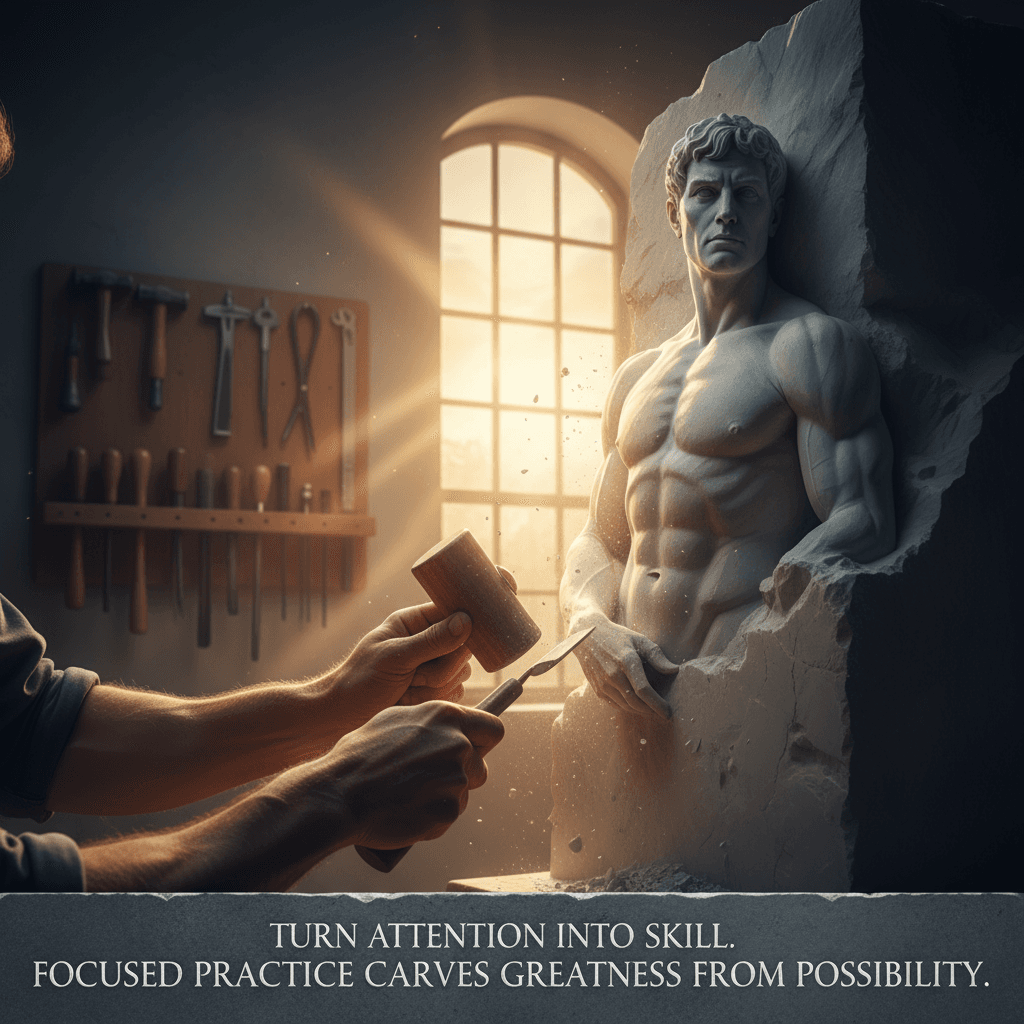
Turn attention into skill; focused practice carves greatness from possibility — Anders Ericsson
—What lingers after this line?
From Attention to Skill
At the outset, Ericsson’s core insight is simple yet radical: attention, when harnessed deliberately, becomes a tool for building skill. Rather than treating talent as a fixed trait, he argued that expertise grows from structured, goal-directed effort that targets specific weaknesses. In this view, practice is not mere repetition; it is a laboratory for improvement in which errors are data and feedback is the catalyst. His landmark paper, The Role of Deliberate Practice in the Acquisition of Expert Performance (Psychological Review, 1993), reframed how scientists and coaches alike think about excellence. From this foundation, the path to greatness becomes less mysterious and more designable—an engineered journey from possibility to performance.
Beyond the 10,000-Hour Myth
Moving beyond popular folklore, Ericsson emphasized that excellence is not a stopwatch contest. The widespread 10,000-hour mantra popularized in Outliers (Gladwell, 2008) obscured his central point: it is the quality, not the quantity, of practice that matters most. In Peak (Ericsson and Pool, 2016), he clarifies that progress depends on operating in a stretch zone, receiving immediate feedback, and refining performance with purpose. Some learners plateau despite long hours because their practice is comfortable rather than corrective. Consequently, time becomes meaningful only when it is invested in methods that systematically reduce errors and sharpen mental representations of the task.
Brains, Myelin, and Mental Representations
Building on this, neuroscience helps explain why focused practice works. Repeated, challenging execution strengthens neural pathways and myelination, increasing the speed and reliability of signals (Fields, 2008; Coyle, The Talent Code, 2009). In a vivid example, juggling practice altered gray matter in adult learners, demonstrating how skill training reshapes the brain (Draganski et al., Nature, 2004). Ericsson argued that elite performers cultivate refined mental representations—internal models that let them anticipate, diagnose, and correct in real time (Peak, 2016). Thus, attention converts into skill not by magic but by iteratively upgrading the brain’s playbook and the body’s execution, knit together through precise feedback.
Illustrations From Violins to Chessboards
Consider the Berlin violinists study: the most accomplished players accumulated more hours of solitary, high-quality practice focused on difficult passages, especially in morning blocks when concentration was sharpest (Ericsson, Krampe, and Tesch-Römer, 1993). A different domain reveals a similar pattern. Laszlo Polgár’s educational experiment—meticulous, feedback-rich chess training for his daughters—produced world-class players including Judit Polgár, who became the strongest female chess player in history (Polgár, Bring Up Genius!, 1989). Even earlier, Benjamin Franklin honed prose by paraphrasing and reconstructing Spectator essays from notes, then comparing his drafts to the originals to pinpoint gaps (Autobiography, 1791). Across arts and intellect, greatness emerges from structured struggle.
Designing Practice That Works
In practice, the recipe is concrete. Start by defining a specific performance goal and the mental representation that exemplifies it—for instance, the sound of a perfect phrase or the signature of a clean surgical suture (Peak, 2016). Then isolate subskills, create drills that raise the difficulty just beyond comfort, and obtain rapid, informative feedback from a coach, instrument, or benchmark. Schedule short, intense sessions with full attention; interleave related skills; and use spaced repetition to consolidate gains (Cepeda et al., Psychological Science, 2006). Finally, log results, review errors, and revise drills so that each session carves away a precise limitation. In this way, practice becomes an iterative design loop.
Avoiding Plateaus and Burnout
Even so, common traps await. Mindless repetition cements mediocrity; overtraining erodes precision; and vague goals invite drift. Sustainable intensity relies on planned recovery, varied drills, and a cadence that protects focus. Motivation matters, but grit alone is insufficient without a deliberate practice plan (Duckworth, Grit, 2016). Useful safeguards include time-boxed deep-work blocks, pre-session checklists that define success cues, and post-session debriefs that convert mistakes into next steps. By aligning effort with evidence and rest, performers dodge plateaus and keep climbing the gradient of improvement.
Translating Mastery to Modern Work
Finally, the same blueprint powers complex professions. Programmers run kata-style refactoring exercises with immediate tests; writers craft constraint-based drafts and compare them to exemplary models; clinicians refine procedures in simulators before the operating room. Ericsson noted that medicine, in particular, benefits from deliberate practice environments that provide high-fidelity feedback and graduated difficulty (Ericsson, Academic Emergency Medicine, 2004). Across fields, the principle holds: when attention is channeled into well-designed practice, possibility becomes proficiency—and, over time, reliable excellence.
Recommended Reading
As an Amazon Associate, we earn from qualifying purchases.
One-minute reflection
Why might this line matter today, not tomorrow?
Related Quotes
6 selectedPractice isn't the thing you do once you're good. It's the thing you do that makes you good. — Malcolm Gladwell
Malcolm Gladwell
Malcolm Gladwell’s line flips a common belief: that practice is a chore reserved for beginners and abandoned once talent arrives. Instead, he frames practice as the engine that creates competence in the first place, not...
Read full interpretation →Refine your craft with attention; mastery grows from repetition — Malcolm Gladwell
Malcolm Gladwell
Gladwell’s line distills a familiar trajectory: craft improves when attention sharpens the loop between doing and noticing, and mastery accrues as those loops repeat. In Outliers (2008), he popularized the “10,000-hour”...
Read full interpretation →Only those who have the patience to do simple things perfectly ever acquire the skill to do difficult things easily. — James J. Corbett
James J. Corbett
At first glance, Corbett’s remark seems to praise modest discipline, yet it points to something deeper: greatness begins with a willingness to repeat basic actions until they become exact. Simple things are rarely truly...
Read full interpretation →Skill is only developed by hours and hours of work. — Usain Bolt
Usain Bolt
Usain Bolt’s line strips skill down to its most unglamorous ingredient: accumulated hours. Rather than presenting excellence as a sudden gift, he frames it as a visible outcome of invisible labor—the uncounted repetition...
Read full interpretation →You must train day and night in order to make decisions. — Miyamoto Musashi
Miyamoto Musashi
Miyamoto Musashi’s line compresses a lifetime of martial experience into a single principle: sound decisions are not improvised—they are earned. When he says you must train “day and night,” he points to a kind of prepara...
Read full interpretation →I fear not the man who has practiced 10,000 kicks once, but I fear the man who has practiced one kick 10,000 times. — Bruce Lee
Bruce Lee
Bruce Lee’s line hinges on a sharp comparison: a person who samples many techniques once may look versatile, but a person who drills one technique relentlessly becomes formidable. The quote isn’t dismissing variety as wo...
Read full interpretation →More From Author
More from Anders Ericsson →