
Planting Courage, Growing Forests of Lasting Change
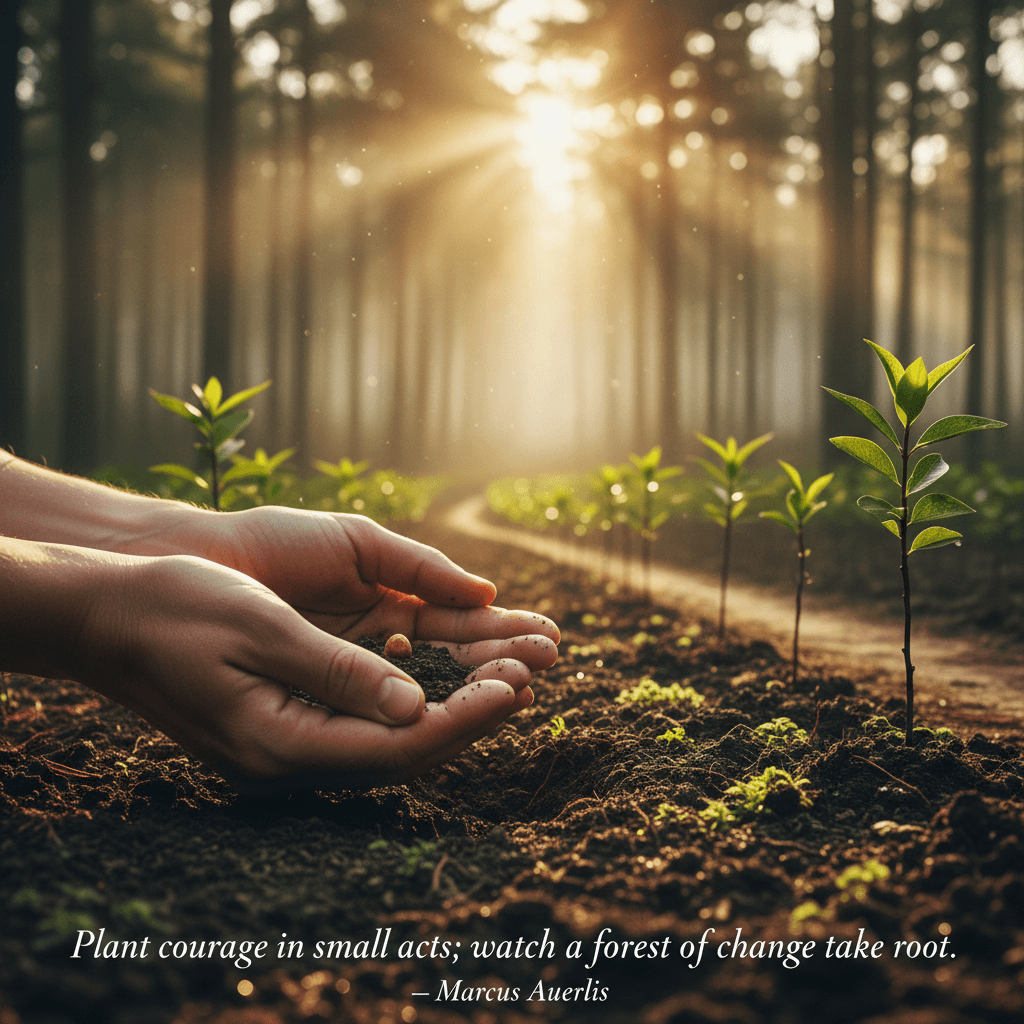
Plant courage in small acts; watch a forest of change take root. — Marcus Aurelius
—What lingers after this line?
Seeds of Virtue in Stoic Practice
At first glance, the line reads like a proverb, yet it channels Marcus Aurelius’s Stoic method in Meditations (c. 170 CE): tend to what is small and within your control. He repeatedly trades grandstanding for quiet duty, insisting that character is grown in the next honest word, the next just decision, the next patient breath. In Stoic terms, our faculty of choice sets the seed; repeated choices till the soil. Thus, courage is less a sudden blaze than a habit of micro-decisions—saying “I’ll speak up,” “I’ll show up,” “I’ll stay kind”—that, over time, alter the landscape of a life.
How Small Acts Compound Into Habits
Continuing the seed metaphor, psychology shows how tiny actions compound. Charles Duhigg’s The Power of Habit (2012) describes “keystone habits” that trigger broader shifts, while James Clear’s Atomic Habits (2018) popularizes 1% improvements that accumulate into outsized results. Classic experiments on the foot-in-the-door effect (Freedman & Fraser, 1966) found that agreeing to a small request makes later, larger commitments more likely. In practice, a daily three-sentence note of appreciation becomes a stronger team; a brief post-mortem after small errors becomes a culture of safety. What begins as a single courageous minute grows into a reliable identity: the sort of person who acts.
Courage Spreads: The Social Ripple
Moving from self to society, courage proves contagious. Studies of social networks by Nicholas Christakis and James Fowler in Connected (2009) show behaviors—like cooperation and generosity—propagate through friends of friends. Meanwhile, bystander research (Latané & Darley, 1968) reveals that one person breaking the silence often unlocks help from many. Therefore, small acts do more than add; they multiply. A teammate who names an overlooked risk can license others to surface concerns; a neighbor who greets the new family can set a street’s tone for welcome. The forest grows not from a solitary tree, but from the way one trunk shelters another and invites more to sprout.
Lessons from Hidden Forest Networks
Nature deepens the metaphor. Forest ecologists like Suzanne Simard (1997; 2010) document mycorrhizal networks—the “wood-wide web”—through which trees share nutrients and warnings, allowing saplings to survive shade and stress. Likewise, seed banks wait invisibly until disturbance, after which diverse growth emerges. In the same way, small courageous acts often travel through unseen ties: a quiet mentorship, a copied email of thanks, a documented fix. We seldom witness the direct line from seed to canopy, yet the network carries the signal and the support. Thus, tending to small acts is not naive; it respects the ecology of change.
From Micro-Bravery to Structures
From ecology back to institutions, Karl Weick’s “small wins” framework (American Psychologist, 1984) explains how modest, well-defined victories create clarity, confidence, and momentum. In practice, publishing a transparent decision log can become a norm; adopting a five-minute check-in can evolve into psychological safety; one accessible doorway leads to universal design. Kaizen—continuous improvement popularized in manufacturing—works similarly, translating minor worker suggestions into systemic upgrades (Imai, 1986). Consequently, courage at the micro-level becomes infrastructure: procedures, rituals, and standards that outlast any single person.
Sustaining Change Without Burnout
Finally, forests survive through cycles, and so must courage. Stoics prepared for setbacks with premeditatio malorum—rehearsing obstacles so action remains steady—while embracing amor fati, a love of one’s fate. Modern research on implementation intentions (Gollwitzer, 1999) echoes this: if-then plans turn values into reflexes—“If the meeting drifts, I’ll name the decision.” Coupled with rest, shared ownership, and regular reflection, such planning keeps brave acts both small and sustainable. As Marcus notes in Meditations, obstacles can be turned into paths; with patient planting and collective care, a forest of change takes root and learns to endure.
Recommended Reading
One-minute reflection
What does this quote ask you to notice today?
Related Quotes
6 selectedCourage is the steady light that outlasts the storm — Marcus Aurelius
Marcus Aurelius
In calling courage a “steady light,” Marcus Aurelius frames bravery not as a sudden blaze of heroism but as something dependable and sustained. The storm stands for everything that batters human life—loss, fear, public c...
Read full interpretation →When fear speaks, meet it with steady, principled motion — Marcus Aurelius
Marcus Aurelius
Marcus Aurelius frames fear as something that “speaks,” implying it is a message we can hear without obeying. In Stoic terms, fear is an impression—an inner signal that something might be threatened—rather than a final j...
Read full interpretation →Make bravery a habit, not an exception — Marcus Aurelius
Marcus Aurelius
Marcus Aurelius’ line pushes courage out of the realm of rare heroics and into ordinary life. Instead of waiting for a dramatic crisis to reveal what we’re made of, he urges us to practice bravery so often that it become...
Read full interpretation →Judge progress by the courage of your new beginnings, not by old burdens. — Marcus Aurelius
Marcus Aurelius
Marcus Aurelius invites a change in the ruler we use to measure growth: not the weight of what we have carried, but the bravery it takes to start again. In a Stoic frame, progress is less about perfect circumstances and...
Read full interpretation →Courage plants its feet in the present and builds tomorrow with steady hands. — Marcus Aurelius
Marcus Aurelius
The quote frames courage not as a dramatic leap, but as a deliberate stance: it “plants its feet in the present.” That image implies stability under pressure—choosing to remain anchored in what is real rather than drifti...
Read full interpretation →Stand where your fear ends and your resolve begins; that border is where life expands. — Marcus Aurelius
Marcus Aurelius
The quote draws a vivid map of the psyche, locating a precise border where fear recedes and resolve takes hold. Rather than treating fear as a sign to retreat, it portrays it as the edge of known territory, much like the...
Read full interpretation →More From Author
More from Marcus Aurelius →You always have the power to have no opinion. Things are not asking to be judged by you. — Marcus Aurelius
Marcus Aurelius frames restraint not as passivity but as power: you can refuse to manufacture an opinion on demand. In Stoic terms, this is a way of protecting the mind’s autonomy, because what disrupts us is often not t...
Read full interpretation →Most of what we say and do is not essential. If you can eliminate it, you will have more time and more tranquility. — Marcus Aurelius
Marcus Aurelius proposes a surprisingly practical path to peace: remove what isn’t essential. Rather than urging us to add better habits, he points to the calmer power of subtraction—speaking less, reacting less, doing l...
Read full interpretation →Receive without conceit, release without struggle. — Marcus Aurelius
Marcus Aurelius compresses an entire discipline into two movements: take what arrives without ego, and let what departs go without resistance. The first clause challenges the impulse to treat gifts—praise, luck, status—a...
Read full interpretation →Be tolerant with others and strict with yourself. — Marcus Aurelius
Marcus Aurelius’ line distills a practical Stoic posture: meet other people with patience, while holding your own choices to a demanding standard. Rather than encouraging moral superiority, it reverses a common impulse—j...
Read full interpretation →