
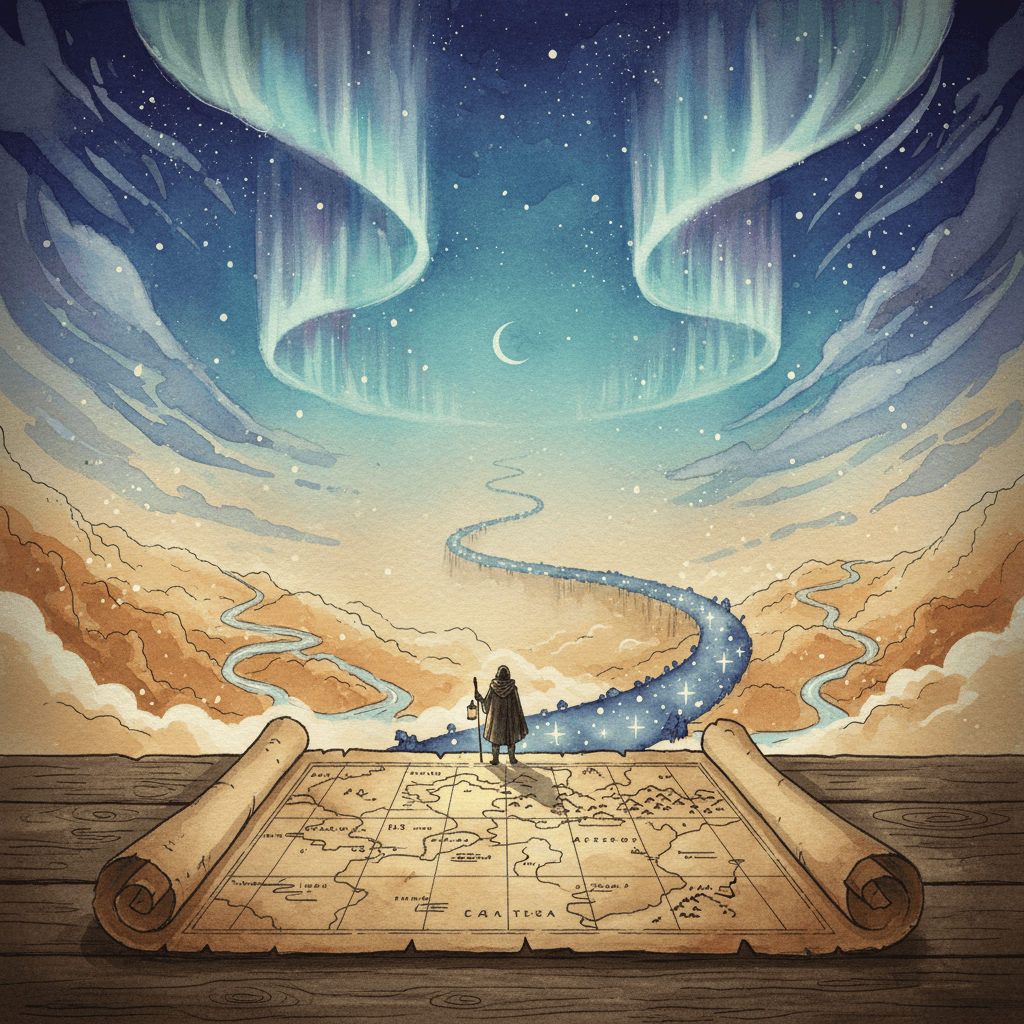
Create a map of wonder, then travel beyond the edges. — Kahlil Gibran
—What lingers after this line?
The Map and the Invitation
Gibran’s line entwines two impulses: to name what astonishes us and to step past what names can hold. A map of wonder gathers the contours of what moves us—places, questions, encounters—so that we are oriented rather than overwhelmed. Yet, by insisting we then travel beyond the edges, the quote acknowledges a paradox: orientation is preparation, not destination. The moment a chart feels complete, it risks becoming a cage.
Gibran’s Mystic Cartography
This tension runs through Kahlil Gibran’s The Prophet (1923), where love, freedom, and work are traced like coastlines, only to dissolve into open sea. “Let there be spaces in your togetherness,” he writes, urging intimacy that does not possess—a gentle crossing beyond the ego’s borders. Influenced by Maronite spirituality, Sufi lyricism, and Nietzschean self-overcoming, Gibran uses poetry as a compass that points outward, suggesting that the truest map is one that keeps us moving.
Awe as a Cognitive Compass
Modern psychology shows why wonder maps are worth making. Studies in Psychological Science by Rudd, Vohs, and Aaker (2012) found that awe expands perceived time, increasing patience and presence—mental space in which to chart what matters. Building on this, Piff et al. (JPSP, 2015) reported that awe softens the self-focus, nudging people toward generosity and curiosity. As Dacher Keltner’s Awe (2023) synthesizes, awe shrinks the “small self” while enlarging our sense of possibility, priming us to approach edges with humility rather than fear.
Edges in the History of Maps
Cartographers have long confessed the limits of their diagrams. The Hunt–Lenox Globe (c. 1510) notoriously hints at “Hic sunt dracones”—here be dragons—where knowledge frays. Likewise, Borges’s “On Exactitude in Science” (1946) satirizes the fantasy of a perfect map, reminding us that fidelity without function is folly. By contrast, Marshallese stick charts encoded swells and currents rather than coastlines, proving that good maps can guide without pretending to be the world. Each example whispers Gibran’s counsel: use the chart, then face the waters it cannot picture.
Art That Crosses the Margin
Artists often stand at the edge and listen. Keats’s notion of “negative capability” (letter, 1817) celebrates dwelling in uncertainties without reflexive grasping, a poise crucial for stepping beyond mapped certainties. His sonnet “On First Looking into Chapman’s Homer” (1816) likens discovery to a stunned conquistador—misnamed as Cortez—peering at an unrealized ocean. In a complementary key, Blake’s aphorism in The Marriage of Heaven and Hell (1790–93) suggests that cleansed perception reveals the infinite. The arts, then, do not merely draw the map; they attune us to the shimmer beyond its frame.
Science at the Rim of Paradigms
Scientific revolutions begin where the legend fades. Thomas Kuhn’s The Structure of Scientific Revolutions (1962) argues that anomalies accumulate at the map’s margins until a new chart is required. Einstein’s 1905 paper “On the Electrodynamics of Moving Bodies” stepped past Newtonian coordinates to redraw space and time. Likewise, Wegener’s continental drift (1912), mocked for decades, seeded plate tectonics in the 1960s. In each case, careful mapping of puzzles made the leap possible, yet the breakthrough came only by traveling past the accepted borders.
Practices for Traveling Past the Edge
Practically, begin by sketching a personal “wonder map”: cluster the questions, places, and people that ignite awe. Then, in Gibran’s spirit, schedule edge-trips—experiences likely to disconfirm your assumptions. Stuart Kauffman’s “adjacent possible” (At Home in the Universe, 1995) suggests that novelty hides just one step past the known; design prompts like Hal Gregersen’s question bursts (Questions Are the Answer, 2018) help you locate that step. The map becomes a living invitation: orient, venture, revise, repeat—until the edge moves, and with it, you.
One-minute reflection
Where does this idea show up in your life right now?
Related Quotes
6 selectedLet curiosity be your compass; wonder opens doors to new effort. — Kōbō Abe
Kōbō Abe
Kōbō Abe frames curiosity as a “compass,” suggesting not a fixed destination but a reliable way to keep moving. A compass doesn’t provide certainty about the terrain; it provides orientation amid ambiguity.
Read full interpretation →Curiosity paired with courage writes the maps others fear to follow. — Antoine de Saint-Exupéry
Exupéry
Curiosity is the quiet spark behind every new path. In Antoine de Saint-Exupéry’s line, it functions as the inner question that refuses to be silenced: What lies beyond what I already know?
Read full interpretation →The horizon’s edge is only a challenge to the brave. — Khalil Gibran
Kahlil Gibran
Khalil Gibran’s evocative phrase positions the horizon not merely as a distant boundary, but as a potent metaphor for possibility and uncharted territory. The edge of the horizon symbolizes the limits of the known—callin...
Read full interpretation →Don't be intimidated by what you don't know. That can be your greatest strength. — Sara Blakely
Sara Blakely
At first glance, Sara Blakely’s quote sounds like a simple encouragement, yet it points to a deeper truth: ignorance is not always a weakness. When people are not trapped by assumptions about how things are “supposed” to...
Read full interpretation →Nurture your curiosity; it paves the way to innovation. — Albert Schweitzer
Albert Schweitzer
This quote highlights that curiosity is essential for personal and intellectual growth. By actively seeking knowledge and exploring new ideas, individuals can develop innovative solutions and expand their understanding.
Read full interpretation →Be a loner. That gives you time to wonder, to search for the truth. Have holy curiosity. Make your life worth living. — Albert Einstein
Albert Einstein
At first glance, Einstein’s advice to “be a loner” may sound like a rejection of society, yet his deeper point is about protecting the inner space where thought can mature. Solitude gives a person room to hear their own...
Read full interpretation →More From Author
More from Kahlil Gibran →Your home is your larger body. It grows in the sun and sleeps in the stillness of the night. — Kahlil Gibran
At first glance, Gibran transforms the idea of home from a mere structure into something intimate and organic: “your larger body.” In this image, a dwelling is not separate from the person who inhabits it, but an outward...
Read full interpretation →March on. Do not tarry. To go forward is to move toward perfection. — Kahlil Gibran
Gibran’s opening imperative—“March on. Do not tarry.”—sets a tone of disciplined urgency.
Read full interpretation →There must be spaces in your togetherness, and let the winds of the heavens dance between you. — Kahlil Gibran
Gibran’s line opens with a gentle paradox: he speaks to people who are already “together,” yet insists that togetherness is healthiest when it includes room. Rather than portraying love as fusion, he frames it as a relat...
Read full interpretation →Our anxiety does not come from thinking about the future, but from wanting to control it. — Kahlil Gibran
Kahlil Gibran reframes anxiety as something more specific than mere anticipation. The future itself—uncertain, unfolding, and not yet real—doesn’t automatically distress us; rather, distress appears when we demand certai...
Read full interpretation →