
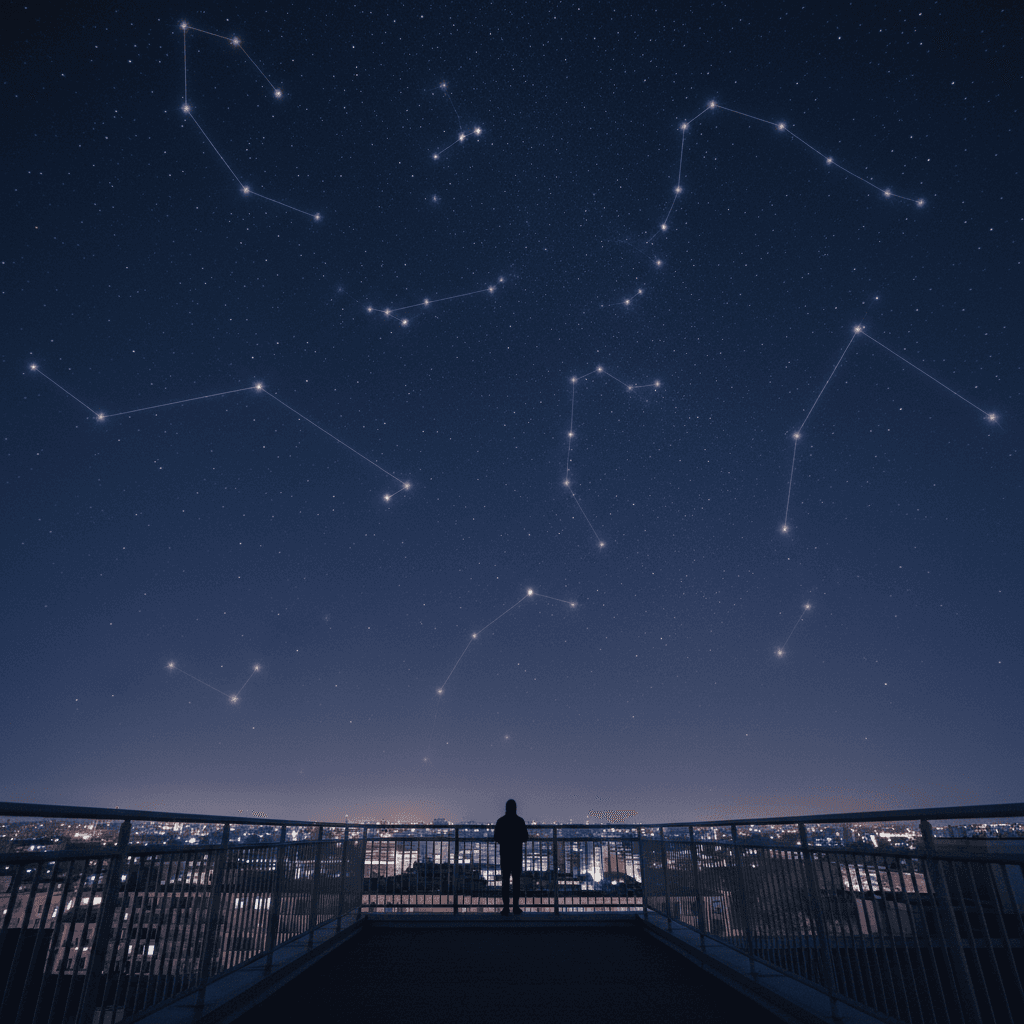
Raise your gaze; the ordinary sky holds unfamiliar constellations. — Pablo Neruda
—What lingers after this line?
An Invitation to Look Differently
Neruda’s line beckons us to tilt the chin and tilt the mind. The ordinary sky, unremarked in its daily blue, becomes a canvas where new patterns can emerge if we allow them. In urging us to raise our gaze, the poet proposes a subtle discipline: attention as transformation. What looks routine from one angle can surprise from another, not because the world has changed, but because perception has. Thus the unfamiliar constellations are less about distant stars and more about a nearer revolution—an awakening of the eye that is willing to see again.
How Minds Draw the Stars
To grasp why new constellations appear, consider how our brains connect dots. Gestalt psychology shows that we naturally organize fragments into wholes, filling gaps to create meaning. Rudolf Arnheim’s Art and Visual Perception (1954) argues that perception is not passive reception but active construction. While pareidolia can mislead, it can also seed insight: the same impulse that finds a hunter in stars can find a solution in scattered data. Therefore, lifting the gaze is also a cognitive reframe—choosing to recombine familiar points until a fresh pattern coheres.
Many Skies, Many Stories
Cultural lenses further shape the heavens we see. The Greek Orion is not the Chinese Shen, and Aboriginal Australians trace the Emu in the Sky in the dark spaces between stars, not the stars themselves (see Duane W. Hamacher et al., 2011). Likewise, Polynesian wayfinders read star paths as living routes across the Pacific, as David Lewis details in We, the Navigators (1972). These divergent maps remind us that unfamiliar constellations are not errors but alternatives—new stories braided from the same lights, discovered when we step outside a single tradition.
Science When the Familiar Turns Strange
This poetic insight mirrors scientific breakthroughs, where the habitual sky reveals hidden structure. Galileo’s Sidereus Nuncius (1610) turned the Milky Way from mist to myriad stars. William Herschel found Uranus in 1781 by noticing a point that moved oddly. In the 1920s, Edwin Hubble showed that fuzzy patches were galaxies beyond our own, expanding the cosmos itself. Later, Vera Rubin’s rotation-curve studies in the 1970s exposed the invisible pull of dark matter. Each moment began with a raised gaze—and the courage to treat the obvious as not yet known.
Navigation for Everyday Life
Turning inward, unfamiliar constellations describe how we solve ordinary problems. Edward de Bono’s lateral thinking (1967) urges us to rearrange the dots rather than add more. Consider the Post-it Note: Spencer Silver’s weak adhesive (1968) seemed useless until Art Fry reframed it in 1974 as reusable bookmarks. The sky did not change; the pattern did. Likewise, projects, careers, and relationships often shift when we redraw their connections—seeing constraints as anchors for new shapes rather than barriers to motion.
Neruda’s Practice of Attentiveness
Neruda models this gaze in his Elemental Odes (1954), where onions glitter like planets and socks turn into companions. By praising the humble, he maps constellations in the pantry and the laundry, showing that reverence can be a method of discovery. The poetic act does not escape the everyday; it saturates it, so that the known becomes newly legible. In this sense, his line is both instruction and proof: attention is a compass, and wonder is the star by which it points.
Cultivating a Constellation Habit
Finally, we can practice this mode of seeing. Change vantage points—read a nightscape from a different street, rotate a chart, ask a contrarian question. Keep a notebook of recurring dots—phrases, obstacles, curiosities—and periodically connect them. Use a stargazing app to learn one new asterism each week, then invent your own. Borrow beginner’s mind from Shunryu Suzuki’s Zen Mind, Beginner’s Mind (1970): in the beginner’s gaze the sky is wide, and patterns are not yet fixed. With time, unfamiliar constellations become familiar—and possibility becomes habit.
One-minute reflection
Why might this line matter today, not tomorrow?
Related Quotes
6 selectedSow curiosity, reap understanding, and paint your life with vivid answers — Pablo Neruda
Pablo Neruda
Neruda’s metaphor begins in the soil of the mind: when we ‘sow curiosity,’ we plant questions instead of settling for easy assumptions. Like any seed, a question appears small and insignificant, yet it holds the potentia...
Read full interpretation →Be a loner. That gives you time to wonder, to search for the truth. Have holy curiosity. Make your life worth living. — Albert Einstein
Albert Einstein
At first glance, Einstein’s advice to “be a loner” may sound like a rejection of society, yet his deeper point is about protecting the inner space where thought can mature. Solitude gives a person room to hear their own...
Read full interpretation →Sometimes, you have to find new angles on life to keep you interested. — John Travolta
John Travolta
John Travolta’s remark begins with a simple but revealing truth: interest in life is not always automatic; sometimes it must be actively rekindled. By suggesting that we ‘find new angles,’ he implies that boredom often c...
Read full interpretation →Perhaps the secret of living well is not in having all the answers but in pursuing unanswerable questions in good company. — Rachel Naomi Remen
Rachel Naomi Remen
Rachel Naomi Remen shifts the idea of a good life away from mastery and certainty. Instead of treating wisdom as the possession of final answers, she suggests that living well may depend on how we travel through mystery.
Read full interpretation →The most important thing is insight, that is... curiosity to wonder, to mull, and to muse why it is that man does what he does. — William Faulkner
William Faulkner
Faulkner places insight above mere information, and in doing so he defines it not as quick understanding but as sustained curiosity. To wonder, to mull, and to muse are slower, deeper acts than simply noticing facts; the...
Read full interpretation →Live every day as if it's your first—to wake up with a sense of curiosity, wonder, and playfulness. — Suleika Jaouad
Suleika Jaouad
Suleika Jaouad’s line hinges on a gentle mental shift: treat today not as a continuation of yesterday’s obligations, but as an opening scene. When you imagine it’s your “first” day, you’re less likely to run on autopilot...
Read full interpretation →More From Author
More from Pablo Neruda →Let the rain kiss you. Let the rain beat upon your head with silver liquid drops. — Pablo Neruda
Neruda’s lines open as a gentle imperative: instead of bracing against bad weather, we are asked to welcome it. “Let the rain kiss you” reframes rain as a gesture offered to the body rather than an inconvenience imposed...
Read full interpretation →Build a bridge of resolve and walk across it one brave step at a time. — Pablo Neruda
Neruda’s image begins with a striking implication: resolve is not merely a feeling you wait for, but a structure you build. A bridge doesn’t appear because the river is intimidating; it exists because someone decided to...
Read full interpretation →Let each sunrise find you leaning toward action. — Pablo Neruda
Neruda’s line frames each sunrise as more than scenery; it’s a daily reset that gently pressures us to move. “Leaning” matters because it suggests a posture, not a perfect performance—an inclination toward doing, even be...
Read full interpretation →Make your hands busy with making—words, gardens, music—and life answers back. — Pablo Neruda
Neruda’s line frames creativity less as self-expression and more as initiation: when you keep your hands busy making, you open a channel through which the world can respond. The emphasis on “hands” matters, because it gr...
Read full interpretation →