
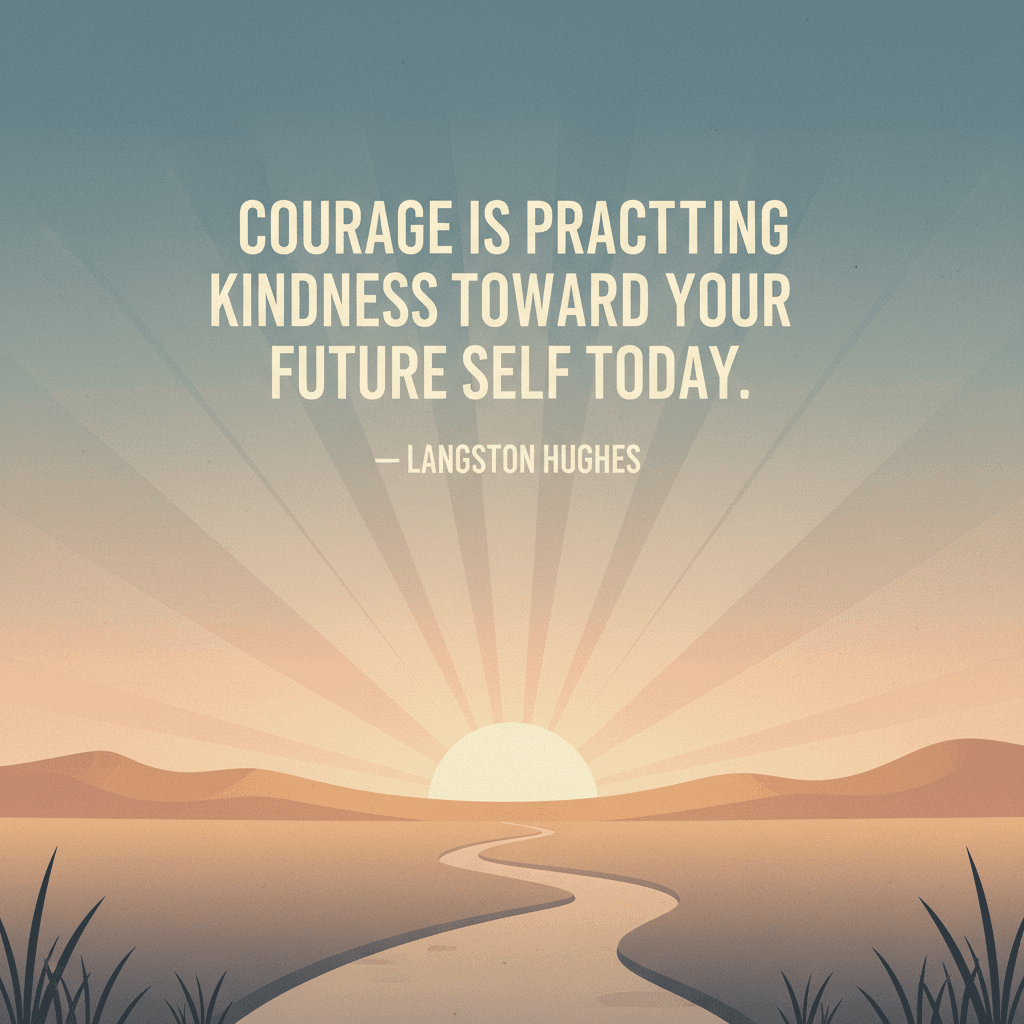
Courage is practicing kindness toward your future self today. — Langston Hughes
—What lingers after this line?
A Quiet Redefinition of Courage
At first glance, courage evokes dramatic risks, yet Hughes reframes it as a gentler bravery: doing something today that reduces tomorrow’s burden. In this view, booking the medical screening, setting aside savings, or drafting the difficult apology becomes an act of moral nerve. The heroic image does not vanish; it simply relocates to the small hinge on which a better future turns. Rather than chasing grand gestures, we practice steady care that our later selves will inherit. This shift not only dignifies mundane choices but also expands our sense of responsibility across time, preparing us to meet the person we are becoming.
Meeting Your Future Self
To make that shift, we must first see the future self as real. Derek Parfit’s Reasons and Persons (1984) argues that personal identity stretches over time through psychological continuity, inviting ethical concern for who we will be. Experiments by Hal Hershfield and colleagues (2011) found that when people viewed aged images of themselves, they increased retirement contributions, suggesting that vivid connection reduces neglect. Simple rituals help, too: writing a letter to next month’s self, keeping a brief end-of-day journal, or borrowing Seneca’s evening review from Letters to Lucilius. By personalizing tomorrow’s inheritor, kindness gains a clear recipient—and courage acquires a target.
Outsmarting Present Bias
But the will alone falters against present bias. George Ainslie’s work on hyperbolic discounting (1975) shows how we overvalue immediate rewards and undervalue future ones. Consequently, courage needs structure. The classic Ulysses pact in Homer’s Odyssey models precommitment: bind yourself while you still can. Modern versions include automatic savings, scheduled focus blocks with site blockers, and placing the alarm across the room. Small frictions make the wiser choice the easier one. In turn, precommitment transforms kindness into a default rather than a heroic exception, ensuring that today’s self reliably serves the one waiting just ahead.
Self-Compassion as Productive Discipline
Moreover, the engine of sustainable courage is not harshness but self-compassion. Kristin Neff’s research in Self-Compassion (2011) shows that treating oneself kindly predicts greater resilience and persistence after setbacks. Likewise, Piers Steel’s The Procrastination Equation (2010) links shame spirals to delay, implying that gentler self-talk can restore momentum. When we replace criticism with a coaching voice, we are more likely to make the phone call, take the walk, or write the first paragraph. Thus, kindness is not indulgence; it is disciplined care that keeps us engaged long enough for improvement to accumulate.
Micro-Bravery in Daily Habits
In practice, courage looks humble and repeatable. Pack tomorrow’s lunch. Draft 200 words before bed. Set an early meeting with your future self by laying out shoes, water, and a short plan for the morning. Benjamin Franklin’s virtue charts in his Autobiography (1791) exemplify this micro-bravery: small, trackable commitments that compound. Even a 10-minute tidy can prevent an hour of future frustration. A handwritten note to your morning self—one clear next step—can dissolve decision fatigue. Individually modest, these acts are collectively transformative, because they steadily lighten the load awaiting the person you will soon be.
Extending Kindness Across Generations
Finally, the logic of temporal kindness scales outward. Climate mitigation, vaccination, and infrastructure maintenance are collective versions of caring for future selves we share with others. Philosopher Hans Jonas, in The Imperative of Responsibility (1979), argues that modern power expands our duties to those not yet born. Planting a tree under whose shade you may never sit embodies this civic courage. When we train on the personal level—saving a little, planning a little, apologizing a little—we strengthen the societal muscle that invests in tomorrow. Thus, courage matures into stewardship, and kindness becomes a public promise kept in advance.
One-minute reflection
Why might this line matter today, not tomorrow?
Related Quotes
6 selectedDo something today that your future self will thank you for. — Unknown
Unknown
This quote highlights the importance of taking actions today that will benefit you in the future. It encourages thinking beyond immediate gratification and preparing for long-term success and well-being.
Read full interpretation →Recovery is not a race. You don't have to feel guilty if it takes you longer than you thought it would. — Anne Lamott
Anne Lamott
Anne Lamott’s reminder begins by challenging one of the quiet cruelties of recovery: the belief that healing should follow a predictable schedule. Whether the wound is physical, emotional, or spiritual, people often comp...
Read full interpretation →Confidence is not arrogance; it is the natural outcome of self-compassion. — Kristin Neff
Kristin Neff
Kristin Neff’s statement begins by separating two qualities often confused: confidence and arrogance. Arrogance tries to stand above others, while confidence rests on an inward steadiness that does not require comparison...
Read full interpretation →Mindfulness is a way of befriending ourselves and our experience. — Jon Kabat-Zinn
Zinn
At its core, Jon Kabat-Zinn’s statement reframes mindfulness as an act of friendship rather than self-improvement. To be mindful is not merely to pay attention, but to meet our thoughts, feelings, and bodily sensations w...
Read full interpretation →Rest for you could look like moving slower as you clean the house or being mindful while you make a meal. It probably means being nicer to yourself. — Jeff Brown
Jeff Brown
At first glance, Jeff Brown’s reflection challenges the common idea that rest only happens when all activity stops. Instead, he suggests that rest can exist inside ordinary moments: in the pace we choose, the attention w...
Read full interpretation →Beyond a wholesome discipline, be gentle with yourself. — Jim Rohn
Jim Rohn
At first glance, Jim Rohn’s line places two values side by side that are often treated as opposites: discipline and gentleness. Yet the force of the quote lies in its quiet correction.
Read full interpretation →More From Author
More from Langston Hughes →Use your words to clear space for others to stand taller beside you. — Langston Hughes
Langston Hughes frames language as something more than self-expression: it is a tool that can rearrange a room. To “clear space” suggests removing clutter—assumptions, interruptions, ego, or the urge to dominate—so other...
Read full interpretation →Work with courage, laugh with defiance, and leave the world kinder than you found it. — Langston Hughes
Langston Hughes compresses an entire moral philosophy into three linked imperatives: work bravely, laugh defiantly, and improve the world. The structure matters, because it moves from inner posture (courage) to public st...
Read full interpretation →Write your courage into the ordinary hours; the page will remember and reward you. — Langston Hughes
Hughes frames courage not as a single grand gesture but as something we “write” into the most unremarkable parts of life—the ordinary hours that tend to blur together. In that phrasing, bravery becomes a habit of attenti...
Read full interpretation →Plant the seeds of your intentions today and tend them with steady hands — Langston Hughes
Langston Hughes frames intention not as a passing wish but as something alive—small at first, yet capable of becoming substantial. A seed holds potential, but it also requires placement in the right ground; likewise, an...
Read full interpretation →