
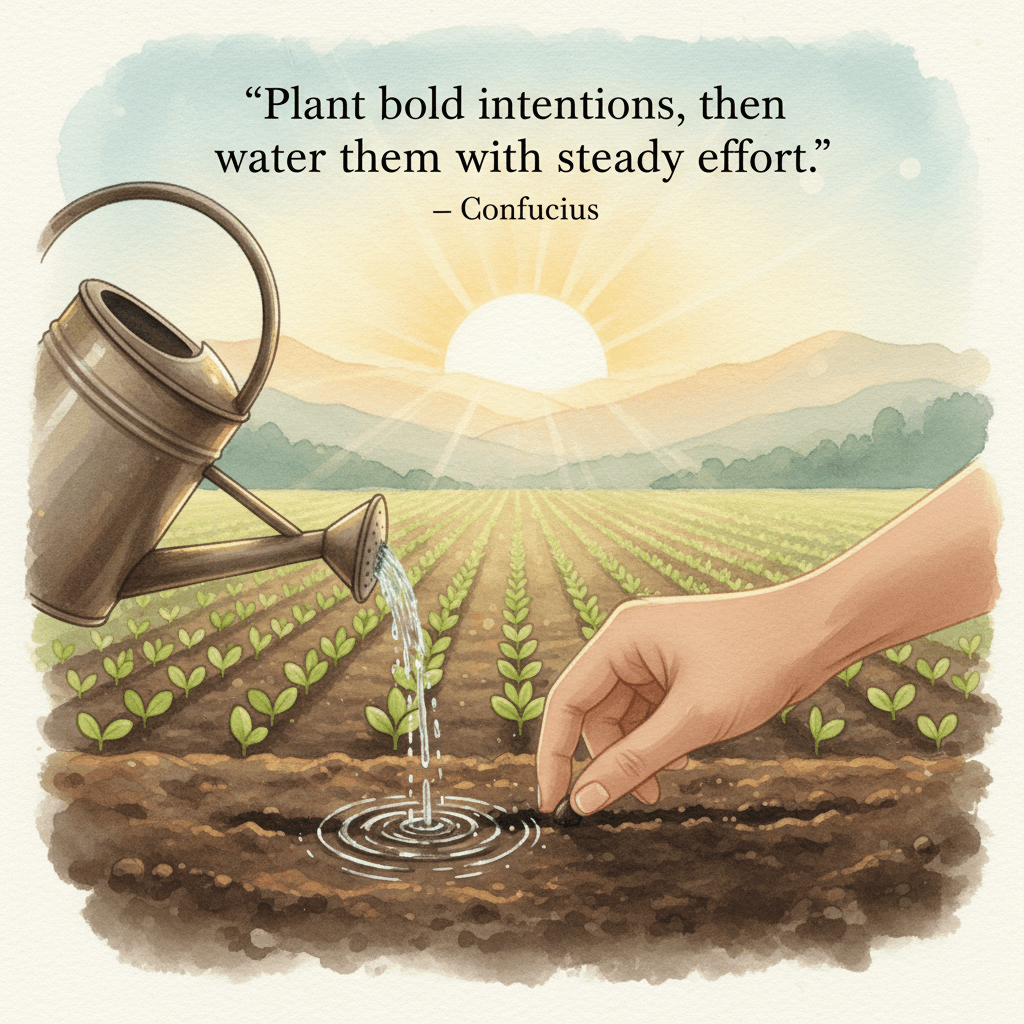
Plant bold intentions, then water them with steady effort. — Confucius
—What lingers after this line?
Seeds of Purpose in Confucian Thought
Although phrased in modern terms, the spirit of the line aligns with Confucius’s emphasis on aligned purpose and ongoing practice. In the Analects, he praises the joy of learning that is regularly rehearsed: "To learn and at due times practice what one has learned—is this not a pleasure?" (Analects 1.1). Intention, or *zhi*, gains moral force only when joined to sincerity (*cheng*) and realized through disciplined action. Likewise, Confucius stages growth over time—"At fifteen, I set my heart on learning; at thirty, I stood firm" (Analects 2.4)—suggesting that planting bold aims is merely the first act. The harvest depends on steady cultivation.
From Words to Deeds: Cultivation Over Time
Building on this metaphor, Confucian ethics insists that aspiration must mature into lived habit. Confucius warns that "the gentleman is ashamed when his words outstrip his deeds" (Analects 14.27), a gentle rebuke against grand plans without follow-through. In practice, this meant repetitive rituals, care for family relations, and daily correction—soil, water, and light for the seed of intention. The junzi, or exemplary person, does not sprint; he tills. Thus, boldness is not bravado but clarity of direction, and effort is not mere exertion but rhythmic, seasonally aware commitment.
Modern Science of ‘Watering’ Intentions
Turning to contemporary insights, psychology shows how to translate aims into action. Peter Gollwitzer’s research on implementation intentions demonstrates that "if–then" plans (e.g., "If it’s 7 a.m., then I write for 25 minutes") significantly increase goal completion (Gollwitzer, 1999). Complementing this, Gabriele Oettingen’s WOOP method—Wish, Outcome, Obstacle, Plan—pairs bold desire with realistic friction, improving persistence (Oettingen, 2014). These findings echo Confucius: clarity of purpose must be joined to structured, recurring behaviors. Where the Analects commend regular practice, modern experiments show why such regularity works.
The Power of Small Wins and Habits
In the same vein, small, repeated actions compound into transformative results. James Clear’s *Atomic Habits* (2018) popularizes "habit stacking" and environment design, showing how tiny adjustments yield outsize effects. A vivid illustration comes from cycling coach Dave Brailsford, who pursued "marginal gains"—1% improvements in countless areas—to produce championship teams. While not Confucian in origin, the principle mirrors an ancient agrarian wisdom: nurture the seed daily and the harvest will follow. Crucially, consistency protects bold intentions from burnout, translating inspiration into sustainable momentum.
Resilience, Feedback, and the Long Arc
Even so, every season brings setbacks. Carol Dweck’s work on growth mindset (2006) shows that framing challenges as learnable tasks sustains effort after failure, while Angela Duckworth’s research on grit (2016) links long-term passion and perseverance to achievement. Confucius would recognize this posture; self-cultivation entails correction as much as progress. Thus, feedback—whether from mentors, metrics, or reflection—acts like pruning. It may look like loss, yet it channels energy toward healthier growth, keeping intention and effort aligned through changing conditions.
Translating Vision into a Daily Cadence
Consequently, the bridge from bold vision to lived reality is a cadence you can keep. Start with a single keystone intention—say, mastering a craft—and bind it to a reliable cue: "If I finish breakfast, then I practice scales for 20 minutes." Review weekly, adjust obstacles the way a gardener redirects water, and celebrate small wins to reinforce identity. Over time, as Confucius’s timeline suggests, you will "stand firm" not by grand gestures but by rhythms that outlast moods. In this way, intention becomes character, and steady effort becomes the quiet engine of a flourishing life.
One-minute reflection
What does this quote ask you to notice today?
Related Quotes
6 selectedSmall acts of consistency bend the arc of possibility. — Confucius
Confucius
Confucius’s insight suggests that the future is not transformed by grand gestures alone but by small, repeated choices. Rather than seeing possibility as fixed, he treats it as something pliable, like a metal rod slowly...
Read full interpretation →Plant intent in the soil of daily habit, and harvest the life you imagine. — Confucius
Confucius
To begin, the aphorism links inner purpose to outward routine the way a seed relies on soil. Intent without habit dries out; habit without intent grows wild.
Read full interpretation →Creativity is the tool we all possess that helps us fulfill this promise by being creative on purpose. — Marcus Aurelius
Marcus Aurelius
The quote begins with an empowering assumption: creativity is not reserved for artists, inventors, or exceptional minds. Instead, it presents creativity as a common human tool, something each person already carries.
Read full interpretation →We are wired for connection, but we must be intentional about how we bridge the gap. — Vivek H. Murthy
Vivek H. Murthy
Vivek H. Murthy’s words begin with a simple truth: human beings are not designed for isolation.
Read full interpretation →Whatever you are doing, do it with a sense of purpose, not merely to pass the time. — Seneca
Seneca
Seneca’s counsel begins with a simple but demanding idea: life should not be treated as something to be spent carelessly. For the Stoics, time was not a disposable background to action but the very material of character.
Read full interpretation →It is not about what can I accomplish? but what do I want to accomplish? — Brené Brown
Brené Brown
Brené Brown’s line redirects attention from external capacity to internal intention. At first glance, asking “What can I accomplish?” seems practical and ambitious; however, it often keeps a person trapped within expecta...
Read full interpretation →More From Author
More from Confucius →Learning is a lifelong process of unlearning the need for immediate results. Patience is the discipline of trusting the slow, quiet compounding of your efforts. — Confucius
At its core, this saying presents learning not as a race toward instant achievement, but as a gradual reshaping of expectation. The phrase “unlearning the need for immediate results” suggests that education is not only a...
Read full interpretation →Anything worth having is worth waiting for, and everything worth doing is worth doing with patience. — Confucius
At its core, this saying ties value to delay. Confucius suggests that truly meaningful things do not arrive instantly; instead, they ask us to endure uncertainty, effort, and time.
Read full interpretation →A common man marvels at uncommon things. A wise man marvels at the commonplace. — Confucius
Confucius draws a quiet but profound distinction between two kinds of attention. The common man, in this saying, is captivated by what appears exceptional—spectacle, rarity, or public greatness.
Read full interpretation →To learn is to admit you do not know. The moment you stop being a student is the moment your growth ends. — Confucius
Confucius frames learning not as the display of knowledge but as the honest recognition of its limits. In that sense, to learn is to begin with humility: one must first admit, without shame, that there is something missi...
Read full interpretation →