
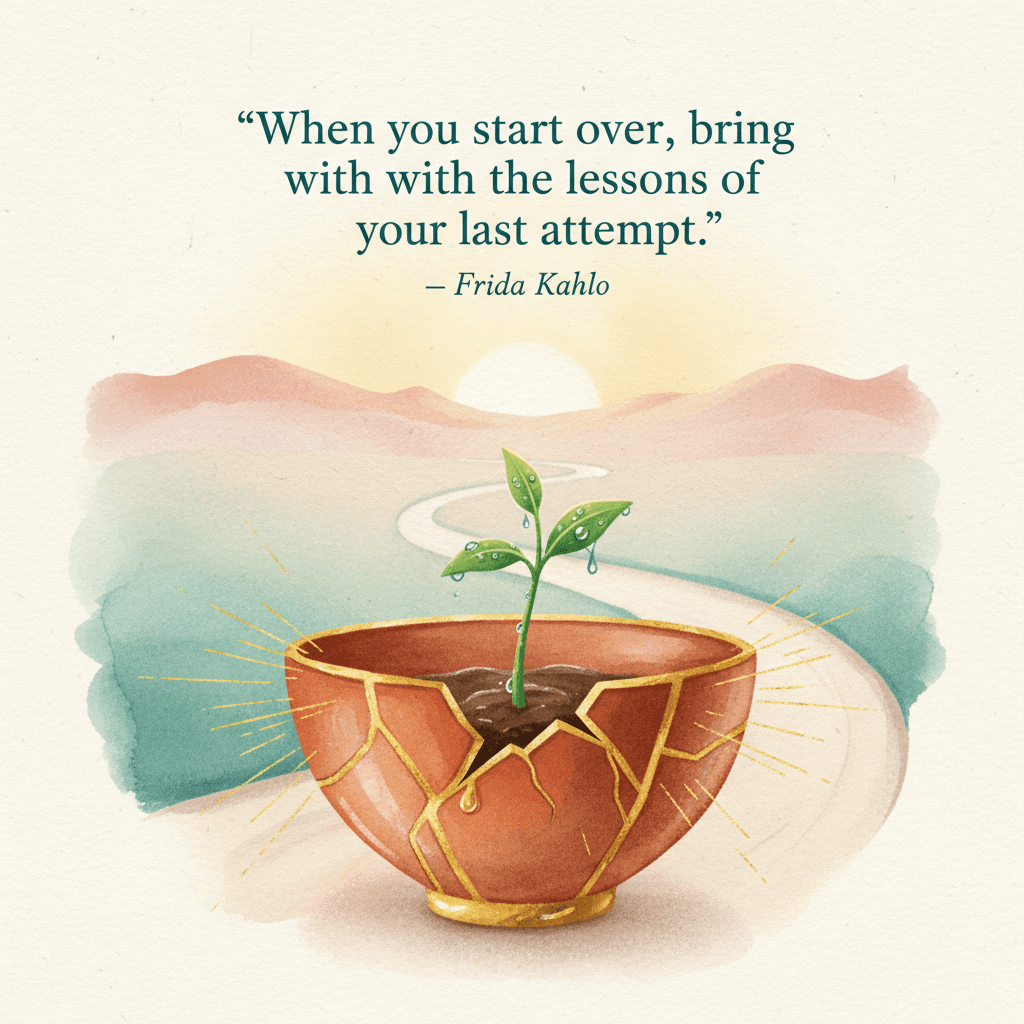
When you start over, bring with you the lessons of your last attempt. — Frida Kahlo
—What lingers after this line?
Frida Kahlo’s Iterative Resilience
Kahlo’s exhortation reframes a restart as informed renewal rather than erasure. After the 1925 bus accident that altered her life, she learned to paint in bed using a mirror rig, adapting craft to constraint. Each new beginning—physical recovery, creative direction, or personal reinvention—was not a clean slate but a revised edition. Hayden Herrera’s biography Frida (1983) describes how Kahlo repeatedly transformed pain into method, mining setbacks for technique and meaning. In this light, starting over becomes cumulative. The past is not baggage; it is curriculum. Kahlo carried forward what worked—discipline, symbolism, and self-observation—while discarding what did not. Thus her life models the principle embedded in the quote: you do not return to zero; you return with tools.
Art That Remembers: Motifs as Lessons
Moving from biography to canvas, her paintings demonstrate learning made visible. Recurring images—spinal columns, surgical corsets, thorn necklaces, and doubled selves—turn experience into a vocabulary. The Broken Column (1944) does more than depict injury; it codifies knowledge about endurance, later echoed in subsequent works. Likewise, The Two Fridas (1939) revisits identity after rupture, showing how she refined themes rather than abandoned them. Her notebook pages, collected in The Diary of Frida Kahlo (1995), reveal experiments with color, symbolism, and captions—an artist conducting ongoing field notes. Across entries, we see iteration: a symbol tested, revised, and redeployed. The lesson is clear: bring forward your lexicon, even as you compose a new sentence.
From Art to Psychology: The Growth Mindset
Extending this insight, psychology explains why carrying lessons works. Carol Dweck’s Mindset (2006) shows that treating outcomes as feedback rather than verdicts builds adaptive skill. Likewise, Robert Bjork’s research on “desirable difficulties” (1994) finds that effortful, error-laden practice deepens retention. When we start again with explicit takeaways, we convert failure into better encoding and future retrieval. Moreover, cognitive reappraisal shifts the meaning of a setback from threat to information. Kahlo’s reframing—pain as palette—mirrors this move. The bridge from canvas to cognition suggests that starting over succeeds when it preserves the structure of understanding gained the hard way.
Turning Lessons into Process: Retrospectives and PDCA
Translating mindset into method, high-performing teams ritualize learning. Norman Kerth’s Project Retrospectives (2001) outlines how to capture insights after each attempt, while W. Edwards Deming’s Plan–Do–Check–Act cycle operationalizes continuous improvement. Instead of treating a restart as a reset, these frameworks insist on carrying forward hypotheses, measurements, and adjustments. In practice, this means pausing after an attempt to ask: What did we intend? What occurred? Why? What will we try next? By documenting answers, the next iteration begins already equipped—much as Kahlo’s next canvas retained the distilled lessons of the last.
Tools to Remember: Journals, Checklists, Cues
To keep lessons accessible, externalize them. Creative routines like Julia Cameron’s morning pages (The Artist’s Way, 1992) capture patterns and pitfalls while they’re fresh. In complex work, Atul Gawande’s The Checklist Manifesto (2009) shows how simple lists prevent the amnesia of past errors by embedding learning at the point of action. Equally, build cues that trigger better choices: a pre-commitment rule, a template, or a visible metric. These artifacts function like Kahlo’s recurring motifs—concise reminders that compress experience into ready guidance when you begin again.
What to Carry—and What to Leave
Finally, not every trace of the past deserves passage. Carry forward principles, patterns, and evidence; leave behind shame and unhelpful scripts. Research on self-compassion (Kristin Neff, 2011) shows that kindness to oneself improves motivation more reliably than self-criticism. Thus the restart is lighter yet wiser. In this balance, Kahlo’s spirit endures: begin again, but not as who you were. Begin as the person your last attempt taught you to become.
One-minute reflection
Where does this idea show up in your life right now?
Related Quotes
6 selectedWhen we learn how to become resilient, we learn how to embrace the beautifully broad spectrum of the human experience. — Steve Maraboli
Steve Maraboli
At first glance, Steve Maraboli’s statement frames resilience not merely as endurance, but as a deeper way of perceiving life. To become resilient is not simply to survive hardship; it is to widen our capacity for joy, g...
Read full interpretation →No matter how difficult the past, you can always begin again today. — Jack Kornfield
Jack Kornfield
Jack Kornfield’s words offer a quiet but powerful assurance: the past may shape us, yet it does not have to imprison us. By saying we can begin again today, he shifts attention from what cannot be changed to what can sti...
Read full interpretation →Resilience is not just enduring the storm; it is learning to harvest the rain to nourish the roots you've already planted. — Elizabeth Edwards
Elizabeth Edwards
At first glance, Elizabeth Edwards rejects the common image of resilience as simple endurance. To ‘endure the storm’ suggests gritting one’s teeth and waiting for suffering to pass, yet her metaphor quickly moves further...
Read full interpretation →Resilience is not pretending that pain doesn't exist. It's learning to dance with it. — Amir (Success Chasers)
Amir (Success Chasers
At first glance, Amir’s quote rejects a common misunderstanding: that resilient people are somehow untouched by suffering. Instead, it reframes strength as honest engagement with pain rather than denial of it.
Read full interpretation →Optimist: someone who figures that taking a step backward after taking a step forward is not a disaster, it's more like a cha-cha. — Robert Brault
Robert Brault
Robert Brault’s line begins with a witty redefinition: an optimist is not someone who denies backward motion, but someone who interprets it differently. Instead of treating a setback as proof of failure, the optimist see...
Read full interpretation →A mind grows by staying with difficulty long enough for the experience to change it. — Mary Catherine Bateson
Mary Catherine Bateson
Mary Catherine Bateson’s observation begins with a quiet but demanding truth: the mind does not grow merely by encountering difficulty, but by remaining with it. Challenge becomes transformative only when we resist the u...
Read full interpretation →More From Author
More from Frida Kahlo →I paint flowers so they will not die. — Frida Kahlo
Frida Kahlo’s line reads like a gentle spell: by painting flowers, she resists the most ordinary tragedy—things fading despite our care. A bouquet wilts, a season ends, a beloved moment slips away; the canvas, however, o...
Read full interpretation →I tried to drown my sorrows, but the bastards learned how to swim. — Frida Kahlo
Frida Kahlo’s line opens with the familiar promise of escape—“I tried to drown my sorrows”—and then snaps into a punchline that refuses sentimentality. The sudden insult, “the bastards,” is more than comic shock; it’s a...
Read full interpretation →I used to think I was the strangest person in the world, but there must be someone just like me who feels bizarre and flawed. — Frida Kahlo
Frida Kahlo’s reflection begins in a familiar loneliness: the belief that one’s inner life is uniquely strange, even irredeemably flawed. That kind of self-story can make ordinary differences feel like permanent exile.
Read full interpretation →Embrace risk as the price of progress; comfort keeps the clock of your life frozen. — Frida Kahlo
Frida Kahlo’s line frames progress as a purchase: you pay for it with risk. In that sense, “embrace” is not a motivational flourish but an instruction to stop treating uncertainty as an error and start treating it as a t...
Read full interpretation →