
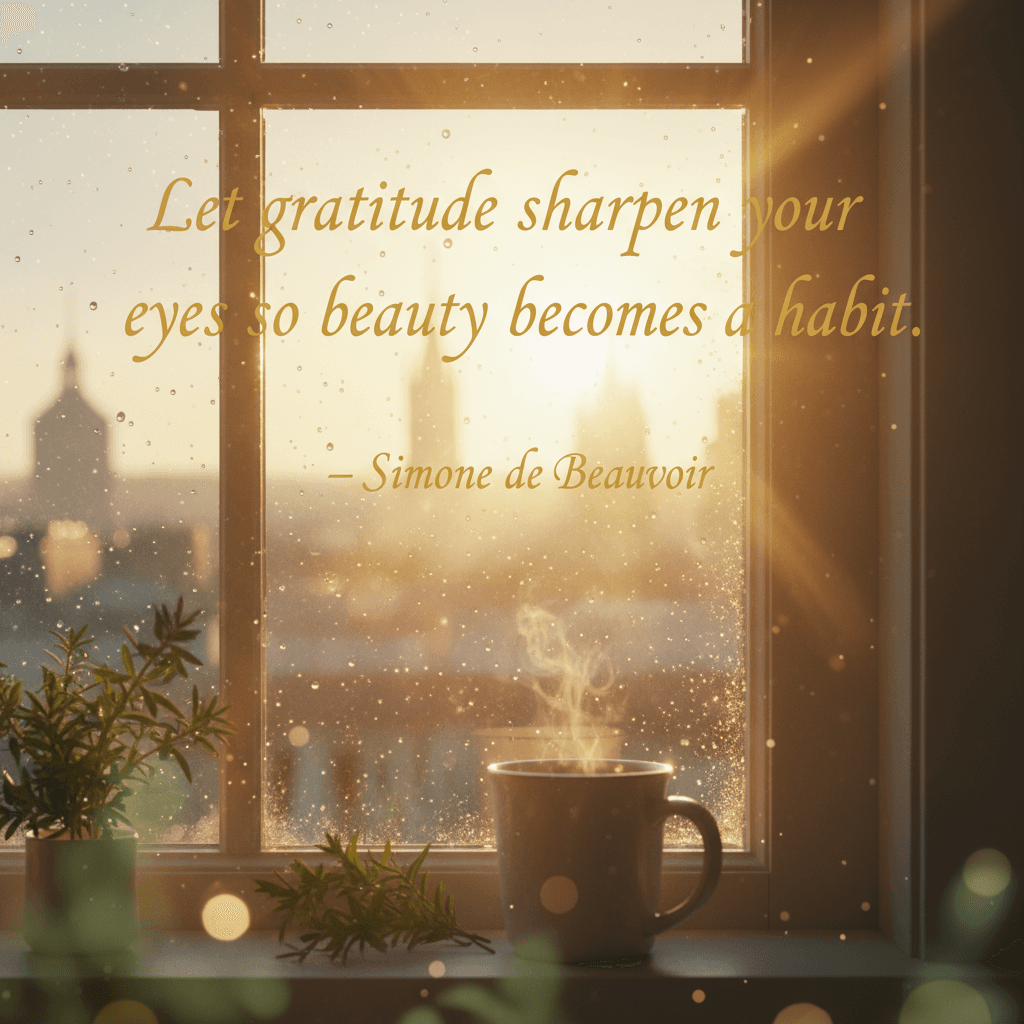
Let gratitude sharpen your eyes so beauty becomes a habit. — Simone de Beauvoir
—What lingers after this line?
Reframing Perception Through Thankfulness
At first glance, the line recasts gratitude from a polite response into a way of seeing. "Sharpen your eyes" suggests training attention; "beauty becomes a habit" hints that perception itself can be cultivated. Though the sentence is a modern paraphrase often attributed to Simone de Beauvoir, it resonates with her existential insistence that we actively choose our stance toward the world (The Ethics of Ambiguity, 1947). Rather than waiting for beauty to strike, we practice noticing it; and in practicing, we subtly become different people. In this light, gratitude is not naivete but disciplined lucidity—an exercise in directing the gaze toward meaning without denying reality’s hardness.
Existential Freedom as Attentional Choice
Building on that, de Beauvoir links freedom to responsibility: we create value through projects and regard for others. Choosing gratitude is a micro-project that resists nihilism by orienting us to what can be affirmed. The gesture echoes her view that becoming is enacted through repeated choices—akin to how The Second Sex (1949) frames identity as lived and constructed. By electing to attend to gifts, however small, we are not escaping ambiguity; we are consenting to it with courage. Thus gratitude is existential, not sentimental: an assertion of agency over where our attention, and therefore our life, will dwell.
Psychology: Gratitude Tunes the Mind
Moreover, contemporary research shows that gratitude reshapes attention. In randomized trials, gratitude journaling increased well-being and prosocial focus (Emmons and McCullough, 2003). Barbara Fredrickson’s broaden-and-build theory (2001) explains why: positive emotions widen perceptual scope, making people more likely to notice connections and opportunities. Related work on savoring shows that naming and lingering on pleasant experiences heightens recall and future sensitivity to them (Bryant and Veroff, 2007). In effect, gratitude trains the brain’s attentional filters, making signals of beauty more salient amid noise. Over time, this learned selectivity feels less like effort and more like how we naturally see.
Habits of Seeing: How Repetition Works
Meanwhile, habit science clarifies the mechanism. William James observed that habit sculpts the nervous system (Principles of Psychology, 1890); modern research echoes him, showing that repeated cues and simple if-then plans automate responses (Gollwitzer, 1999; Wood, 2019). Translate the quote into a loop: cue (a doorway), routine (notice one beautiful detail), reward (a brief lift). Iterated daily, this loop reduces friction until beauty-spotting becomes default. Even small implementations—placing a pen on your pillow to prompt a two-line gratitude note—compound. As habits migrate from effortful choice to effortless bias, the eyes really do sharpen.
Aesthetic Education in Everyday Life
From there, the practice expands into an education of the senses. John Dewey’s Art as Experience (1934) argues that aesthetic perception is not confined to museums; it is a way of undergoing the ordinary so that it becomes meaningful. Iris Murdoch called this moral attention—an "unselfing" that frees us to see what is there (The Sovereignty of Good, 1970). Imagine a commuter who, each morning, names one overlooked beauty: the rough gold on a brick wall, a bus driver’s wave, steam curling from a cup. After weeks, the world has not changed; the gaze has. Beauty becomes less an exception than a rhythm.
Guardrails: Gratitude Without Denial
At the same time, gratitude must not become denial. De Beauvoir insists on lucidity about injustice; to see beauty habitually is not to overlook harm. Viktor Frankl’s notion of tragic optimism—finding meaning without minimizing suffering—offers a helpful balance (Man’s Search for Meaning, 1946). Practically, pair gratitude with truth-telling: acknowledge the hard fact, then name a resource, ally, or moment of relief. This preserves moral clarity while protecting the capacity for joy. In this way, gratitude sharpens the eyes not by blurring pain, but by widening the frame to include reasons to continue.
Practices to Sharpen the Eyes
Finally, translate the idea into simple rituals. Try a three-breath pause before meals: breathe, look, and name two specifics you appreciate. Use an if-then plan: if I unlock my phone, then I will notice one beautiful texture around me. Keep a one-line evening log; once a week, write a gratitude letter, which robustly boosts well-being (Seligman et al., 2005). Add a photo-a-day of something ordinary made striking by light. As these practices accumulate, attention shifts from scanning for lack to scanning for value. And gradually, beauty ceases to be a surprise and becomes a habit.
One-minute reflection
What does this quote ask you to notice today?
Related Quotes
6 selectedIt is through thanks that we create progress. — Simone de Beauvoir
Simone de Beauvoir
This quote suggests that expressing gratitude can be a powerful catalyst for both personal and collective progress. By recognizing what we have and showing appreciation, we lay the groundwork for further development and...
Read full interpretation →Gratitude is the closest thing to beauty manifested in an emotion. — Mindy Kaling
Mindy Kaling
At first glance, Mindy Kaling’s line suggests that beauty is not only something we see but something we feel. Gratitude becomes a kind of inward radiance, transforming an ordinary emotional response into something almost...
Read full interpretation →Gratitude is not merely an emotion; it is the practice of noticing the quiet light that persists, even when the world feels loud and uncertain. — Thich Nhat Hanh
Thich Nhat Hanh
At first glance, gratitude may seem like a simple emotional response to good fortune. Yet Thich Nhat Hanh reframes it as a discipline of attention, suggesting that thankfulness is less about waiting for ideal circumstanc...
Read full interpretation →The most important aspect of gratitude is that it spurs action—that it compels us to go outside ourselves to express our gratitude in a way that makes a difference in someone else's life. — Rebecca Solnit
Rebecca Solnit
Rebecca Solnit shifts gratitude away from being a private sentiment and turns it into a moral impulse. In her view, thankfulness matters most not when it remains an inward glow, but when it pushes us outward toward other...
Read full interpretation →Gratitude means that you are being seen and recognized for the beauty of who you are. — Geoffrey L. Cohen
Geoffrey L. Cohen
At first glance, Geoffrey L. Cohen’s quote makes gratitude sound deceptively simple, yet it reaches far beyond polite manners.
Read full interpretation →Let gratitude be the compass that guides your labor. — Helen Frankenthaler
Helen Frankenthaler
Helen Frankenthaler’s line frames gratitude as an instrument for direction rather than a medal earned after success. A compass matters most while you’re still moving—when the route is unclear, the weather changes, and yo...
Read full interpretation →More From Author
More from Simone de Beauvoir →I am too intelligent, too demanding, and too resourceful for anyone to be able to take charge of me entirely. — Simone de Beauvoir
Simone de Beauvoir’s line reads first as a firm personal boundary: she refuses the premise that another person could—or should—“take charge” of her entirely. The triad “too intelligent, too demanding, and too resourceful...
Read full interpretation →Hold fast to what you can change and gently release what you cannot. — Simone de Beauvoir
Simone de Beauvoir’s line works like a practical compass: first, grasp firmly the parts of life that respond to effort; then, loosen your grip on what will not yield. The pairing matters because willpower alone can becom...
Read full interpretation →One can never consent to creep when one feels an impulse to soar. — Simone de Beauvoir
Simone de Beauvoir’s line begins with a quiet rebellion: once you feel the tug of possibility, “consenting to creep” becomes intolerable. The word consent matters, because it frames smallness as a choice we are pressured...
Read full interpretation →Turn hesitation into rehearsal, and action will follow. — Simone de Beauvoir
Simone de Beauvoir’s line reframes hesitation not as failure, but as raw material. Instead of treating uncertainty like a wall, she implies it can be treated like a doorway—an early stage of becoming capable.
Read full interpretation →