
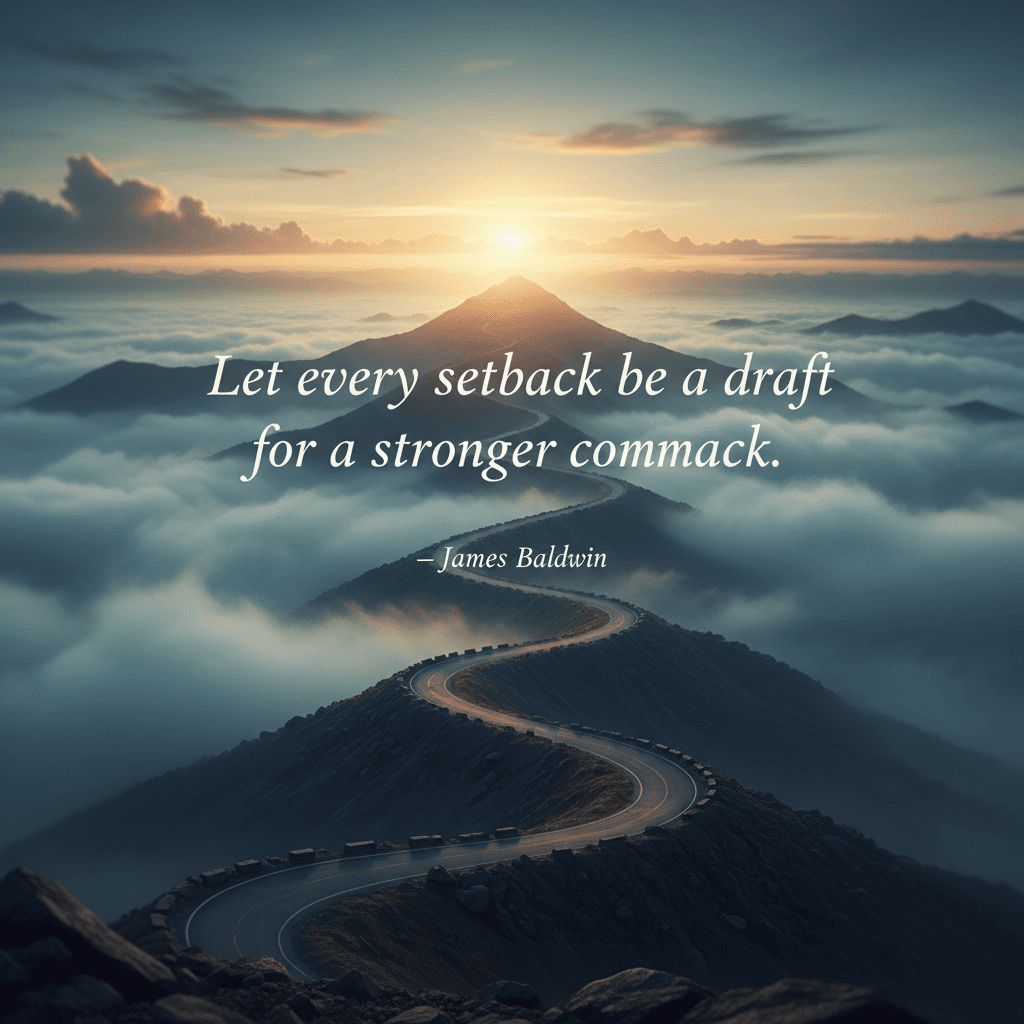
Let every setback be a draft for a stronger comeback. — James Baldwin
—What lingers after this line?
Setbacks as Living Rough Drafts
Baldwin’s line invites us to treat each setback not as a final verdict but as a draft—unfinished, editable, and rich with possibility. In writing, a draft is expected to be flawed; its purpose is to reveal what works and what does not. By extending this metaphor to life, Baldwin subtly reframes failure as part of a creative process. Instead of seeing disappointment as proof of inadequacy, we can view it as material to be revised. This perspective loosens the grip of shame and opens space for curiosity: what, precisely, can be rewritten in the next attempt?
From Wound to Workshop
Yet a draft is only useful when we return to it with attention. Baldwin implies that our wounds can become workshops, provided we are willing to examine them. Just as an editor marks the margins with questions and corrections, we can annotate our own missteps: Where did I underestimate the challenge? Which habits failed me? This analytical stance does not erase pain, but it channels it into learning. Over time, the very experiences that hurt us become blueprints for wiser choices and sturdier character, turning raw injury into informed intention.
Resilience as an Ongoing Revision
Seen this way, resilience is less a fixed trait and more a continuous act of revision. Psychologist Carol Dweck’s work on growth mindset (2006) shows that people who interpret difficulty as feedback, rather than as a final judgment, tend to improve more over time. Baldwin’s metaphor harmonizes with this insight: each draft of our effort—every interview botched, relationship strained, or project shelved—supplies data for the next version of ourselves. The comeback, therefore, is not a single dramatic moment but the cumulative result of countless small edits in how we think, choose, and respond.
Historical Echoes of Stronger Returns
History offers vivid illustrations of this drafting process. Nelson Mandela’s 27 years in prison, for instance, became a crucible in which he refined his strategy and sharpened his vision for a post-apartheid South Africa, eventually emerging as its first Black president in 1994. Similarly, Thomas Edison reportedly tested thousands of filament materials before perfecting a practical light bulb, treating each failed experiment as information rather than defeat. These stories mirror Baldwin’s insight: a powerful comeback is rarely spontaneous; it is usually the polished result of many unseen revisions born from adversity.
Practicing the Art of the Comeback
To live out Baldwin’s advice, we must deliberately practice turning setbacks into drafts. This can mean pausing after a disappointment to write down what happened, what we controlled, and what we might change next time. It can involve seeking honest feedback instead of retreating into silence, or setting a modest new goal that applies the lessons just learned. Over time, these practices cultivate a quiet confidence: we may still stumble, but we no longer believe that stumbling is the end of the story. Instead, it becomes the beginning of a revised, and often stronger, chapter.
One-minute reflection
Where does this idea show up in your life right now?
Related Quotes
6 selectedExcellence is the capacity to take pain. It is the refusal to let a difficult season define a permanent limit. — James Baldwin
James Baldwin
Baldwin’s line strips “excellence” of its usual polish—talent, prestige, or effortless success—and recasts it as a practiced toughness. In this view, excellence begins where comfort ends: it is the capacity to endure pai...
Read full interpretation →Turn hurt into a lesson the future can learn from — James Baldwin
James Baldwin
James Baldwin’s line begins with a simple but demanding shift: hurt is not merely something to endure, but something to translate. Pain, in this view, is raw material—an experience that can remain a private injury or bec...
Read full interpretation →When I hear somebody sigh, 'Life is hard,' I am always tempted to ask, 'Compared to what?' — Sydney J. Harris
Sydney J. Harris
Sydney J. Harris’s remark begins with an ordinary expression of fatigue: “Life is hard.” Yet his response, “Compared to what?” quietly turns complaint into inquiry.
Read full interpretation →Don't fight the challenges. Just find a new way to stand. — Germany Kent
Germany Kent
Germany Kent’s words begin with a quiet reversal of instinct: instead of treating every challenge as an enemy to defeat, she invites us to reconsider our posture toward difficulty. The emphasis is not on surrender, but o...
Read full interpretation →Optimist: someone who figures that taking a step backward after taking a step forward is not a disaster, it's more like a cha-cha. — Robert Brault
Robert Brault
Robert Brault’s line begins with a witty redefinition: an optimist is not someone who denies backward motion, but someone who interprets it differently. Instead of treating a setback as proof of failure, the optimist see...
Read full interpretation →A mind grows by staying with difficulty long enough for the experience to change it. — Mary Catherine Bateson
Mary Catherine Bateson
Mary Catherine Bateson’s observation begins with a quiet but demanding truth: the mind does not grow merely by encountering difficulty, but by remaining with it. Challenge becomes transformative only when we resist the u...
Read full interpretation →More From Author
More from James Baldwin →Perhaps home is not a place but simply an irrevocable condition. — James Baldwin
At first glance, Baldwin overturns a familiar assumption: home is usually imagined as a house, a street, or a homeland on a map. Yet his phrase suggests something deeper and less movable, a condition that lives within a...
Read full interpretation →Rarely are we more exposed than when we are being kind. — James Baldwin
At first glance, Baldwin’s line appears simple, yet it quickly reveals a harder truth: kindness is never merely polite behavior. When we are kind, we lower our defenses and allow another person to see what we value, what...
Read full interpretation →People who shut their eyes to reality simply invite their own destruction. — James Baldwin
James Baldwin frames denial not as a harmless coping mechanism but as a decision with consequences. By “shut[ting] their eyes,” he points to willful blindness—choosing comfort over truth—and suggests that reality does no...
Read full interpretation →People who cannot suffer can never grow up, can never discover who they are. — James Baldwin
James Baldwin’s claim binds two ideas we often separate: maturity and suffering. To “grow up,” in his sense, is not simply to age or acquire skills; it is to undergo experiences that test the stories we tell about oursel...
Read full interpretation →