
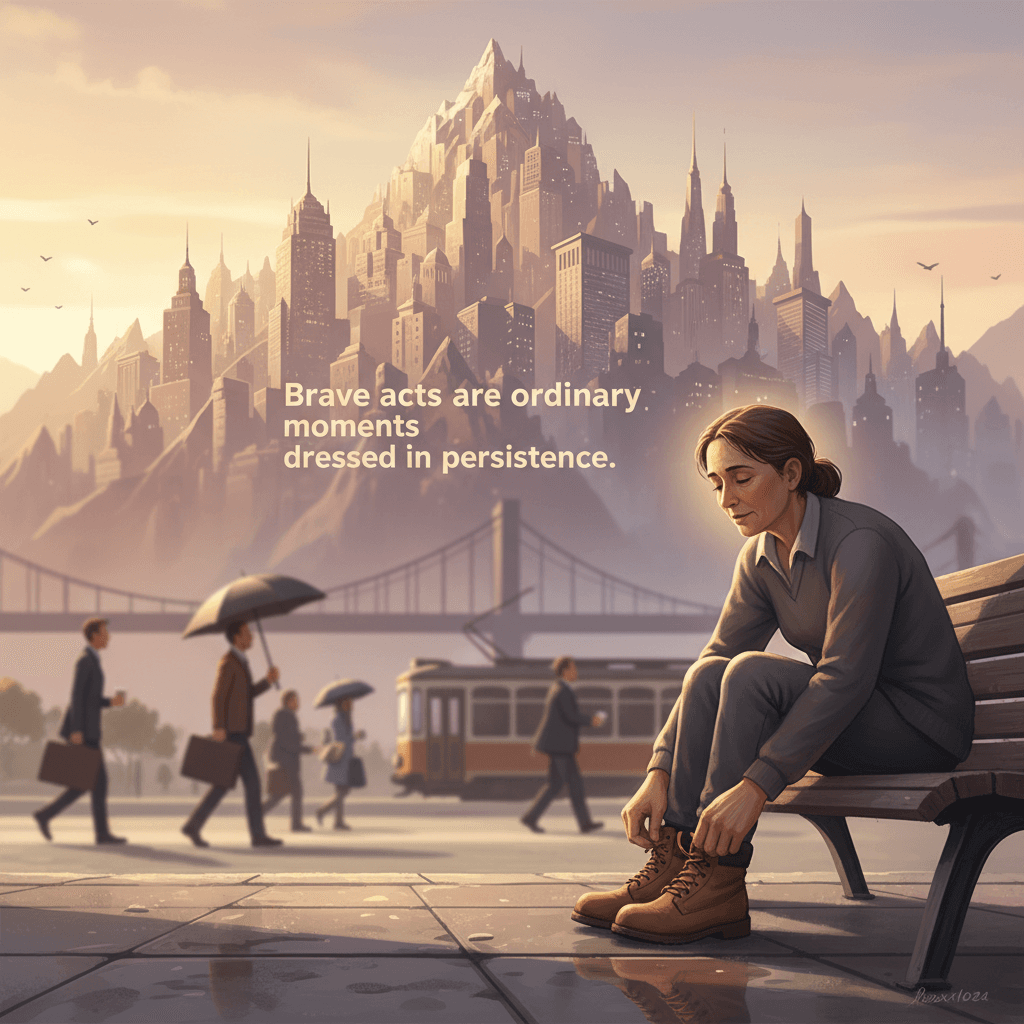
Brave acts are ordinary moments dressed in persistence — George Eliot
—What lingers after this line?
Redefining What It Means to Be Brave
George Eliot’s line, “Brave acts are ordinary moments dressed in persistence,” challenges the familiar image of courage as rare and dramatic. Instead of picturing heroes on battlefields or in burning buildings, she invites us to see bravery emerging quietly within everyday life. This shift reframes courage from a sudden, spectacular gesture into a steady, repeatable practice. By doing so, Eliot—whose novels like *Middlemarch* (1871–72) spotlight the inner lives of apparently unremarkable people—suggests that heroism is less about circumstance and more about character.
Ordinary Moments as Hidden Arenas of Courage
From this perspective, ordinary moments become the true stage on which bravery plays out. A difficult conversation with a loved one, returning to study after failure, or showing up to work while grieving all appear mundane on the surface. Yet, as in Eliot’s portrayal of Dorothea Brooke, small choices made in kitchens, offices, and village streets accumulate moral weight. These scenes rarely attract applause, but they demand quiet resolve. Thus the humdrum routines of life conceal countless, often invisible, opportunities to act bravely without spectacle.
Persistence as the Clothing of Heroism
Eliot’s metaphor of ordinary moments “dressed in persistence” is crucial: it is not a single act but ongoing effort that transforms the everyday into the heroic. Persistence “clothes” our choices, giving them form and dignity. A one‑time attempt at kindness or integrity may falter, but returning again and again—apologizing repeatedly, seeking help after relapse, or continuing a demanding caregiving role—turns isolated actions into a pattern of courage. Much like a costume signals a character on stage, persistence signals that an ordinary life is quietly embodying bravery.
The Psychology of Small, Repeated Acts
Modern psychology reinforces Eliot’s insight. Research on habit formation, such as work by Wendy Wood (2019), shows that repeated behaviors shape identity: people come to see themselves as “the sort of person who doesn’t give up.” Similarly, Angela Duckworth’s studies on grit link long‑term perseverance with achievement across domains. These findings suggest that what looks like bravery is often the visible tip of an iceberg of small, sustained choices. Over time, persistent action rewires both brain and self-concept, making courage feel less like a leap and more like a natural next step.
Recognizing Everyday Heroes Around and Within Us
Once we accept that bravery wears the clothes of persistence, our attention shifts to quiet heroes: the nurse working another night shift, the activist who keeps organizing after setbacks, the older adult learning new skills despite fear of technology. Eliot’s view encourages us not only to honor such people but also to recognize this same capacity in ourselves. When we keep going in the face of boredom, doubt, or pain, we are not merely enduring—we are enacting a modest, steadfast form of heroism. In this light, every day offers another chance to dress an ordinary moment in persistence and, thereby, in courage.
One-minute reflection
Why might this line matter today, not tomorrow?
Related Quotes
6 selectedBravery often looks like ordinary work continued with a steady heart. — bell hooks
bell hooks
bell hooks shifts the image of bravery away from cinematic heroics and toward persistence. In her framing, courage isn’t reserved for emergencies or grand speeches; it appears in the daily choice to keep going, even when...
Read full interpretation →Quietly persist. The world is loud, but your work only needs to be true. — Anne Lamott
Anne Lamott
Anne Lamott’s line begins with a simple imperative: “Quietly persist.” At once, it rejects the idea that meaningful work must announce itself to be real. Instead, she points toward a steadier form of effort, one rooted i...
Read full interpretation →Collect tiny brave acts until they become a landscape. — Kenzaburō Ōe
Kenzaburō Ōe
Kenzaburō Ōe’s line, “Collect tiny brave acts until they become a landscape,” reframes courage not as a sudden, heroic explosion but as a slow accumulation of modest gestures. Rather than highlighting one grand sacrifice...
Read full interpretation →Turn ordinary moments into offers of courage; the small invites become revolutions — bell hooks
bell hooks
bell hooks suggests that what appears mundane can actually be a threshold to transformation. A casual conversation, a shared meal, or a brief pause to listen might seem insignificant, yet these are the spaces where value...
Read full interpretation →Hold fast to the idea that small acts of bravery stitch the fabric of a freer tomorrow. — Victor Hugo
Victor Hugo
Imagine freedom as a fabric: resilient yet always at risk of fraying. Small acts of bravery are the stitches that prevent it from unraveling, and holding fast to this idea keeps our hands steady at the needle.
Read full interpretation →The greatest effort is not necessarily the most visible; it is often the subtle persistence that gives birth to progress. — Jewel Diamond Taylor
Jewel Diamond Taylor
This quote suggests that the hardest work is not always the most noticeable. True progress often stems from small, consistent efforts rather than grand, dramatic actions.
Read full interpretation →More From Author
More from George Eliot →It is easy finding reasons why other folks should be patient. — George Eliot
George Eliot’s remark turns on a quiet but piercing irony: patience is a virtue we readily prescribe when someone else must practice it. In other words, distance makes endurance look simple.
Read full interpretation →It is a narrow mind which cannot look at a subject from various points of view. — George Eliot
George Eliot’s remark immediately frames narrowness not as a lack of intelligence, but as a failure of perspective. To look at only one side of a subject is to confuse partial vision with complete understanding.
Read full interpretation →Build your future in deeds; imagination is the blueprint, labor the bricks. — George Eliot
George Eliot’s line frames the future as something constructed through action rather than awaited as fate. By saying we “build” with “deeds,” she shifts attention from abstract wishing to concrete doing, implying that pr...
Read full interpretation →Effort without passion is drudgery; effort with passion is progress. — George Eliot
George Eliot’s line hinges on a clean, memorable opposition: the same act of exertion can feel like drudgery or become progress, depending on whether passion is present. In other words, effort alone is not the full story...
Read full interpretation →