
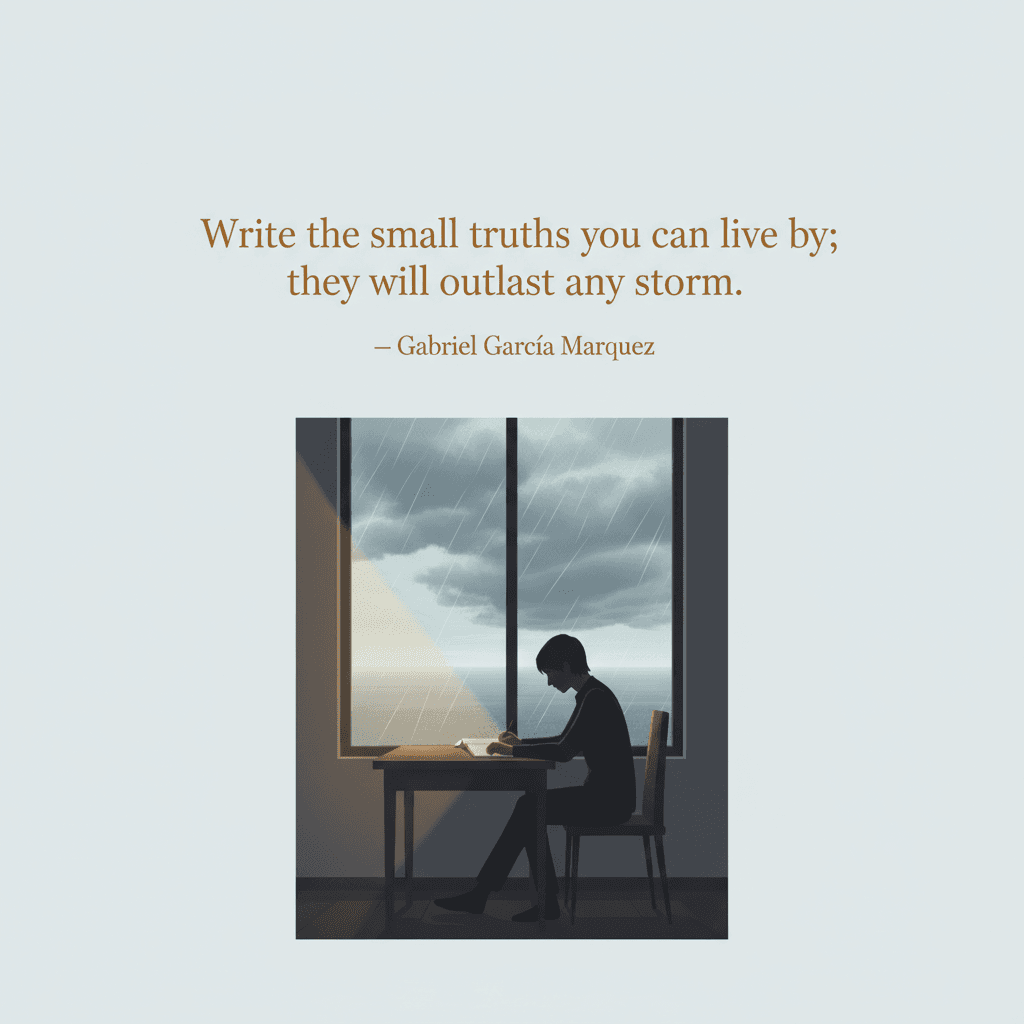
Write the small truths you can live by; they will outlast any storm. — Gabriel García Márquez
—What lingers after this line?
The Power of Modest, Lived Truths
Gabriel García Márquez’s line urges us to turn away from grand slogans and instead craft small, honest truths that can guide our daily lives. These are not sweeping ideologies but simple sentences that feel real when put into practice: “I will speak kindly when I’m angry,” or “I will finish what I begin.” Because they are modest in scale, they can be repeated, tested, and refined in the ordinary rhythms of a day. In this sense, they become anchors rather than decorations—quiet principles sturdy enough to hold when life becomes chaotic.
Why Small Principles Outlast Big Promises
Transitioning from this idea of modesty, it becomes clear why such truths endure more than lofty declarations. Big promises often collapse under the weight of expectation, much like rigid structures that crack in an earthquake. By contrast, small truths are flexible; they can bend without breaking. The Japanese concept of kaizen, or continuous small improvements, reflects this logic: incremental steps, grounded in clear, simple principles, resist burnout and disillusionment. Over time, these tiny commitments weave a durable fabric of character that survives upheaval.
Writing as an Act of Self-Construction
Márquez’s choice of the verb “write” subtly shifts the insight from mere reflection to creation. By writing our truths, we do not just discover ourselves—we construct ourselves. Much like the notebooks in which Márquez drafted his novels, a private page becomes a laboratory for the self. First we put words down, then we test them in life, revising when they prove false or hollow. In this ongoing process, the act of writing gives form and continuity to who we are, even when our circumstances feel scattered or unstable.
Storms as Tests, Not Exceptions
Once these truths are written and lived, the storms that arrive—loss, illness, failure, or sudden change—cease to be exceptions and instead become tests of authenticity. Viktor Frankl’s reflections in “Man’s Search for Meaning” (1946) show how even in a concentration camp, a handful of guiding convictions could not be taken away. In much gentler contexts, our own small truths work similarly: they ask, in the middle of a crisis, “Will you still be this person now?” When the answer is yes, the storm reveals not our weakness, but the tensile strength of our values.
From Private Maxims to Shared Legacy
Finally, those small truths, faithfully lived, ripple outward and quietly outlast us. A grand theory might fade with fashion, but the remembered habits of a person—how they listened, forgave, or refused to lie—often become family lore. Just as Márquez’s fictional Macondo in “One Hundred Years of Solitude” (1967) is sustained by stories passed down, our written and enacted truths slowly turn into stories others repeat. In this way, brief, personal sentences become a kind of legacy: not carved in stone, but inscribed in the everyday choices of the people who watched us live them.
One-minute reflection
Why might this line matter today, not tomorrow?
Related Quotes
6 selectedResilience is not just enduring the storm; it is learning to harvest the rain to nourish the roots you've already planted. — Elizabeth Edwards
Elizabeth Edwards
At first glance, Elizabeth Edwards rejects the common image of resilience as simple endurance. To ‘endure the storm’ suggests gritting one’s teeth and waiting for suffering to pass, yet her metaphor quickly moves further...
Read full interpretation →Carry a quiet rebellion of joy and let it dismantle doubt brick by brick — Gabriel García Márquez
Gabriel García Márquez
Gabriel García Márquez’s image of a “quiet rebellion of joy” invites us to imagine resistance that does not shout, but endures. Instead of anger or spectacle, this rebellion chooses delight, gratitude, and tenderness as...
Read full interpretation →When I hear somebody sigh, 'Life is hard,' I am always tempted to ask, 'Compared to what?' — Sydney J. Harris
Sydney J. Harris
Sydney J. Harris’s remark begins with an ordinary expression of fatigue: “Life is hard.” Yet his response, “Compared to what?” quietly turns complaint into inquiry.
Read full interpretation →Don't fight the challenges. Just find a new way to stand. — Germany Kent
Germany Kent
Germany Kent’s words begin with a quiet reversal of instinct: instead of treating every challenge as an enemy to defeat, she invites us to reconsider our posture toward difficulty. The emphasis is not on surrender, but o...
Read full interpretation →Optimist: someone who figures that taking a step backward after taking a step forward is not a disaster, it's more like a cha-cha. — Robert Brault
Robert Brault
Robert Brault’s line begins with a witty redefinition: an optimist is not someone who denies backward motion, but someone who interprets it differently. Instead of treating a setback as proof of failure, the optimist see...
Read full interpretation →A mind grows by staying with difficulty long enough for the experience to change it. — Mary Catherine Bateson
Mary Catherine Bateson
Mary Catherine Bateson’s observation begins with a quiet but demanding truth: the mind does not grow merely by encountering difficulty, but by remaining with it. Challenge becomes transformative only when we resist the u...
Read full interpretation →More From Author
More from Gabriel García Márquez →No one should fear shadows. It simply means there's a light shining somewhere nearby. — Gabriel García Márquez
Gabriel García Márquez turns a common source of unease into a quiet reassurance: shadows are not threats in themselves, but evidence. When we fear shadows, we often respond to what is vague, enlarged, or half-seen—our mi...
Read full interpretation →Open one window of wonder each day and the light of possibility will rush in. — Gabriel García Márquez
García Márquez frames wonder not as a rare accident, but as something you can choose—one “window” at a time. The image suggests a small, deliberate action: a pause, a question, a moment of attention.
Read full interpretation →Persist like a river: find the cracks and flow through them. — Gabriel García Márquez
García Márquez’s image begins with something ordinary but unstoppable: a river. It doesn’t “win” by force or by arguing with the landscape; it keeps moving, day after day, and that continued motion becomes its power.
Read full interpretation →Imagine boldly, then write the first line with your feet. — Gabriel García Márquez
Gabriel García Márquez’s line, “Imagine boldly, then write the first line with your feet,” begins with an impossibility. No one literally writes with their feet, yet the image lingers because it challenges our sense of w...
Read full interpretation →