
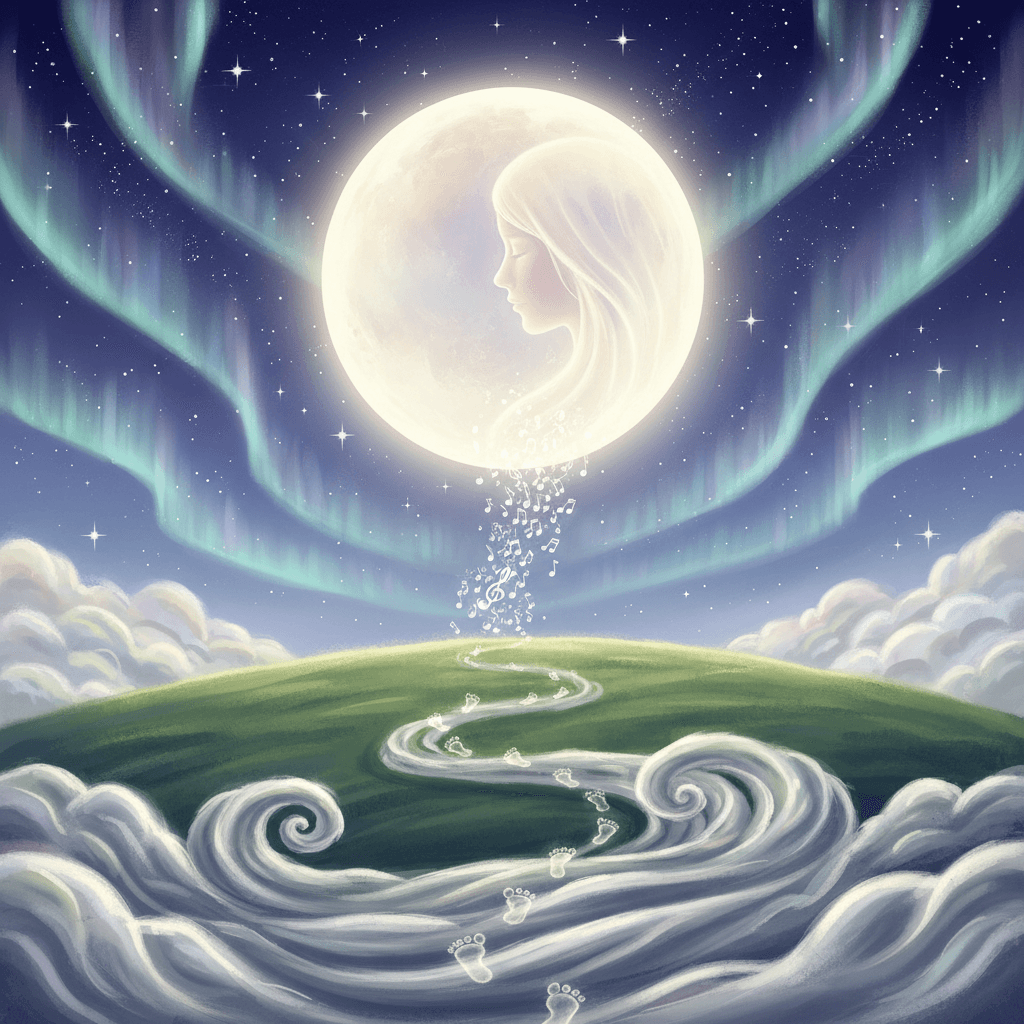
Sister moon, rise—let whispers become songs and songs become steps. — Sappho
—What lingers after this line?
Moonrise as a Signal of Transformation
The invocation, “Sister moon, rise,” immediately personifies the moon as a familiar presence, suggesting intimacy rather than distant awe. In Greek lyric tradition, celestial bodies often serve as confidants for human emotion, and this line continues that practice by inviting the moon to participate in a change of state. As the moon rises, it does more than illuminate the night; it initiates a movement from quiet interiority toward shared expression, preparing the ground for whispers to evolve into something larger.
Whispers: The Seed of Unspoken Desire
Beginning with “whispers,” the quote locates us in a realm of secrecy and half-uttered feelings. Sappho’s surviving fragments often gesture toward private moments—glances, shivers, or broken phrases—that hint at emotions too fragile to name aloud. These whispers are the first tremors of desire and longing, carrying truths that cannot yet bear the full light of day. By naming them, the line acknowledges that all overt expression starts as something tentative, delicate, and almost inaudible within the self.
Songs: When Emotion Finds Its Voice
As the line moves from whispers to songs, it traces the path from private feeling to articulated art. In antiquity, Sappho’s poems were originally performed to music on the lyre, so “songs” here evoke both personal confession and public performance. Emotions once concealed are now structured into rhythm and melody, capable of being shared, remembered, and repeated. This transformation suggests that when we dare to give voice to what was hidden, our inner lives acquire form and beauty that others can witness.
Steps: Turning Expression into Embodied Action
The final movement—from songs to steps—pushes expression into the physical world. Steps imply dance, journey, or deliberate action, all of which extend beyond the realm of words. Greek lyric culture often combined poetry, music, and dance in ritual contexts, and this progression echoes that integration. What began as a murmur now reshapes the body’s behavior, turning feeling into choreography or forward motion. In this way, the quote implies that authentic emotion ultimately seeks embodiment, not just articulation.
The Moon as Witness and Catalyst of Change
Circling back to the moon, its presence frames the entire sequence as both intimate and ritualistic. In Sappho’s Lesbos, moonlit gatherings and nocturnal rites provided spaces where music, desire, and community intersected, as glimpsed in fragments like “the moon has set, and the Pleiades” (fr. 168B). Here, calling the moon “sister” suggests solidarity in cycles of change: just as the moon waxes from thin crescent to full disk, so too do human emotions swell from faint whispers to decisive steps, under her steady, silver gaze.
A Subtle Map of Emotional Courage
Taken together, the line outlines a quiet map of courage. To move from whisper to song requires the bravery to be heard; to progress from song to step demands the resolve to act. The rising moon blesses this progression, casting a gentle light over each risky transition. By threading these images into a single ascending motion, the quote suggests that inner truth seeks ever fuller expression, and that the natural world, personified in “Sister moon,” not only witnesses but gently beckons us toward that unfolding.
Recommended Reading
As an Amazon Associate, we earn from qualifying purchases.
One-minute reflection
Why might this line matter today, not tomorrow?
Related Quotes
6 selectedGather your doubts as stones, then build the stairway they once blocked. — Sappho
Sappho
Sappho’s image begins by giving doubt a physical form: stones you can pick up, hold, and count. Rather than treating uncertainty as a vague mood, she frames it as something concrete—heavy, real, and capable of piling up...
Read full interpretation →If seeds in the black earth can turn into such beautiful roses, what might not the heart of man become in its long journey toward the stars? — G.K. Chesterton
G. K. Chesterton
Chesterton begins with a striking contrast: black earth, dark and ordinary, somehow gives rise to roses of astonishing beauty. From that image, he invites us to see human nature in the same light.
Read full interpretation →A blazing fire makes flame and brightness out of everything that is thrown into it. — Marcus Aurelius
Marcus Aurelius
Marcus Aurelius compresses a central Stoic lesson into a vivid image: a strong fire does not merely endure what is cast into it, but transforms it into more flame and light. In that sense, adversity is not just something...
Read full interpretation →It doesn't happen all at once. You become. It takes a long time. — Margery Williams
Margery Williams
Margery Williams’s line from The Velveteen Rabbit (1922) begins with a gentle refusal of sudden change. ‘It doesn’t happen all at once’ suggests that becoming—whether becoming real, mature, or fully oneself—is not an eve...
Read full interpretation →To create is to destroy the old version of yourself that no longer fits the new truth you have found. — Martha Graham
Martha Graham
Martha Graham’s statement presents creativity not as decoration, but as a radical act of inner change. To create something genuine, she suggests, a person must let go of an earlier self—the habits, beliefs, and identitie...
Read full interpretation →Art is a wound turned into light. — Georges Braque
Georges Braque
At its core, Georges Braque’s line suggests that art does not erase suffering; instead, it converts injury into meaning. A wound is intimate, raw, and often hidden, while light is what reveals, guides, and makes things v...
Read full interpretation →More From Author
More from Sappho →One's own self is well worth knowing. — Sappho
At first glance, Sappho’s brief statement seems simple, yet its force lies in its directness: the self is not a trivial subject but a worthy one. In a world that often rewards attention to status, duty, or appearance, he...
Read full interpretation →Sow a single clear word and let it bloom into a chorus. — Sappho
Sappho’s line begins by shrinking expression down to its smallest unit: a single clear word. The emphasis on clarity suggests intention rather than verbosity, as if meaning can be planted only when it is cleanly chosen.
Read full interpretation →Let desire fuel your craft but let kindness steady the heart. — Sappho
Sappho’s line sets up a deliberate pairing: desire as the engine of making, and kindness as the stabilizer of being. Desire pushes the artist toward intensity—toward risk, experimentation, and the hunger to shape experie...
Read full interpretation →Let your voice fracture the silence; even a small sound reshapes the air. — Sappho
Sappho’s line begins by treating silence not as emptiness, but as a kind of held breath—an atmosphere with shape and tension. When she urges, “Let your voice fracture the silence,” she implies that quiet has weight, and...
Read full interpretation →