
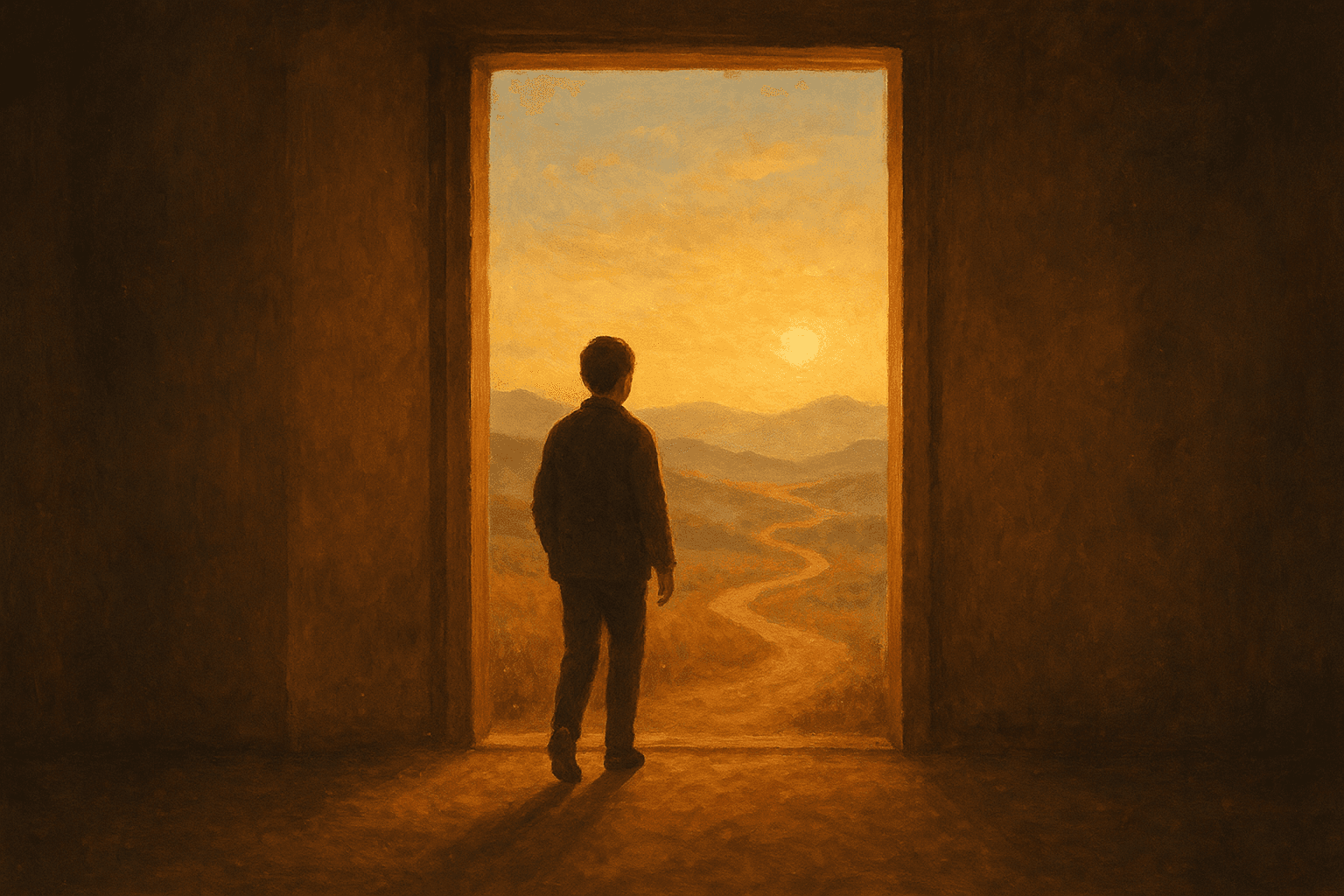
Find what pulls you outside your door and follow it with gentle stubbornness. — Mary Oliver
—What lingers after this line?
The Call Just Beyond Threshold
Mary Oliver’s line begins at the most ordinary of places: the doorway. Yet this simple threshold becomes a metaphor for the boundary between habit and possibility. “What pulls you outside your door” suggests an invitation that is already present, a subtle gravity tugging at our attention. Instead of prescribing a grand mission, Oliver points to whatever already stirs a faint curiosity—birdsong, a half-formed idea, a wish to learn, or the urge to walk into the morning light. In this way, the call is not distant or abstract; it lives in the small restlessness we feel when routine no longer quite fits.
Listening to Subtle Longings
From this threshold, the quote turns our focus inward to the source of that pull. Oliver’s poetry often honors quiet intuitions, as seen in collections like *Blue Pastures* (1995), where she treats attention itself as a form of prayer. The “pull” can be understood as those soft signals—daydreams, recurring interests, or moments of awe—that we usually dismiss as impractical. By naming them, she suggests they are not distractions but directions. Thus, what seems like mere wandering desire begins to look more like a compass pointing toward a more authentic way of living.
The Practice of Gentle Stubbornness
However, sensing a pull is not enough; the second half of the quote insists we “follow it with gentle stubbornness.” This phrase weaves together two qualities we rarely pair: soft receptivity and firm persistence. Gentleness guards us from harsh self-judgment or frantic striving, while stubbornness keeps us from abandoning our path at the first hint of difficulty. Much like Oliver’s own decades of dawn walks chronicled in *Devotions* (2017), the practice is quiet but unwavering: you keep stepping outside, again and again, even when the initial excitement has faded.
Resisting Cultural Noise and Expectation
Moving outward, this gentle stubbornness also serves as protection against the louder pulls of convention and comparison. Modern life urges us toward goals that are easily measured—status, speed, productivity—while the pull Oliver describes is often slow, unprofitable, and private. To follow it requires politely but firmly refusing some of these external demands. In this sense, the doorway is also a filter: each time we step through it for our own reasons, we choose inner alignment over external approval, quietly rewriting what success looks like in our daily lives.
Allowing a Path to Reveal Itself
Finally, Oliver’s guidance implies that clarity comes from movement, not from perfect planning. We do not need to see the entire road; we need only trust the next small pull and meet it with steady care. Like the walkers and naturalists she admired—akin to Henry David Thoreau in *Walden* (1854)—we discover the path by walking it. Over time, these repeated, gently stubborn choices form a life recognizable as our own. Thus the quote becomes a quiet manifesto: open the door, heed the tug, and let persistence turn a fleeting urge into a living, unfolding way of being.
One-minute reflection
What feeling does this quote bring up for you?
Related Quotes
6 selectedAnswer the call that trembles inside you and step into honest work. — Virginia Woolf
Virginia Woolf
Woolf’s phrase “the call that trembles inside you” frames vocation not as a booming command but as something intimate and easily ignored. It suggests an inner knowing that arrives with uncertainty—felt more as restlessne...
Read full interpretation →Do the work your heart sketches, and the world will frame it. — Elizabeth Gilbert
Elizabeth Gilbert
Elizabeth Gilbert’s creative ethos in Big Magic (2015) urges makers to trust the quiet instructions of curiosity. In that spirit, the “heart’s sketch” is the inner blueprint—imperfect, hand-drawn, alive.
Read full interpretation →Everything that is made is made by slow, steady effort. — Mary Oliver
Mary Oliver
Mary Oliver’s line distills a quiet truth: meaningful things rarely appear all at once. Instead, they emerge through repetition, patience, and attention, whether one is writing a poem, raising a family, or restoring a ga...
Read full interpretation →Certain things catch your eye, but pursue only those that capture the heart. — Ancient Indian Proverb
Ancient Indian Proverb
This proverb highlights the importance of distinguishing between superficial attractions and deeper, more meaningful connections. It's a reminder to seek out experiences and relationships that resonate on a deeper emotio...
Read full interpretation →Act quietly, but never stop. — Maxim Gorky
Maxim Gorky
This quote advises the value of persistence. By steadily working towards a goal without unnecessary spectacle or noise, one can achieve long-term success.
Read full interpretation →Finding your passion is not just about doing what you love; it’s about doing what you can’t not do. — David Brooks
David Brooks
This quote highlights that true passion is not merely about enjoyment but about a deep, irresistible drive. It's something you feel compelled to do because it’s an intrinsic part of who you are.
Read full interpretation →More From Author
More from Mary Oliver →Everything that is made is made by slow, steady effort. — Mary Oliver
Mary Oliver’s line distills a quiet truth: meaningful things rarely appear all at once. Instead, they emerge through repetition, patience, and attention, whether one is writing a poem, raising a family, or restoring a ga...
Read full interpretation →The real flex is no longer looking busy. It is looking peaceful. It is having ambition without self-destruction. — Anonymous (skipped) -> The quietest moments are often where the greatest strength is found. — Mary Oliver
At first glance, these paired lines challenge a modern performance ritual: the need to appear constantly overwhelmed in order to seem important. Instead of praising busyness, they propose a subtler ideal—peacefulness as...
Read full interpretation →The slow work of cultivation is the only antidote to the frantic pace of our digital existence. — Mary Oliver
Mary Oliver’s line sets two tempos against each other: the hurried pulse of digital life and the patient rhythm of cultivation. By calling cultivation an antidote, she implies that our overstimulated routines are not mer...
Read full interpretation →When you feel like you've reached the end of your rope, tie a knot in it and hang on—or better yet, realize you can just let go and float. — Mary Oliver
At first, Mary Oliver’s line begins with a familiar survival lesson: when life feels unbearable, hold on. The image of reaching the end of a rope evokes exhaustion, fear, and the instinct to preserve oneself at any cost.
Read full interpretation →