
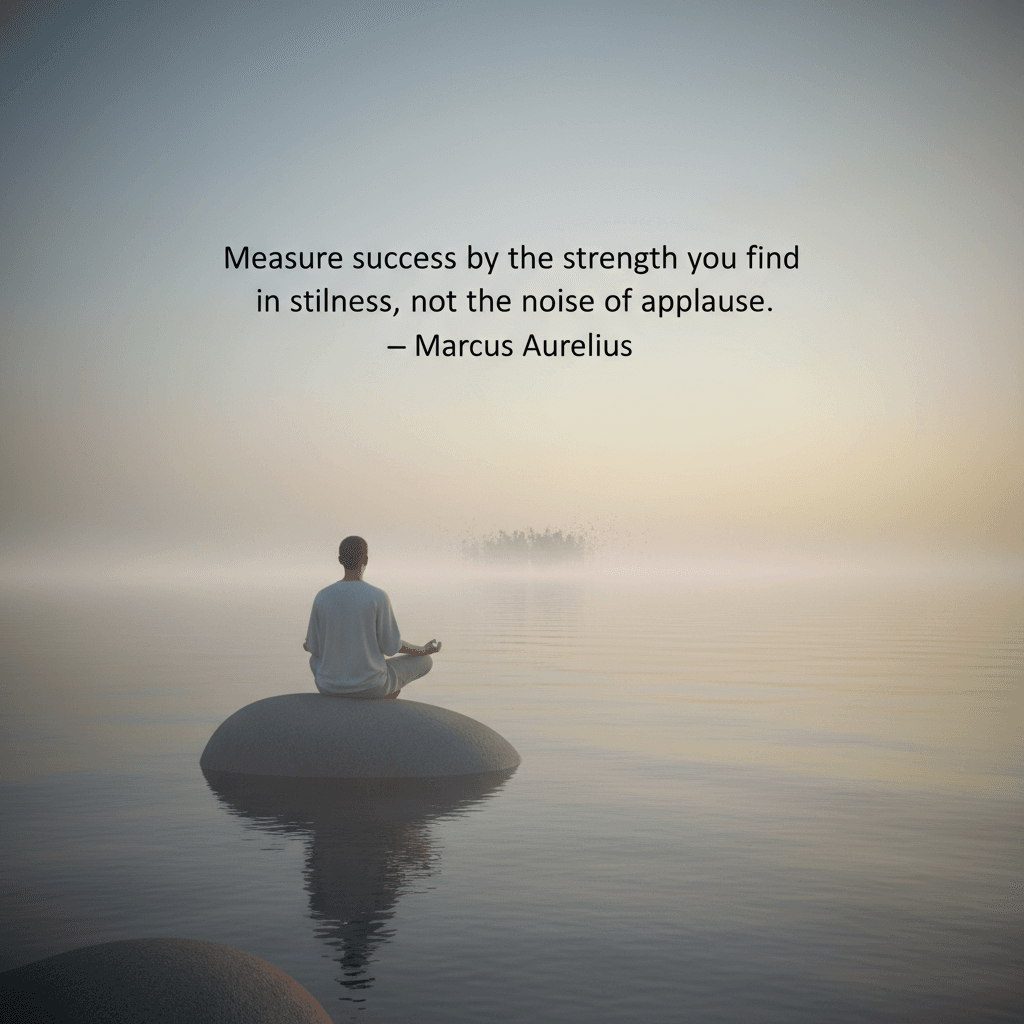
Measure success by the strength you find in stillness, not the noise of applause — Marcus Aurelius
—What lingers after this line?
Redefining What It Means to Succeed
Marcus Aurelius’ insight invites a radical shift in how we measure success. Instead of counting achievements by how loudly the world responds, he suggests we look inward to the calm resilience we cultivate. This moves success away from followers, titles, and trophies, and toward an inner state that cannot be taken away. In doing so, he challenges the modern culture of constant validation and performance metrics, asking us to consider whether applause is evidence of genuine worth or merely an echo of passing fashion.
The Stoic Roots of Inner Stillness
To understand this quotation, it helps to recall that Marcus Aurelius wrote as a Stoic philosopher-emperor, recording his thoughts privately in *Meditations* (c. 170–180 CE). Stoicism teaches that peace comes from mastering our responses, not our circumstances. Thus, stillness is not laziness or withdrawal; it is an active steadiness amid chaos. By valuing the strength discovered in this composed inner space, Marcus aligns success with virtue—wisdom, courage, justice, and self-control—rather than with fleeting external recognition.
Applause as a Dangerous Distraction
From this perspective, applause becomes not just secondary but potentially dangerous. Praise can seduce us into living for appearances, measuring our days by likes and compliments rather than by integrity. History offers many examples: Cicero’s oratory won huge acclaim, yet his dependence on public favor left him vulnerable to political tides. In contrast, Marcus urges us to ground our sense of worth in something that does not rise and fall with public opinion: the quiet knowledge that we acted well, even when no one noticed.
Cultivating Strength in Moments of Quiet
However, the kind of strength Marcus admires is not forged in the spotlight, but in unobserved choices: getting up when discouraged, returning to a difficult task, or remaining kind under provocation. These small, quiet acts train the mind like a muscle. Practices such as daily reflection, journaling, or mindful breathing echo Marcus’ own habits, helping us become less reactive and more deliberate. Over time, this cultivated stillness becomes a reservoir of strength we can draw on when life becomes loud, uncertain, or painful.
Living by Inner Metrics, Not Outer Noise
Ultimately, measuring success by inner stillness means adopting different metrics for a life well lived. Instead of asking, “How many people noticed me?” we ask, “Did I stay true to my values? Did I remain steady, honest, and compassionate?” This shift does not forbid enjoying recognition; rather, it refuses to treat it as the final judge. In this way, Marcus Aurelius offers a liberating standard: your deepest success is not the clamor of applause, but the quiet certainty that you have become stronger, wiser, and more at peace with yourself.
Recommended Reading
As an Amazon Associate, we earn from qualifying purchases.
One-minute reflection
What's one small action this suggests?
Related Quotes
6 selectedReal strength is not the absence of struggle, but the presence of a calm, steady mind. — Marcus Aurelius
Marcus Aurelius
At first glance, the quote overturns a common assumption: that strength means never suffering, wavering, or feeling pressure. Instead, it proposes a deeper standard.
Read full interpretation →The strength of a person is not measured by their achievements, but by their ability to remain centered when the world around them feels like it is unraveling. — Marcus Aurelius
Marcus Aurelius
At first glance, strength is often associated with visible accomplishments—titles earned, obstacles conquered, or victories displayed for others to admire. Yet this reflection attributed to Marcus Aurelius redirects atte...
Read full interpretation →Silence the noise, strengthen the soul. — Marcus Aurelius
Marcus Aurelius
At first glance, Marcus Aurelius’s line condenses the heart of Stoic practice into a simple command: reduce distraction so that character can grow. In his Meditations (c.
Read full interpretation →It's time you realized that you have something in you more powerful and miraculous than the things that affect you. — Marcus Aurelius
Marcus Aurelius
Marcus Aurelius frames his thought as a timely realization: the truly decisive force in your life is not what happens to you, but what lives within you. Rather than denying hardship, he redirects attention to a “more pow...
Read full interpretation →You have power over your mind—not outside events. Realize this, and you will find strength. — Marcus Aurelius
Marcus Aurelius
Marcus Aurelius’ line distills a central Stoic distinction: our judgments, choices, and attention are ours to govern, while external events unfold according to forces beyond us. In Meditations (c.
Read full interpretation →Use each obstacle as a teacher; the stronger your will, the fewer things can unsettle you. — Marcus Aurelius
Marcus Aurelius
Marcus Aurelius frames hardship not as an interruption to life but as part of its curriculum. By calling obstacles “teachers,” he shifts the focus from what happens to us to what we can learn from it, which is a central...
Read full interpretation →More From Author
More from Marcus Aurelius →The strength of a person is not measured by their achievements, but by their ability to remain centered when the world around them feels like it is unraveling. — Marcus Aurelius
At first glance, strength is often associated with visible accomplishments—titles earned, obstacles conquered, or victories displayed for others to admire. Yet this reflection attributed to Marcus Aurelius redirects atte...
Read full interpretation →External things are not the problem. It's your assessment of them, which you can erase right now. — Marcus Aurelius
At its core, Marcus Aurelius redirects attention away from the outer world and back toward the mind that interprets it. In this brief line, he argues that events themselves do not automatically wound us; rather, our judg...
Read full interpretation →The art of living well is knowing when to hold your focus and when to let the world fall away. True resilience is found in the stillness of a mind that knows its own direction. — Marcus Aurelius
At its core, this reflection presents living well as an act of disciplined attention. To ‘hold your focus’ is not merely to concentrate harder; rather, it means choosing what deserves the mind’s energy and refusing to be...
Read full interpretation →Anything that is beautiful is beautiful just as it is. Praise forms no part of its beauty. — Marcus Aurelius
Marcus Aurelius argues that beauty does not depend on approval from others to become real. In this Stoic view, a flower, a sunset, or a noble action possesses its worth inherently; praise may acknowledge that worth, but...
Read full interpretation →