
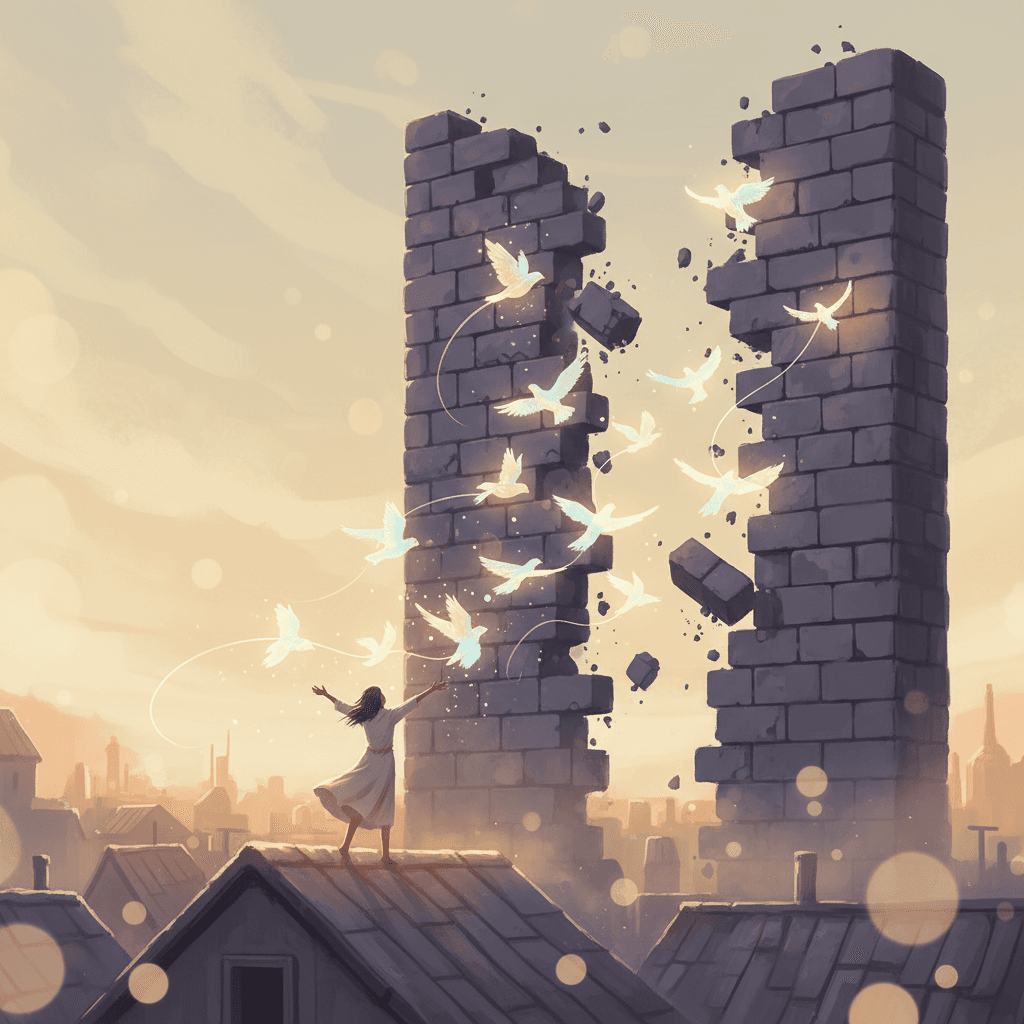
Carry a quiet rebellion of joy and let it dismantle doubt brick by brick — Gabriel García Márquez
—What lingers after this line?
The Power of a Soft Uprising
Gabriel García Márquez’s image of a “quiet rebellion of joy” invites us to imagine resistance that does not shout, but endures. Instead of anger or spectacle, this rebellion chooses delight, gratitude, and tenderness as its tools. It is quiet not because it is weak, but because it is persistent and hard to detect, like water slowly reshaping stone. In Márquez’s own novels, such as *One Hundred Years of Solitude* (1967), characters often endure hardship not by crushing it directly, but by preserving an inner flame of humor, love, or wonder that refuses to be extinguished. This quote distills that ethos into a simple, portable directive for daily life.
Joy as a Counterforce to Cynicism
From this perspective, joy becomes more than a passing emotion; it is a deliberate counterforce to cynicism and despair. While doubt whispers that nothing will change, joy insists that meaning can still be made, connections can still be forged, and beauty can still emerge from chaos. This does not deny suffering, but rather places it alongside small, stubborn acts of appreciation—a shared meal, a kind word, a moment of awe. Philosophers like Albert Camus, in *The Myth of Sisyphus* (1942), frame such defiant happiness as a form of revolt: the decision to affirm life even when absurdity looms large. Joy, then, becomes a stance—quiet, but unmistakably oppositional.
Dismantling Doubt Brick by Brick
The second half of the quote, with its image of dismantling doubt “brick by brick,” suggests that our inner fortresses of fear and skepticism rarely crumble all at once. Instead, they are gradually disassembled through repeated experiences that contradict their premises. Every time we allow ourselves a moment of unguarded joy—laughing freely, admiring a sunset, trusting in someone’s kindness—we loosen a stone in the wall. Psychological research on neuroplasticity shows something similar: repeated positive experiences can literally reshape neural pathways over time. Thus, Márquez’s metaphor is not merely poetic; it aligns with how the mind incrementally rewires itself away from chronic doubt toward cautious hope.
Daily Practices of Quiet Rebellion
Translating this idea into daily life means reframing ordinary actions as subtle acts of resistance. Choosing to listen attentively when distraction is easier, to savor a simple meal instead of rushing, or to compliment a stranger in a world primed for indifference—each becomes a small, insurgent gesture. These actions accumulate, much as García Márquez’s magical realist details accumulate to transform a plain village into a mythic landscape. Over time, such practices create a personal culture in which doubt loses its absolute authority. The rebellion remains quiet, but its effects are concrete: more patience, more generosity, and a sturdier sense of meaning that is harder for fear to erode.
Sustaining Hope in a Fractured World
Finally, seen against the backdrop of social turmoil and uncertainty, a quiet rebellion of joy takes on a communal dimension. When groups of people insist on celebrating life—through festivals, music, stories, or mutual aid—they contest narratives that reduce human beings to problems or statistics. García Márquez’s Colombia, marked by conflict and political instability, often found reflection in his work, where collective memory and shared festivity preserved dignity amid violence. In the same way, our own small circles of joy become shelters against collective doubt, demonstrating that hope is not naive optimism but a hard-won, shared practice that dismantles despair one brick at a time.
One-minute reflection
What feeling does this quote bring up for you?
Related Quotes
6 selectedWrite the small truths you can live by; they will outlast any storm. — Gabriel García Márquez
Gabriel García Márquez
Gabriel García Márquez’s line urges us to turn away from grand slogans and instead craft small, honest truths that can guide our daily lives. These are not sweeping ideologies but simple sentences that feel real when put...
Read full interpretation →When I hear somebody sigh, 'Life is hard,' I am always tempted to ask, 'Compared to what?' — Sydney J. Harris
Sydney J. Harris
Sydney J. Harris’s remark begins with an ordinary expression of fatigue: “Life is hard.” Yet his response, “Compared to what?” quietly turns complaint into inquiry.
Read full interpretation →Don't fight the challenges. Just find a new way to stand. — Germany Kent
Germany Kent
Germany Kent’s words begin with a quiet reversal of instinct: instead of treating every challenge as an enemy to defeat, she invites us to reconsider our posture toward difficulty. The emphasis is not on surrender, but o...
Read full interpretation →Optimist: someone who figures that taking a step backward after taking a step forward is not a disaster, it's more like a cha-cha. — Robert Brault
Robert Brault
Robert Brault’s line begins with a witty redefinition: an optimist is not someone who denies backward motion, but someone who interprets it differently. Instead of treating a setback as proof of failure, the optimist see...
Read full interpretation →A mind grows by staying with difficulty long enough for the experience to change it. — Mary Catherine Bateson
Mary Catherine Bateson
Mary Catherine Bateson’s observation begins with a quiet but demanding truth: the mind does not grow merely by encountering difficulty, but by remaining with it. Challenge becomes transformative only when we resist the u...
Read full interpretation →When you are friends with your storm, you dance, instead of getting blown away. — Michael Bassey Johnson
Michael Bassey Johnson
Michael Bassey Johnson’s line begins with a striking reversal: the storm is not merely an enemy to survive, but a force one can learn to understand. In this sense, the storm may represent grief, fear, conflict, uncertain...
Read full interpretation →More From Author
More from Gabriel García Márquez →No one should fear shadows. It simply means there's a light shining somewhere nearby. — Gabriel García Márquez
Gabriel García Márquez turns a common source of unease into a quiet reassurance: shadows are not threats in themselves, but evidence. When we fear shadows, we often respond to what is vague, enlarged, or half-seen—our mi...
Read full interpretation →Open one window of wonder each day and the light of possibility will rush in. — Gabriel García Márquez
García Márquez frames wonder not as a rare accident, but as something you can choose—one “window” at a time. The image suggests a small, deliberate action: a pause, a question, a moment of attention.
Read full interpretation →Persist like a river: find the cracks and flow through them. — Gabriel García Márquez
García Márquez’s image begins with something ordinary but unstoppable: a river. It doesn’t “win” by force or by arguing with the landscape; it keeps moving, day after day, and that continued motion becomes its power.
Read full interpretation →Imagine boldly, then write the first line with your feet. — Gabriel García Márquez
Gabriel García Márquez’s line, “Imagine boldly, then write the first line with your feet,” begins with an impossibility. No one literally writes with their feet, yet the image lingers because it challenges our sense of w...
Read full interpretation →