
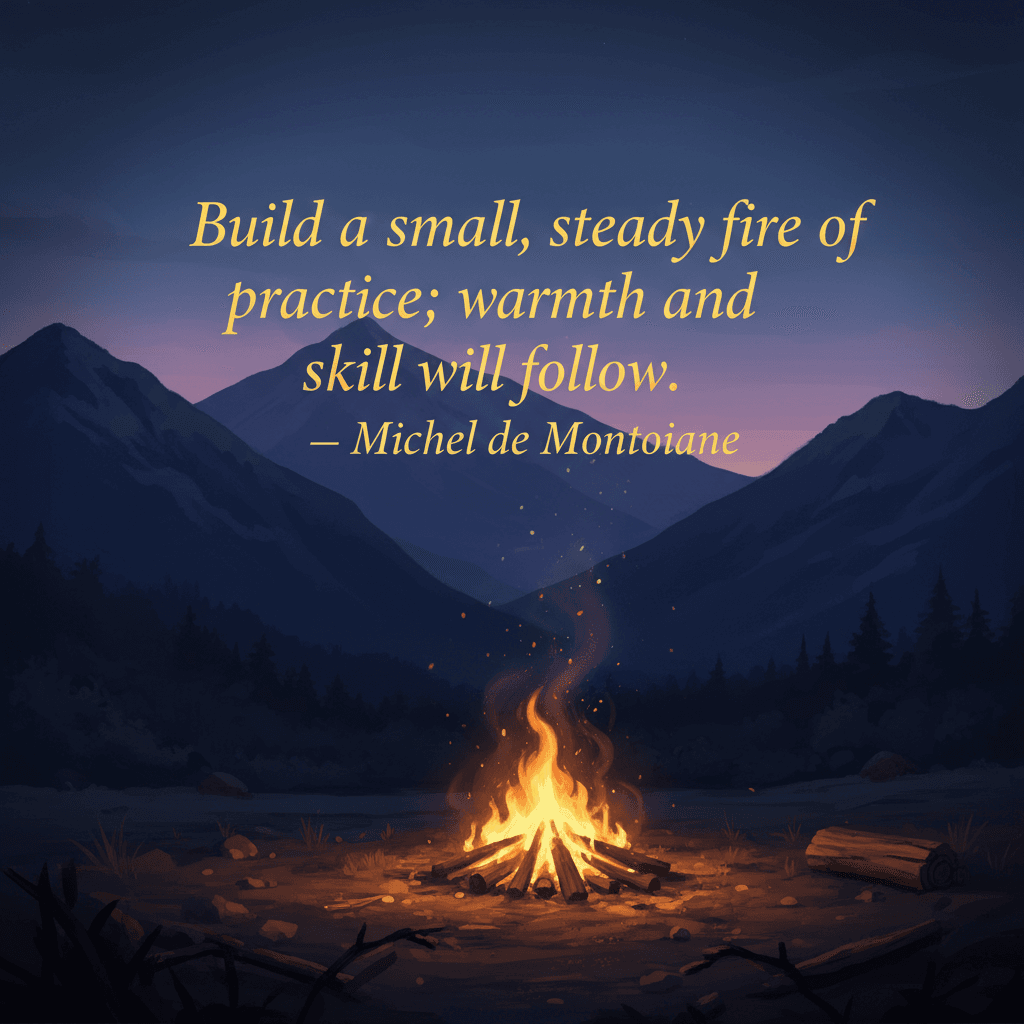
Build a small, steady fire of practice; warmth and skill will follow — Michel de Montaigne
—What lingers after this line?
The Image of a Quiet, Growing Fire
Montaigne’s line invites us to picture not a roaring blaze, but a modest campfire, patiently tended. This is his metaphor for practice: something that begins almost insignificantly, yet holds the potential to transform its surroundings. By asking us to “build a small, steady fire,” he shifts our focus from dramatic breakthroughs to humble beginnings. Just as a good fire starts with dry tinder and careful arrangement, meaningful learning starts with simple, repeatable actions. In his Essays (first published 1580), Montaigne repeatedly favors modest, daily effort over grand, sporadic gestures, suggesting that true change grows from continuity rather than spectacle.
Steadiness Over Intensity
Moreover, the key adjective in his image is “steady,” not “small.” A small fire that is consistent will outlast a huge bonfire that quickly burns out. In the same way, Montaigne subtly criticizes our fascination with intense but short-lived efforts—cram sessions, all-or-nothing resolutions, or sudden, unsustainable motivation. Instead, he praises a rhythm that can be kept. Ancient thinkers like Aristotle in the *Nicomachean Ethics* argued that virtue is built through repeated actions; Montaigne adapts this idea to everyday skill, implying that reliability of practice matters far more than its initial size or apparent power.
From Warmth to Comfort and Confidence
The promise that “warmth…will follow” highlights the first reward of sustained effort: a subtle change in how life feels. Warmth here suggests comfort, reassurance, and a sense of safety. When you return repeatedly to a practice—writing a paragraph, playing a scale, meditating for a few minutes—the activity gradually stops feeling foreign and threatening. Over time, it becomes a source of solace rather than stress. Montaigne, who often examined his own mind’s fluctuations, knew that familiarity breeds ease; as the fire grows, what once felt cold and inhospitable becomes a place where you can rest and think more clearly.
How Skill Emerges Almost Incidentally
Crucially, Montaigne claims that “skill will follow,” as if it arrives quietly, almost as a by-product of showing up. This reverses the usual order many people assume, where skill must come first before one feels worthy of practice. Instead, the small fire of effort precedes visible talent. A musician’s calloused fingers or a coder’s instinctive problem-solving emerge from hours of unremarkable repetition. As in the craftsmanship described by Richard Sennett in *The Craftsman* (2008), excellence is less a sudden gift and more the residue of long, attentive engagement. Montaigne’s phrasing reassures us that we do not need to chase mastery directly; we need only keep tending the flame.
Guarding the Fire: Patience and Protection
However, any small fire is fragile at first. A careless gust, a missed evening, or an impatient demand for results can snuff it out. Montaigne’s broader work warns against the human tendency to judge too quickly and give up when we do not see immediate progress. Protecting practice means lowering expectations at the outset and valuing the act itself more than the outcome. Just as one shields new flames with cupped hands, we can ring-fence brief, non-negotiable moments of practice from distraction and self-criticism. Over time, as habit sets in, the fire needs less protection; it begins to sustain itself, becoming a reliable source of both warmth and growing competence.
Living by the Fire: A Philosophy of Growth
Ultimately, Montaigne’s image is more than advice on learning; it is a philosophy of growth. Instead of chasing sudden transformations, he urges us to build lives organized around modest, repeating acts that slowly change who we are. The fire becomes a center: a daily writing desk, a morning walk, a quiet study corner. Around it, warmth expands into broader well-being, and skill branches into new opportunities. Like the reflective tone of his Essays, this quote suggests that genuine development is quiet, cumulative, and often unnoticed until one day we realize the room is lit, our hands are sure, and the small fire we once feared would go out now burns on its own.
One-minute reflection
What does this quote ask you to notice today?
Related Quotes
6 selectedThe most beloved deeds are small and consistent, even if they are few. — Proverb
Proverb
The proverb suggests that affection is rarely secured by a single grand gesture; instead, it is built through repeated, modest acts that quietly confirm care. A brief check-in, a reliably kept promise, or a simple help o...
Read full interpretation →Hold fast to the craft of showing up; mastery follows attendance. — Louise Erdrich
Louise Erdrich
To begin, Erdrich’s line reframes consistency as an art in its own right: showing up is not passive attendance but a practiced craft. It means engineering the conditions—time, place, and mental posture—that lower frictio...
Read full interpretation →Do the honest work of showing up; meaning is forged in repetition. — Toni Morrison
Toni Morrison
At the outset, Morrison’s injunction treats presence not as a feeling but as labor—the honest work of appearing even when inspiration hesitates. In practice, she modeled this ethic: writing before dawn, coffee at hand, w...
Read full interpretation →Learn to speak in actions as plainly as in words; consistency is a revolution — bell hooks
bell hooks
To begin, hooks’ aphorism compresses a demanding ethic: words can signal intent, but only repeated conduct makes meaning undeniable. To speak in actions is to let behavior carry the thesis, so that leadership, care, and...
Read full interpretation →There is no greater harm than that of time wasted. — Michel de Montaigne
Michel de Montaigne
Montaigne’s warning begins with a simple but unsettling truth: wasted time often feels harmless because it leaves no immediate wound. Unlike lost money or damaged property, it disappears quietly, making its harm easy to...
Read full interpretation →The challenge is not to build a perfect life, but to fortify the vessel that carries you through it. Master your own conduct, for that is your only true domain. — Michel de Montaigne
Michel de Montaigne
Montaigne’s insight shifts attention away from controlling the world and toward strengthening the self that must move through it. Life, in this view, is not a structure we can engineer into perfection, but a changing sea...
Read full interpretation →More From Author
More from Michel de Montaigne →There is no greater harm than that of time wasted. — Michel de Montaigne
Montaigne’s warning begins with a simple but unsettling truth: wasted time often feels harmless because it leaves no immediate wound. Unlike lost money or damaged property, it disappears quietly, making its harm easy to...
Read full interpretation →The challenge is not to build a perfect life, but to fortify the vessel that carries you through it. Master your own conduct, for that is your only true domain. — Michel de Montaigne
Montaigne’s insight shifts attention away from controlling the world and toward strengthening the self that must move through it. Life, in this view, is not a structure we can engineer into perfection, but a changing sea...
Read full interpretation →Our great and glorious masterpiece is to live appropriately. All other things—ruling, hoarding, building—are only little appendages and props. — Michel de Montaigne
Montaigne turns ordinary ambition upside down by declaring that the real work of a human life is not conquest, wealth, or reputation, but learning how to live properly. In this view, a good life is itself an achievement...
Read full interpretation →To compose our character is our duty, not to compose books, and to win, not battles and provinces, but order and tranquility in our conduct. — Michel de Montaigne
Montaigne redirects ambition away from public achievement and toward the difficult art of self-formation. At the heart of the quote is a striking reversal: the true work of a human life is not producing admired objects,...
Read full interpretation →