
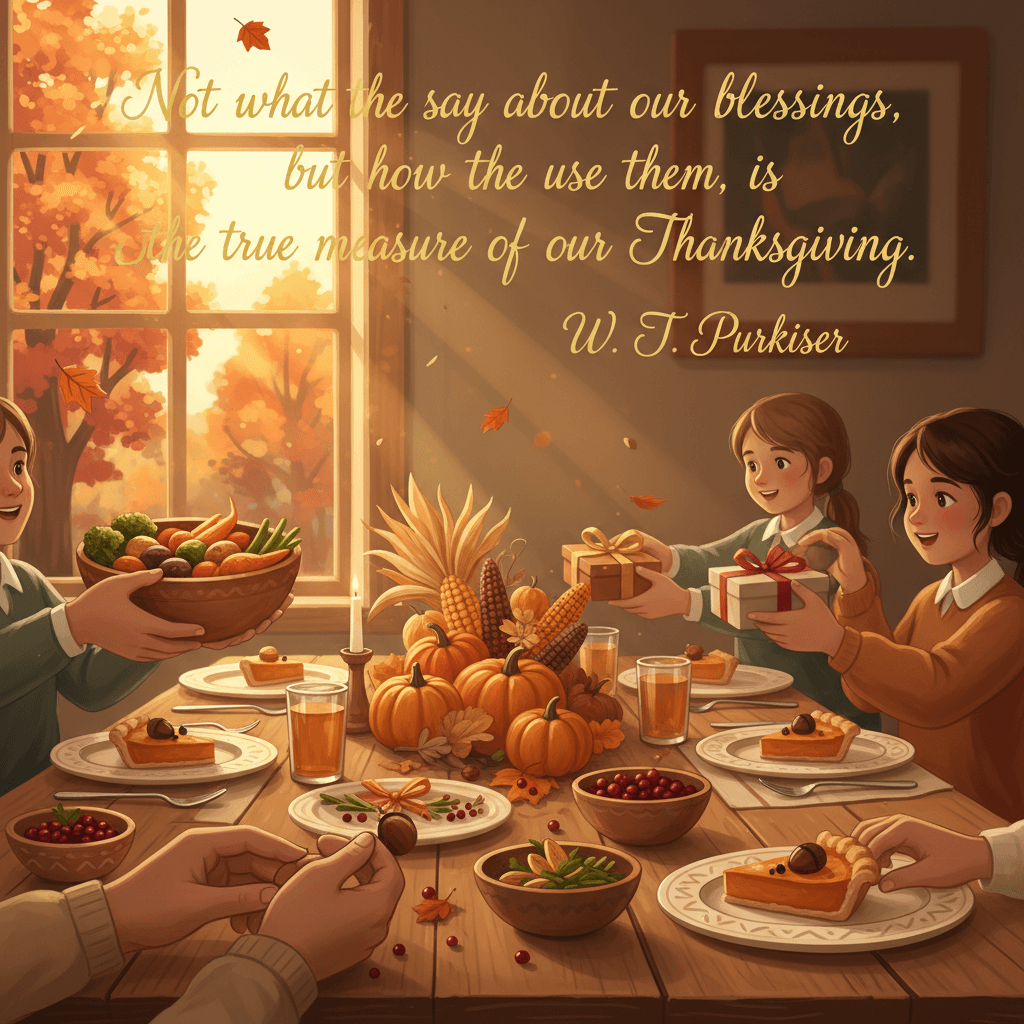
Not what we say about our blessings, but how we use them, is the true measure of our Thanksgiving. — W. T. Purkiser
—What lingers after this line?
From Words of Thanks to Acts of Gratitude
W. T. Purkiser’s quote shifts the focus of Thanksgiving from spoken appreciation to practical application. Rather than treating gratitude as a season of polite words or ceremonial prayers, he suggests that its real weight is found in what we do with what we have. In this way, Thanksgiving becomes less about reciting lists of blessings and more about letting those blessings reshape our daily conduct.
The Limits of Verbal Gratitude
To understand this shift, it helps to recognize the limits of words alone. Expressions like “I’m thankful for my health” or “I’m grateful for my job” are meaningful, yet they can remain superficial if they never stir us to action. Just as the Epistle of James notes that “faith without works is dead” (James 2:17), Purkiser implies that gratitude without deeds is hollow. Words may reveal our intentions, but they do not, by themselves, transform our character or our communities.
Blessings as Responsibilities, Not Just Rewards
Seen through Purkiser’s lens, blessings are not merely rewards to be enjoyed; they are responsibilities to be stewarded. Wealth, for example, becomes an opportunity for generosity rather than a private comfort. Likewise, education turns into a tool for service, and free time becomes a chance to encourage or assist others. This perspective parallels the parable of the talents in the New Testament (Matthew 25:14–30), where gifts entrusted to individuals are meant to be invested and multiplied, not buried or hoarded.
Thanksgiving as a Year-Round Practice
By redefining the measure of Thanksgiving, Purkiser also extends it beyond a single holiday. If gratitude is measured by how blessings are used, then every ordinary day becomes a test of our thankfulness. The question shifts from “What am I thankful for this Thursday in November?” to “How did I employ my resources, skills, and opportunities this week?” Thus, Thanksgiving turns into a continuous posture of life, where daily decisions silently testify to our appreciation.
Living Out Gratitude in Concrete Ways
Finally, Purkiser’s insight invites tangible expressions of thanks. A person grateful for family might invest more time and attention in relationships; someone thankful for food security might support local pantries or reduce waste. Even small, consistent actions—mentoring a younger colleague, volunteering, or sharing knowledge—become quiet proofs of sincere thanksgiving. In linking gratitude to use, Purkiser calls us to let our lives, more than our language, reveal how deeply we value what we have been given.
One-minute reflection
What does this quote ask you to notice today?
Related Quotes
6 selectedThe root of joy is gratefulness. It is not what we say about our blessings, but how we use them. — David Steindl-Rast
Rast
This quote highlights that joy stems from a sense of gratitude. By appreciating what we have and recognizing the goodness in our lives, we cultivate a deep inner happiness.
Read full interpretation →A farmer is helpless to grow grain; all he can do is provide the right conditions for the growing of grain. — Richard J. Foster
Richard J. Foster
At first glance, Foster’s farming metaphor shifts attention away from control and toward humility. A farmer cannot command a seed to sprout, just as a person cannot force true growth—whether spiritual, personal, or relat...
Read full interpretation →Stop begging God to increase your territory when you can't even maintain the territory you already have. — Iyanla Vanzant
Iyanla Vanzant
At its core, Iyanla Vanzant’s statement confronts a common contradiction: people often ask for more influence, wealth, opportunity, or responsibility before proving they can care for what is already in their hands. In th...
Read full interpretation →It is not our part here to take thought only for a season, or for a few lives of men, or for a passing age of the world. — J.R.R. Tolkien
J.R.R. Tolkien
At its core, Tolkien’s line rejects narrow, short-term thinking. He urges us to look beyond a single season, a generation, or even an era, and to measure our actions against a far larger horizon.
Read full interpretation →Ours is not the task of fixing the entire world all at once, but of stretching out to mend the part of the world within our reach. — Clarissa Pinkola Estés
Clarissa Pinkola Estés
Clarissa Pinkola Estés begins by stripping away the fantasy of total repair. The quote quietly challenges the heroic impulse to “fix everything,” suggesting that such ambition can become a form of avoidance—grand, exhaus...
Read full interpretation →Keep a quiet steadiness; storms pass and the ground still needs tending. — Thich Nhat Hanh
Thich Nhat Hanh
Thich Nhat Hanh’s line frames life as a field and our responsibilities as ongoing tending of the ground. The storms represent crises, conflicts, or emotional upheavals that feel all-consuming in the moment.
Read full interpretation →More From Author
More from W. T. Purkiser →