
From Problem to Purpose Through Stoic Courage
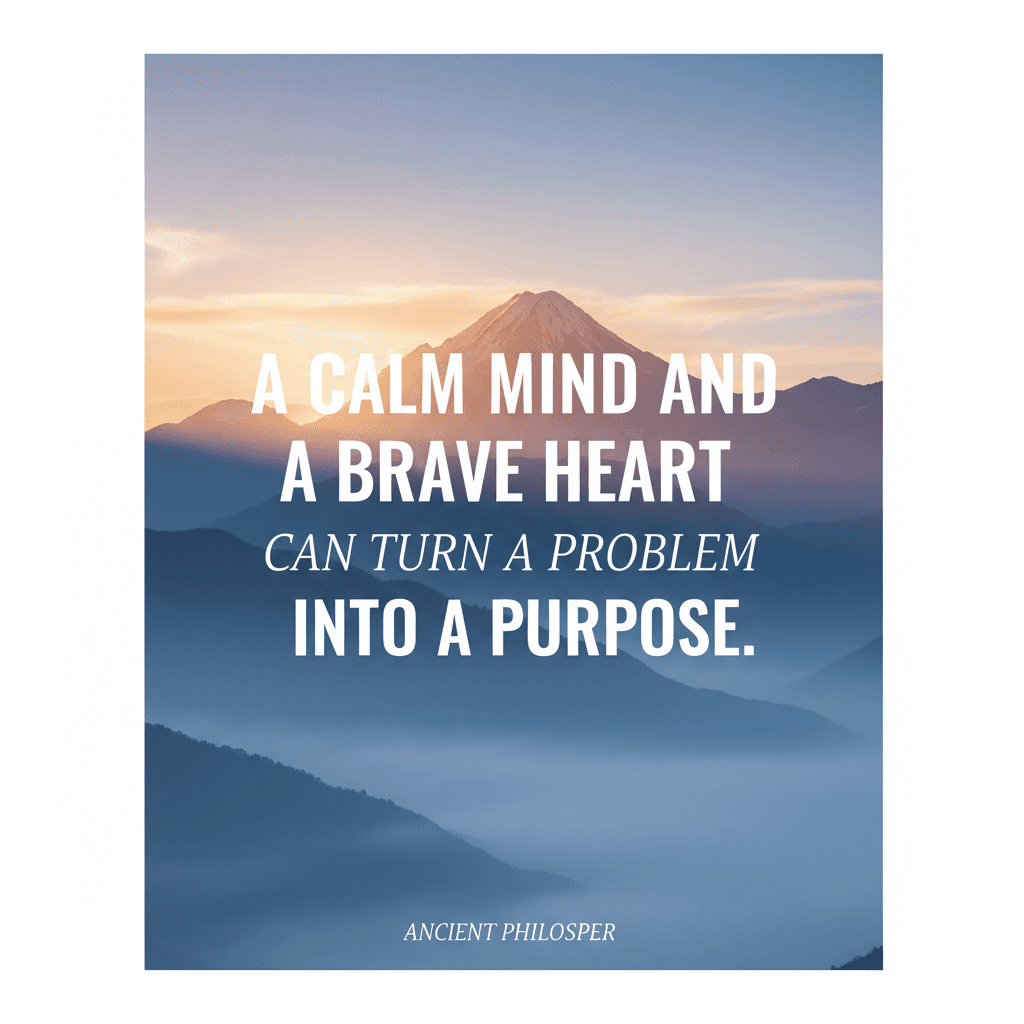
A calm mind and a brave heart can turn a problem into a purpose. — Marcus Aurelius
—What lingers after this line?
Seeing Problems as Potential Purposes
This statement, attributed to Marcus Aurelius, distills a central Stoic insight: our greatest difficulties can become the raw material for a meaningful life. Rather than treating problems as dead ends, it suggests they can be transformed into purposes—ongoing, guiding missions that shape who we are. This shift is not about denying hardship; instead, it reframes obstacles as opportunities to exercise and refine our character, turning passive suffering into active direction.
The Power of a Calm Mind
The first ingredient in this transformation is a calm mind. Marcus often wrote in his *Meditations* (c. 170 CE) that the mind’s judgment, not events themselves, disturbs us. When we cultivate inner stillness, we create enough distance to observe a problem without panic or denial. This composure allows us to separate the facts from our fears, to see what is truly within our control, and to identify constructive responses instead of reacting impulsively.
Why a Brave Heart Is Essential
Yet clarity alone is not enough; a brave heart must act on what a calm mind perceives. Courage, in the Stoic sense, is not fearlessness but the willingness to move forward despite fear or uncertainty. Marcus Aurelius ruled during plagues and wars, and his writings reveal a steady insistence on doing his duty regardless of personal discomfort. Such bravery turns insight into action, allowing us to step toward difficult tasks rather than shrinking from them.
The Alchemy of Turning Pain Into Purpose
When calm perception combines with courageous action, something like alchemy occurs: pain can be channeled into purpose. A personal setback, for instance, might inspire someone to mentor others facing similar challenges, much as many recovery groups transform individual struggles into communal support. This echoes Viktor Frankl’s argument in *Man’s Search for Meaning* (1946), where meaning arises not in spite of suffering but through the stance we take toward it.
Living the Stoic Lesson Day by Day
Ultimately, this idea is less a slogan than a daily practice. Each time we pause to steady our mind before responding, and then choose the brave action rather than the easy escape, we rehearse the Stoic lesson Marcus embodied. Over time, recurring problems—stressful work, health challenges, strained relationships—can become the arenas in which we practice our chosen purpose: to act with wisdom, courage, and service, no matter what confronts us.
Recommended Reading
One-minute reflection
What feeling does this quote bring up for you?
Related Quotes
6 selectedMaster yourself steadily; the calm within moves mountains without. — Marcus Aurelius
Marcus Aurelius
Marcus Aurelius’ line condenses a Stoic program into a single image: mastery is not sudden conquest but steady training, and its power comes from an inner calm that does not need to announce itself. Rather than urging do...
Read full interpretation →Master yourself and the world becomes a single field for your purpose. — Marcus Aurelius
Marcus Aurelius
Marcus Aurelius’ line distills a central Stoic promise: the surest form of influence begins inside. Rather than chasing control over people, events, or outcomes, he points to mastery of one’s own judgments, impulses, and...
Read full interpretation →When you begin with purpose, the distant horizon rearranges itself into reachable ground. — Marcus Aurelius
Marcus Aurelius
Marcus Aurelius frames purpose not as a final achievement but as a starting posture: when you begin with a clear “why,” the shape of everything that follows changes. In Stoic terms, intention organizes attention, and att...
Read full interpretation →Stand where your purpose meets patience, and the world will learn your footsteps. — Marcus Aurelius
Marcus Aurelius
The line frames a precise meeting point: purpose gives direction, while patience gives duration. By telling you to “stand where” they meet, it implies a disciplined stillness—not passivity, but a refusal to be blown off...
Read full interpretation →Stand steady in reason, and storms will pass through your calm. — Marcus Aurelius
Marcus Aurelius
Marcus Aurelius frames life’s upheavals as storms—loud, forceful, and temporary—while portraying the mind as a place that can remain undisturbed. The line hinges on a subtle inversion: the goal is not to stop the storm,...
Read full interpretation →Temper your impulses with purpose; quiet resolve moves empires. — Marcus Aurelius
Marcus Aurelius
Marcus Aurelius, writing in his private journal later known as the *Meditations* (c. 170–180 CE), constantly urged himself to curb sudden reactions and act in accordance with reason.
Read full interpretation →More From Author
More from Marcus Aurelius →You always have the power to have no opinion. Things are not asking to be judged by you. — Marcus Aurelius
Marcus Aurelius frames restraint not as passivity but as power: you can refuse to manufacture an opinion on demand. In Stoic terms, this is a way of protecting the mind’s autonomy, because what disrupts us is often not t...
Read full interpretation →Most of what we say and do is not essential. If you can eliminate it, you will have more time and more tranquility. — Marcus Aurelius
Marcus Aurelius proposes a surprisingly practical path to peace: remove what isn’t essential. Rather than urging us to add better habits, he points to the calmer power of subtraction—speaking less, reacting less, doing l...
Read full interpretation →Receive without conceit, release without struggle. — Marcus Aurelius
Marcus Aurelius compresses an entire discipline into two movements: take what arrives without ego, and let what departs go without resistance. The first clause challenges the impulse to treat gifts—praise, luck, status—a...
Read full interpretation →Be tolerant with others and strict with yourself. — Marcus Aurelius
Marcus Aurelius’ line distills a practical Stoic posture: meet other people with patience, while holding your own choices to a demanding standard. Rather than encouraging moral superiority, it reverses a common impulse—j...
Read full interpretation →