
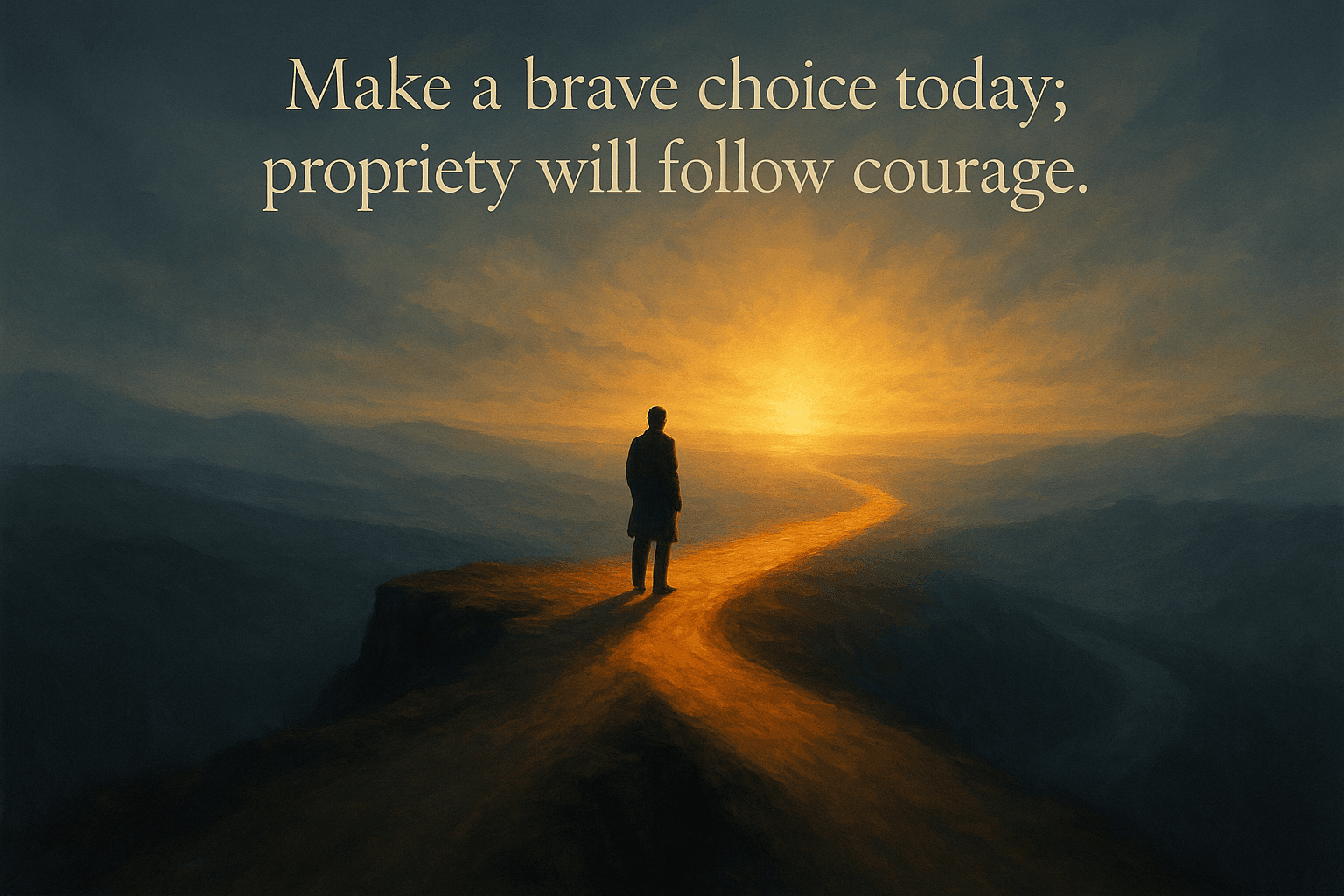
Make a brave choice today; propriety will follow courage. — Jane Austen
—What lingers after this line?
Courage Before Convention
Austen’s line urges a reversal of the usual order: instead of asking what is proper and then acting, she suggests acting bravely and trusting that propriety will align in time. In other words, moral backbone, not social approval, should lead. This reflects a deeper claim that true integrity is often ahead of its era, while rules and customs tend to lag behind human conscience.
Austen’s World of Rules and Risks
Placed against the backdrop of Regency England, the statement becomes even sharper. Austen wrote in a society bound by etiquette—on class, gender, and marriage. Within that tight framework, her heroines repeatedly risk disapproval to do what is right. Consequently, the quote reads less like a gentle maxim and more like a quiet rebellion against letting rigid social codes dictate one’s character.
Heroines Who Step Out of Line
Throughout Austen’s novels, characters embody this principle. Elizabeth Bennet in *Pride and Prejudice* refuses Mr. Collins’s proposal despite immense pressure, choosing self-respect over financial security. Likewise, Elinor and Marianne in *Sense and Sensibility* navigate love by listening first to conscience. Initially, their choices seem improper to others, yet by the end, their courage appears not only justified but exemplary, and social opinion adjusts around them.
From Social Approval to Moral Propriety
The quote also distinguishes between two types of propriety: mere conformity and genuine moral rightness. Austen hints that when courage is guided by a well-formed conscience—rather than by impulse—what looks shocking at first may later be recognized as the truly proper course. Thus, propriety is not abandoned; it is refined and elevated by brave action, revealing which customs deserve to survive.
Living the Principle Today
Applied to modern life, Austen’s insight encourages principled risk-taking: reporting misconduct at work, ending an unhealthy relationship, or defending an unpopular truth. Such choices may appear improper within a given group’s norms. Yet, as with Austen’s characters, time often vindicates those who lead with courage. By acting bravely first—and thoughtfully—individuals help reshape what their communities eventually come to regard as proper and just.
One-minute reflection
What feeling does this quote bring up for you?
Related Quotes
6 selectedConfidence is not pretending you're fearless. It's walking straight into fear and realizing it doesn't own you. — Emma Watson
Emma Watson
At first glance, Emma Watson’s quote challenges a common misunderstanding: confidence is not the absence of fear. Many people imagine confident individuals as naturally bold, untouched by doubt or anxiety.
Read full interpretation →To be courageous is to act with the heart. — Molière
Molière
Molière’s line suggests that courage is not merely the absence of fear, but the decision to move despite it. By connecting courage with the heart, he frames bravery as an emotional and moral act rather than a simple disp...
Read full interpretation →The best people possess a feeling for beauty, the courage to take risks, the discipline to tell the truth, the capacity for sacrifice. — Ernest Hemingway
Ernest Hemingway
Hemingway’s line presents goodness not as politeness or success, but as a demanding inner code. The “best people” are those who combine sensitivity, bravery, honesty, and self-denial—qualities that do not always coexist...
Read full interpretation →If you are not willing to look stupid, nothing great is ever going to happen to you. — Julia Cameron
Julia Cameron
Julia Cameron’s remark begins with a hard truth: many people do not fail because they lack talent, but because they fear embarrassment. In that sense, ‘looking stupid’ becomes shorthand for being seen trying, stumbling,...
Read full interpretation →You don't have to bully yourself out of feeling fear. You just have to move while it's still there. — Annie Wright
Annie Wright
At its core, Annie Wright’s quote challenges the common belief that courage begins only after fear has disappeared. Instead, it reframes fear as something that can accompany action rather than prevent it.
Read full interpretation →For what matters in life is not whether we receive a round of applause; what matters is whether we have the courage to venture forth despite the uncertainty of acclaim. — Amor Towles
Amor Towles
At its core, Amor Towles shifts attention away from public approval and toward private resolve. The quote argues that a life’s value is not determined by applause—those visible signs of recognition—but by the willingness...
Read full interpretation →More From Author
More from Jane Austen →We must all do what we can to help one another. — Jane Austen
At first glance, Jane Austen’s line sounds modest, yet its moral force is striking: each person carries some responsibility for the well-being of others. The phrase “what we can” is especially important, because it does...
Read full interpretation →There is nothing like staying at home for real comfort. — Jane Austen
At first glance, Jane Austen’s line seems simple, yet its force lies in its calm certainty: no pleasure, status, or novelty quite matches the comfort of home. Rather than praising luxury, she points to a deeper ease—the...
Read full interpretation →True luxury is not about excess, but the absence of stress and the presence of soul in your surroundings. — Jane Austen
At first glance, luxury is often associated with abundance, ornament, and visible wealth. Yet this quote reframes the idea entirely, suggesting that genuine richness lies not in excess but in relief: a life with less str...
Read full interpretation →Arrange kindness like stars in the sky; it will guide your nights. — Jane Austen
Jane Austen’s line turns kindness into a celestial image: small points of light arranged with intention, bright enough to matter when the world goes dark. By choosing “stars,” she implies that kindness is not a single gr...
Read full interpretation →