
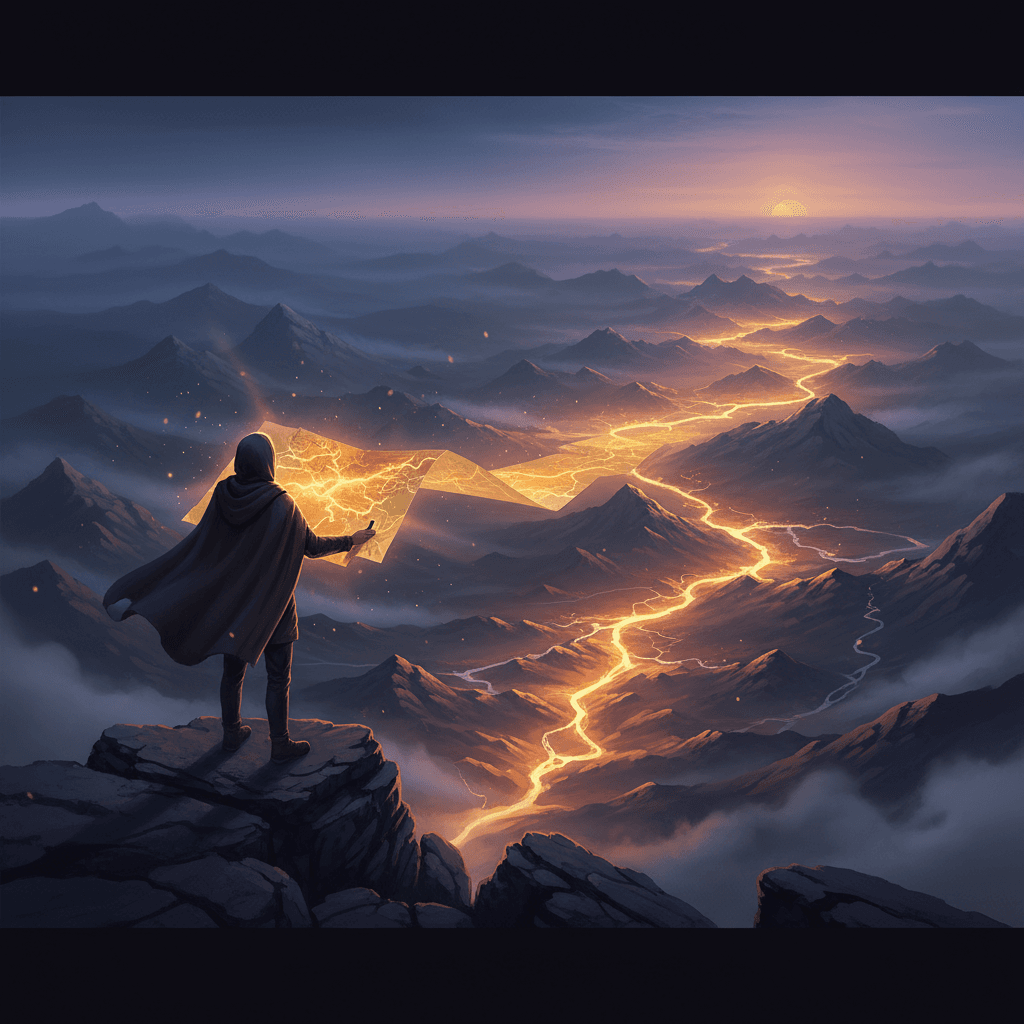
Map your own territory; the unknown becomes familiar through careful passage. — Jorge Luis Borges
—What lingers after this line?
Claiming Ownership of Your Inner Landscape
Borges’s invitation to “map your own territory” urges each person to become the cartographer of their life. Rather than inheriting second‑hand maps—social expectations, family scripts, or conventional success stories—he suggests drawing one’s own. This territory is not just physical space but also the inner landscape of fears, desires, and ideas. By framing life as a mapping project, Borges shifts us from passive travelers to active explorers of meaning. In this sense, the quote echoes the spirit of Montaigne’s essays (1580), which explored the self as a world worthy of study. Yet Borges adds a distinctly modern twist: the true frontier lies not out there but within, where our perceptions and choices gradually define the borders of who we are.
The Unknown as a Living, Shifting Frontier
Having established that our primary task is self‑mapping, the quote then turns toward “the unknown.” For Borges, whose stories like “The Library of Babel” (1941) revel in infinite possibility, the unknown is not a void to fear but a frontier that keeps expanding. However, it resists instant comprehension; it can only be approached. By calling it “territory,” he implies that the unknown is not chaos but simply land not yet walked. This reframing is crucial: what scares us is often not danger itself but vagueness. When we see the unknown as unmapped rather than unknowable, curiosity gains a foothold and anxiety loses some of its power.
Careful Passage as a Method of Transformation
The phrase “careful passage” provides the method by which the unknown becomes familiar. Borges does not celebrate reckless leaps or blind faith; instead, he advocates deliberate movement—small, attentive steps through uncertainty. Just as early navigators in the Age of Discovery hugged coastlines and recorded every bay and shoal, we too transform confusion into knowledge by moving slowly enough to notice patterns. This patient approach recalls the scientific method: observation, hypothesis, test, revision. It also echoes Buddhist walking meditation, where mindfulness of each step gradually reveals the terrain of one’s own mind. The transformation is mutual: as we traverse the unknown, not only does the territory become clearer, but our capacity for perception deepens.
From Fearful Mystery to Familiar Ground
Through this careful passage, the quote suggests, the unknown “becomes familiar.” This does not mean it grows trivial; rather, it becomes navigable. A forest that once seemed menacing feels different when we’ve traced paths, learned the sounds of its animals, and marked reliable shelters. Similarly, new careers, relationships, or intellectual pursuits start as opaque thickets and slowly turn into recognizable routes and landmarks. Plato’s allegory of the cave in the *Republic* portrays a dramatic version of this process: the painful adjustment to light eventually yields clarity. Borges captures the more everyday version—how repeated, mindful crossings turn first‑time terrors into second‑nature habits, allowing confidence to replace dread.
The Endless Redrawing of Personal Maps
Finally, Borges’s metaphor hints that mapping is never finished. Territories shift, we age, cultures change, and what was once safe ground can become strange again. Consequently, maps must be revised. In works like “Of Exactitude in Science” (1946), Borges playfully imagines a map as large as the empire it describes, exposing the absurdity of perfect representation. Likewise, our self‑maps are always partial, always provisional. Recognizing this keeps us humble and adaptable: the goal is not to possess a flawless chart, but to remain a skilled, attentive mapper. The more we accept this, the more we can greet each new region of life not as a threat, but as another chance for careful passage and expanding familiarity.
One-minute reflection
Why might this line matter today, not tomorrow?
Related Quotes
6 selectedWalk toward the unknown with hands open; discovery favors the willing — Rabindranath Tagore
Rabindranath Tagore
Tagore’s line begins with a deceptively simple image: walking toward the unknown with hands open. This posture suggests not only physical movement but also an inner stance of receptivity.
Read full interpretation →Explore what frightens you; beyond fear lies a clearer map of who you can be. — Carl Jung
Carl Jung
Often attributed to Carl Jung, the line invites us to treat fear not as a wall but as a directional signal. What unsettles us marks borders between what is known and what remains unlived—ambitions deferred, truths unspok...
Read full interpretation →Create a map of wonder, then travel beyond the edges. — Kahlil Gibran
Kahlil Gibran
Gibran’s line entwines two impulses: to name what astonishes us and to step past what names can hold. A map of wonder gathers the contours of what moves us—places, questions, encounters—so that we are oriented rather tha...
Read full interpretation →You will never be able to experience everything. So, please, do poetical justice to your soul and simply experience yourself. — Albert Camus
Albert Camus
Camus begins from a humbling truth: no person can live every possible life, see every landscape, or test every path. Because existence is finite, the dream of total experience becomes a source of restlessness rather than...
Read full interpretation →Build maps of your thoughts and then walk into the places they reveal. — Jorge Luis Borges
Jorge Luis Borges
Borges’s invitation to “build maps of your thoughts” suggests that our inner life is not a formless fog but a terrain that can be charted. Like a cartographer sketching coastlines and mountains, we can trace recurring id...
Read full interpretation →You cannot express something you have not first discovered. — Carl Jung
Carl Jung
At its core, Jung’s remark suggests that authentic expression begins not with performance but with discovery. A person cannot meaningfully speak, create, or reveal what has never been encountered within the self.
Read full interpretation →More From Author
More from Jorge Luis Borges →Claim the page of your life with honest strokes, and color it without apology. — Jorge Luis Borges
Borges’ image of a “page” invites us to see life not as a fixed script but as something still being written. Rather than a completed book, our days resemble blank or half-filled pages, open to revision and fresh lines.
Read full interpretation →Build maps of your thoughts and then walk into the places they reveal. — Jorge Luis Borges
Borges’s invitation to “build maps of your thoughts” suggests that our inner life is not a formless fog but a terrain that can be charted. Like a cartographer sketching coastlines and mountains, we can trace recurring id...
Read full interpretation →Every person who passes through our life is unique. They always leave a bit of themselves and take a bit of us with them. - Jorge Luis Borges
This quote highlights the idea that every person we encounter in life impacts us in some way. There is an exchange of experiences, emotions, and memories that leaves a lasting imprint on both individuals.
Read full interpretation →One can’t choose their battlefield, but one can choose their weapons. — Jorge Luis Borges
This quote highlights that life often presents us with challenges and situations that are beyond our control. We may not get to choose the circumstances we face, but we can decide how we respond to them.
Read full interpretation →