
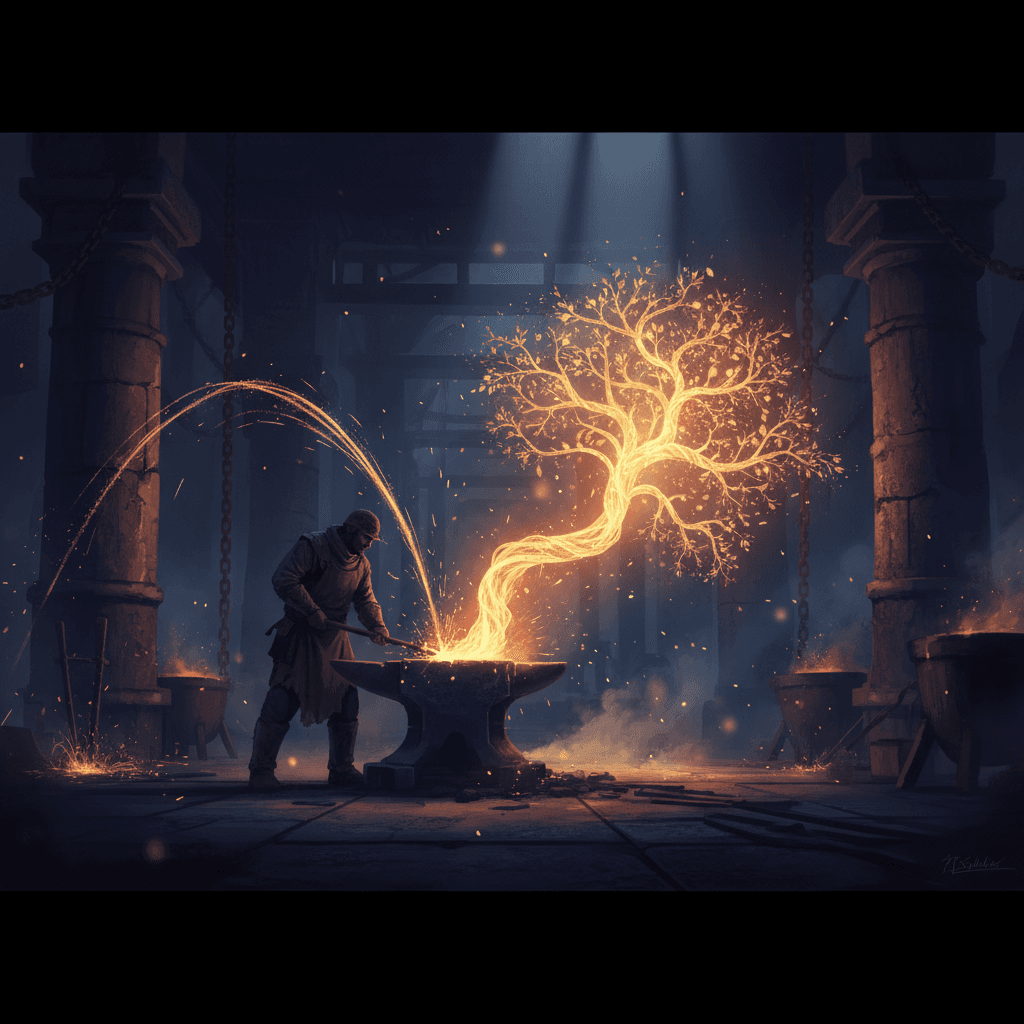
Forge meaning from challenge; it is the raw ore of growth. — Viktor E. Frankl
—What lingers after this line?
Challenge as Life’s Raw Material
Viktor E. Frankl’s line casts challenge as “raw ore,” suggesting that hardship is not an accident at the margins of life but the crude material from which our character is forged. Just as unrefined mineral holds latent value, difficulties contain undeveloped possibilities. Rather than treating suffering as merely something to avoid, Frankl invites us to see it as the starting point of transformation, much like a mine is the starting point of a precious metal’s journey.
Frankl’s Perspective from the Camps
This metaphor gains weight when rooted in Frankl’s own biography. In *Man’s Search for Meaning* (1946), he recounts surviving Nazi concentration camps, where deprivation and loss were absolute. Yet he argues that even there, people could choose their attitude and discover purpose in service, love, or dignity. Thus, his claim about forging meaning is not an abstract slogan; it emerges from observing how some prisoners used extreme challenge as the very context in which to grow morally and spiritually.
The Inner Forge: Will and Interpretation
If challenge is ore, then our interpretive will is the forge. Frankl’s logotherapy rests on the idea that humans are driven by a “will to meaning,” not just pleasure or power. We cannot always control the blows life delivers, but we can determine what those blows come to signify. Through reflection, choice, and responsibility, we heat and hammer raw experiences into coherent narratives, turning “Why me?” into “What now?” and “How can I respond?”
Growth Through Purposeful Response
Once challenge is reinterpreted as material rather than mere misfortune, growth becomes possible. People who lose a job and then retrain, or who face illness and subsequently advocate for patients, exemplify this alchemy. Their circumstances did not automatically ennoble them; instead, they actively transformed pain into purpose. This shift echoes Frankl’s insistence that meaning is discovered in concrete tasks, loving relationships, and courageous stances—not in suffering itself, but in how we respond to it.
Choosing Meaning in an Uncertain World
Finally, Frankl’s insight offers a compass for an unpredictable world. Since we cannot eliminate all hardship, our freedom lies in deciding what it will mean. By approaching each trial as ore awaiting refinement, we acknowledge both life’s harshness and our agency. In doing so, we turn passive endurance into active authorship, crafting a self that is not merely shaped by adversity but strengthened and clarified through it.
One-minute reflection
What does this quote ask you to notice today?
Related Quotes
6 selectedThe meaning of life is to give life meaning. — Viktor E. Frankl
Viktor E. Frankl
At first glance, Frankl’s line turns a timeless question inside out. Instead of treating meaning as a hidden answer waiting to be discovered, he suggests that meaning emerges through our response to life itself.
Read full interpretation →When I hear somebody sigh, 'Life is hard,' I am always tempted to ask, 'Compared to what?' — Sydney J. Harris
Sydney J. Harris
Sydney J. Harris’s remark begins with an ordinary expression of fatigue: “Life is hard.” Yet his response, “Compared to what?” quietly turns complaint into inquiry.
Read full interpretation →Don't fight the challenges. Just find a new way to stand. — Germany Kent
Germany Kent
Germany Kent’s words begin with a quiet reversal of instinct: instead of treating every challenge as an enemy to defeat, she invites us to reconsider our posture toward difficulty. The emphasis is not on surrender, but o...
Read full interpretation →Optimist: someone who figures that taking a step backward after taking a step forward is not a disaster, it's more like a cha-cha. — Robert Brault
Robert Brault
Robert Brault’s line begins with a witty redefinition: an optimist is not someone who denies backward motion, but someone who interprets it differently. Instead of treating a setback as proof of failure, the optimist see...
Read full interpretation →A mind grows by staying with difficulty long enough for the experience to change it. — Mary Catherine Bateson
Mary Catherine Bateson
Mary Catherine Bateson’s observation begins with a quiet but demanding truth: the mind does not grow merely by encountering difficulty, but by remaining with it. Challenge becomes transformative only when we resist the u...
Read full interpretation →When you are friends with your storm, you dance, instead of getting blown away. — Michael Bassey Johnson
Michael Bassey Johnson
Michael Bassey Johnson’s line begins with a striking reversal: the storm is not merely an enemy to survive, but a force one can learn to understand. In this sense, the storm may represent grief, fear, conflict, uncertain...
Read full interpretation →More From Author
More from Viktor E. Frankl →The meaning of life is to give life meaning. — Viktor E. Frankl
At first glance, Frankl’s line turns a timeless question inside out. Instead of treating meaning as a hidden answer waiting to be discovered, he suggests that meaning emerges through our response to life itself.
Read full interpretation →Turn the weight of doubt into the engine of your learning. — Viktor E. Frankl
Frankl’s line reframes doubt from a symptom of weakness into a signal that something matters enough to examine. Rather than treating uncertainty as an obstacle, he invites us to see it as the first honest step in underst...
Read full interpretation →Even in the narrowest room, choose freedom by how you meet the day — Viktor E. Frankl
Frankl’s line begins with a stark image: the “narrowest room,” a place of constraint where choice seems to shrink to nothing. Yet he immediately pivots to a counterclaim—that freedom can still be chosen—not by changing t...
Read full interpretation →Choose one honest act and build a life from it. — Viktor E. Frankl
Frankl’s line treats integrity not as a vague trait but as a concrete starting point: one honest act solid enough to build on. Instead of waiting for a grand moral transformation, he suggests choosing a single moment of...
Read full interpretation →