
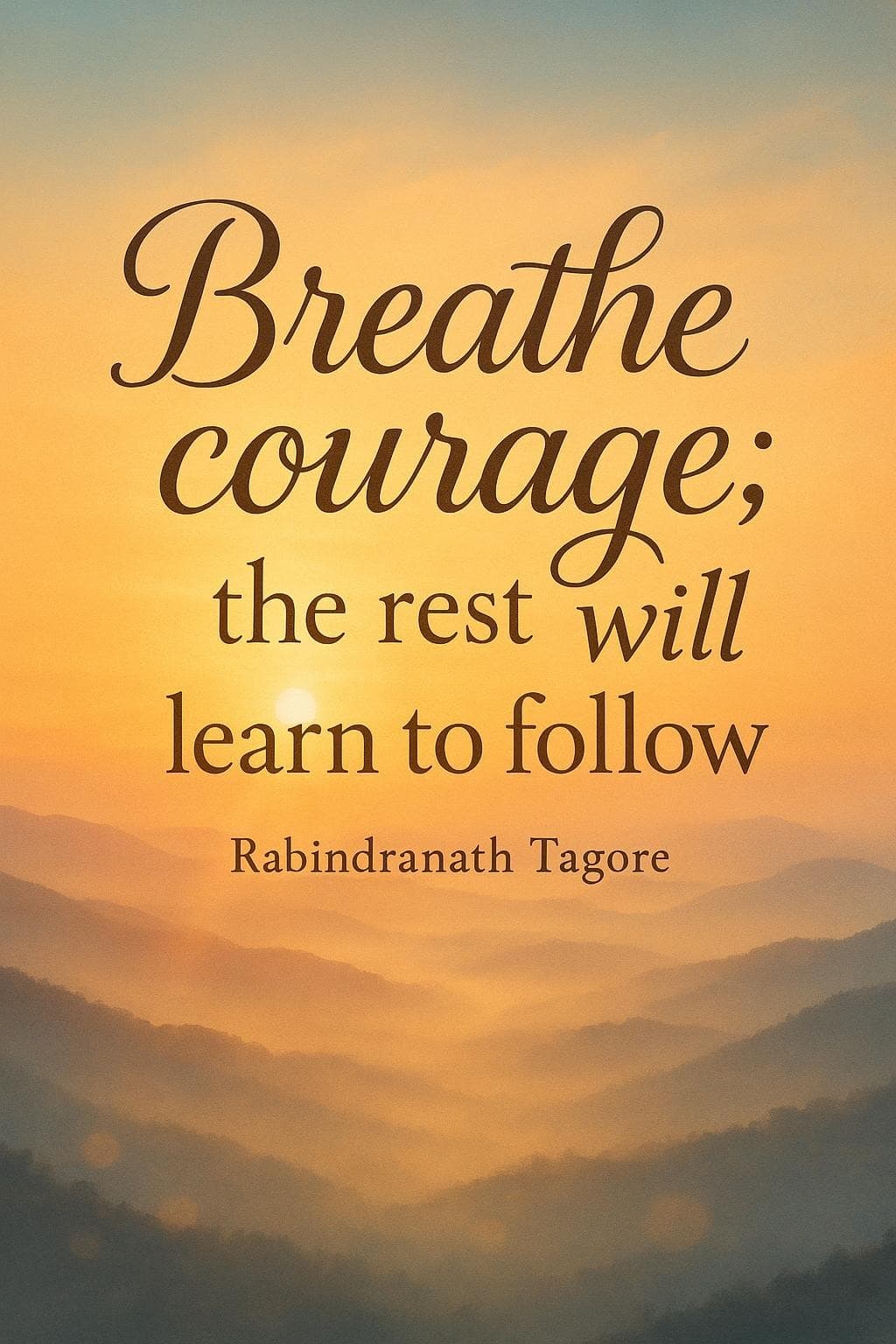
Breathe courage; the rest will learn to follow — Rabindranath Tagore
—What lingers after this line?
Courage as a First, Inner Movement
Tagore’s line, “Breathe courage; the rest will learn to follow,” begins with the intimate image of breath. By tying courage to something as fundamental as breathing, he suggests it is not an external add‑on but a primary inner movement. Just as breath sustains the body, courage sustains meaningful action. This framing shifts bravery from grand heroics to a quiet, constant readiness—an attitude we carry into every decision, however small.
From Inner Resolve to Outer Action
Once courage is taken in like air, Tagore implies that outer behaviors naturally rearrange themselves. Decisions that once felt paralyzing become manageable, not because circumstances change, but because our stance toward them has changed. In this way, the “rest” that follows—our words, choices, and habits—are downstream of an inner resolve. The transformation begins invisibly in the heart and only later becomes visible in our actions, much as roots grow before leaves appear.
Learning and Habit: Why ‘The Rest’ Follows
By saying the rest will ‘learn’ to follow, Tagore subtly invokes the psychology of habit. Behaviorists such as B. F. Skinner argued that repeated actions shape patterns over time; Tagore anticipates this by casting courage as the starting cue. When we consistently choose the brave option, our skills, confidence, and even our environment adapt in response. Over time, what was once a trembling first step becomes a well‑trodden path, taught and reinforced by repetition.
Influencing Others Through Lived Bravery
Moreover, the learning Tagore hints at is not only personal but social. Courage, like breath in a crowded room, alters the atmosphere. Historical figures such as Mahatma Gandhi, deeply influenced by spiritual thinkers including Tagore, showed how quiet, steadfast bravery can train others to act with similar resolve. When one person “breathes” courage, families, teams, and communities often begin to align their conduct with that example, discovering capacities they did not know they possessed.
A Daily Practice of Choosing Courage
Ultimately, Tagore’s metaphor invites a practice rather than a single act. Just as we inhale again and again, we are called to recommit to courage in each new situation: speaking an uncomfortable truth, starting a daunting project, or admitting a mistake. As this practice deepens, the ancillary pieces—skills, opportunities, and support—tend to follow in its wake. Thus the quote becomes both reassurance and instruction: nourish courage first, and let life reorganize around that steady, deliberate breath.
Recommended Reading
As an Amazon Associate, we earn from qualifying purchases.
One-minute reflection
Why might this line matter today, not tomorrow?
Related Quotes
6 selectedWhen fear whispers 'pause,' let hope answer 'try'. — Rabindranath Tagore
Rabindranath Tagore
Tagore’s line stages a quiet yet powerful drama within the human mind: fear whispers “pause,” while hope responds “try.” Rather than depicting emotions as vague moods, he personifies them as conversational partners, each...
Read full interpretation →Courage is the daily practice of showing up for what matters. — Toni Morrison
Toni Morrison
Toni Morrison’s line shifts courage away from grand, cinematic heroics and into the realm of repetition. Rather than a single decisive moment, courage becomes something you rehearse—like a craft—through ordinary choices...
Read full interpretation →To begin again is not a weakness; it is the most courageous act you can perform when the weight of the past becomes too heavy to carry. — Rupi Kaur
Rupi Kaur
At first glance, starting over can look like failure, as though one has lost ground and must return to the beginning. Yet Rupi Kaur’s line overturns that assumption by framing renewal as an act of bravery rather than sur...
Read full interpretation →He that cannot obey, cannot command. — Benjamin Franklin
Benjamin Franklin
At its core, Benjamin Franklin’s statement argues that authority is not truly earned by status alone. A person who has never learned to follow rules, accept correction, or work within a larger order lacks the discipline...
Read full interpretation →Steady leadership is not a personality. It's a practice. It is the ability to think clearly, listen deeply, and act with intention in the middle of uncertainty. — Dorie Clark
Dorie Clark
Dorie Clark’s quote begins by dismantling a common myth: that steady leadership belongs only to people with calm personalities. Instead, she reframes steadiness as something practiced, not inherited.
Read full interpretation →I have accepted fear as part of life, especially the fear of change. I have gone ahead despite the pounding in the heart that says: turn back. — Erica Jong
Erica Jong
Erica Jong’s statement begins with an act of realism rather than defeat: she does not claim to conquer fear, only to accept it as part of life. That distinction matters, because it shifts courage away from fearlessness a...
Read full interpretation →More From Author
More from Rabindranath Tagore →Opinions are nothing; better is the self-contained calm of true realization. — Rabindranath Tagore
Tagore’s line draws a sharp contrast between what people say and what a person is. “Opinions” are portrayed as weightless—changeable, socially contagious, and often untethered from lived truth—while “true realization” im...
Read full interpretation →The butterfly counts not months but moments, and has time enough. — Rabindranath Tagore
Tagore’s line immediately reframes time as something felt rather than counted. The butterfly does not live by calendars or long-term schedules; it lives by what is available right now.
Read full interpretation →Rest belongs to the work as the eyelids to the eyes. — Rabindranath Tagore
Tagore’s image is deceptively simple: eyelids are not an extra feature of the eye but part of how seeing works. In the same way, rest is not an optional reward after labor; it is built into the very functioning of meanin...
Read full interpretation →Sing with your hands and teach the world by doing. — Rabindranath Tagore
Tagore’s line begins with a paradox that clarifies his intent: to “sing with your hands” suggests a song made not of sound but of visible, tangible motion. In other words, expression is not limited to words; it can be ca...
Read full interpretation →