
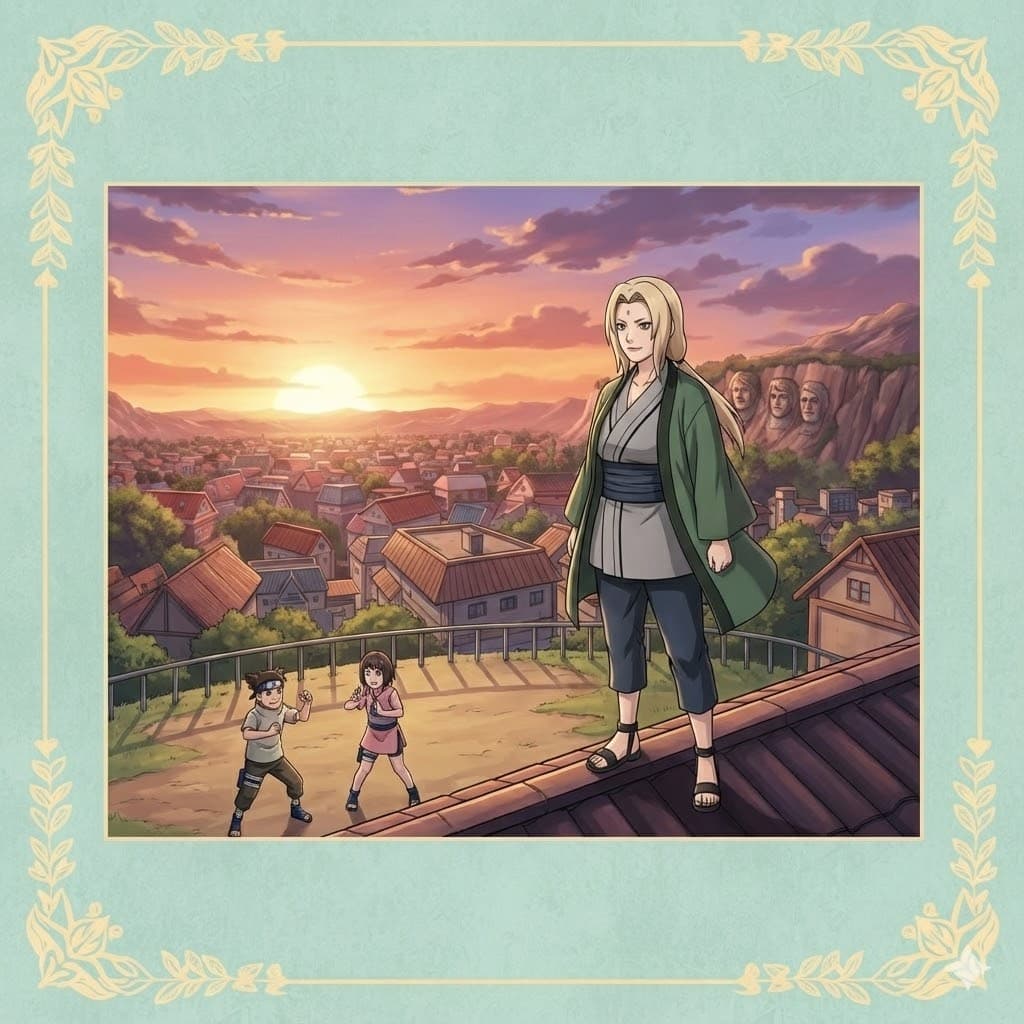
A Hokage's duty is to protect the dreams of the next generation. — Tsunade, Naruto Series
—What lingers after this line?
Leadership Rooted in Future, Not Power
Tsunade’s line reframes what it means to lead: a Hokage is not simply the strongest ninja or the one who commands obedience, but the guardian of possibility. Rather than clinging to authority, the Hokage exists so that children can grow up believing their hopes are worth pursuing. In this sense, the office becomes less a throne and more a promise that the village will prioritize its future over the comfort of the present.
From Surviving War to Protecting Hope
To understand the weight of Tsunade’s words, it helps to see how the Naruto world is scarred by endless conflict. Earlier generations of shinobi—like Hashirama and Hiruzen—spent their lives in cycles of war, often sacrificing youth to preserve a fragile peace. Tsunade, who lost loved ones to that violence, recognizes that mere survival is not enough. Her declaration marks a shift from protecting borders to protecting hope itself, ensuring that the next generation does more than inherit old grudges.
Naruto as the Embodiment of Protected Dreams
This duty becomes concrete when we look at Naruto himself. Once shunned and weaponized as a jinchūriki, he is precisely the kind of child whose dreams could have been crushed by fear and prejudice. Yet, through Iruka’s kindness and the gradual trust of the village, Naruto’s dream of becoming Hokage is allowed to live. Tsunade’s stance validates his journey: by backing his ambitions instead of limiting them, she shows how true leadership converts an outcast into a symbol of shared aspiration.
The Cost and Courage of Carrying Others’ Dreams
However, protecting dreams is not sentimental; it is costly. In the series, the Hokage repeatedly risks their life so that younger shinobi can return home and keep believing in a better tomorrow. Minato’s sacrifice during the Nine-Tails’ attack and the Third Hokage’s final battle against Orochimaru illustrate this starkly. Tsunade’s statement acknowledges that the Hokage must accept personal loss—reputation, safety, even life—so that the next generation is spared those burdens and can imagine futures untouched by the same traumas.
A Universal Lesson on Mentorship and Legacy
Ultimately, Tsunade’s view of the Hokage extends beyond the Naruto universe into a broader insight about mentorship, leadership, and legacy. Whether in a family, classroom, or community, true leaders measure their success not by what they keep, but by what they enable others to dream and achieve. By centering the ‘dreams of the next generation,’ the quote reminds us that the highest form of power is stewardship: using present strength so that those who follow can see farther, reach higher, and fear less.
One-minute reflection
Why might this line matter today, not tomorrow?
Related Quotes
6 selectedStrength comes from enduring the pain you thought would break you. — Tsunade, Naruto Series
Tsunade, Naruto Series
Tsunade’s words suggest that strength is not something we discover in comfort, but something hammered into shape in our most painful moments. What we once believed would destroy us instead becomes the very experience tha...
Read full interpretation →To love and lose is still better than never to have loved at all. — Tsunade, Naruto Series
Tsunade, Naruto Series
Tsunade’s line, echoing Lord Alfred Tennyson’s famous sentiment, distills a hard-won truth: love is so meaningful that its value survives even after it is gone. In the Naruto series, she speaks not as an idealistic roman...
Read full interpretation →Every cloud has a pure heart, unaffected by wind and rain, solely guarding the clear dreams of the sky.
Unknown
The cloud represents purity and resilience. Despite being exposed to external forces like wind and rain, it remains unaffected at its core, symbolizing innocence and steadfastness.
Read full interpretation →The responsibility of leadership is to think about the next generation. — Jack Ma
Jack Ma
This quote highlights that true leadership is not just about immediate success but about preparing for the future. A great leader ensures that their decisions benefit generations to come.
Read full interpretation →A true leader builds a world where children can laugh freely. — Hashirama Senju, Naruto Series
Hashirama Senju, Naruto Series
Hashirama Senju’s words shift leadership away from power and glory toward a gentler benchmark: the sound of children laughing without fear. Rather than celebrating conquest or authority, this view treats safety, joy, and...
Read full interpretation →When your heart grows, your power follows. — Choji Akimichi, Naruto Series
Choji Akimichi, Naruto Series
In the Naruto series, Choji Akimichi begins as an often-overlooked character, more associated with snacks than strength. Yet his line, “When your heart grows, your power follows,” quietly summarizes his entire journey.
Read full interpretation →More From Author
More from Tsunade, Naruto Series →Strength comes from enduring the pain you thought would break you. — Tsunade, Naruto Series
Tsunade’s words suggest that strength is not something we discover in comfort, but something hammered into shape in our most painful moments. What we once believed would destroy us instead becomes the very experience tha...
Read full interpretation →To love and lose is still better than never to have loved at all. — Tsunade, Naruto Series
Tsunade’s line, echoing Lord Alfred Tennyson’s famous sentiment, distills a hard-won truth: love is so meaningful that its value survives even after it is gone. In the Naruto series, she speaks not as an idealistic roman...
Read full interpretation →