
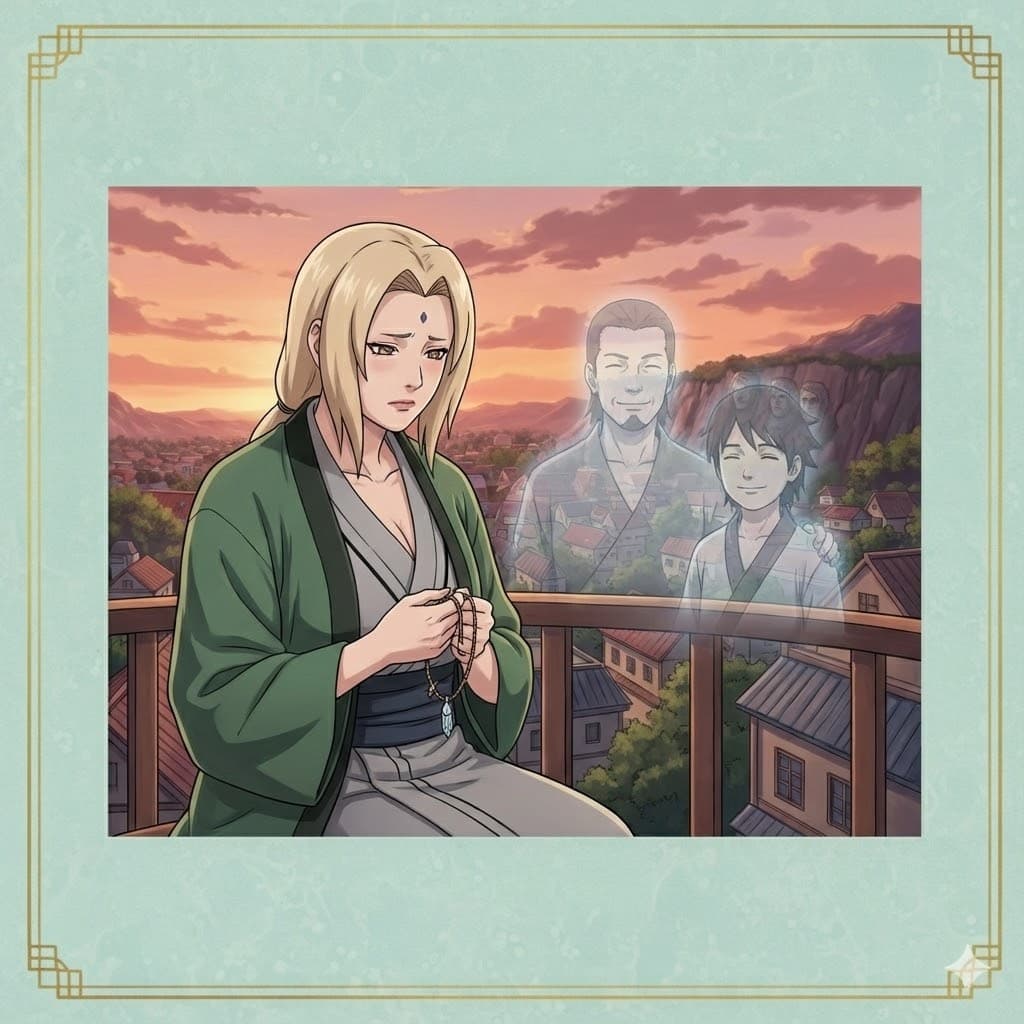
To love and lose is still better than never to have loved at all. — Tsunade, Naruto Series
—What lingers after this line?
The Heart of Tsunade’s Reflection
Tsunade’s line, echoing Lord Alfred Tennyson’s famous sentiment, distills a hard-won truth: love is so meaningful that its value survives even after it is gone. In the Naruto series, she speaks not as an idealistic romantic, but as someone deeply scarred by bereavement. Thus, when she claims that loving and losing is still better than never loving, she is weighing two different kinds of suffering: the sharp pain of loss versus the dull, empty ache of having never opened one’s heart at all.
Tsunade’s Personal Losses and Vulnerability
To understand the weight of this quote, it helps to recall Tsunade’s past. She loses both her younger brother Nawaki and her lover Dan, each tied to her hope for a better future for the village. These deaths drive her into cynicism, gambling, and emotional withdrawal. Yet, over time, her bond with Naruto reawakens her capacity for care and responsibility. The very person who embodies her greatest fear—another young dreamer who might die—also reminds her why love mattered in the first place. This journey gives her words a layered credibility: she speaks from the far side of devastation.
The Risk–Reward Balance of Human Connection
Moving from character to concept, Tsunade’s statement confronts a universal dilemma: is emotional safety worth the cost of isolation? By affirming that love is worth the pain, she suggests that connection, meaning, and shared joy outweigh the inevitable risk of grief. This aligns with broader philosophical thought; for instance, Tennyson’s *In Memoriam* (1850) frames grief as the price of having truly lived and loved. Tsunade’s version translates that insight into the language of a shinobi world, where every bond is also a potential wound.
Love as a Source of Strength, Not Just Sorrow
Importantly, the quote does not glorify suffering for its own sake; it highlights how love shapes identity and resilience. Tsunade’s renewed commitment as Hokage is fueled by the memories of those she lost and the affection she feels for the next generation. Similarly, Naruto’s own growth is rooted in bonds that both empower and endanger him. In this light, love is not merely a prelude to loss, but a source of courage that makes enduring loss possible. The hurt is real, yet it is interwoven with pride, gratitude, and a sense of shared history.
Choosing Openness in a World of Uncertainty
Ultimately, Tsunade’s insight points toward a conscious choice: to remain open-hearted in a world where nothing is guaranteed. In everyday life, many people respond to betrayal, death, or disappointment by vowing never to be vulnerable again. Her stance gently rejects that impulse, arguing that a life without deep attachment is safer but emptier. By affirming that it is better to love and lose, she invites us to accept impermanence while still investing fully in our relationships, trusting that the experience of love itself is a lasting gift, even when its presence is gone.
Recommended Reading
As an Amazon Associate, we earn from qualifying purchases.
One-minute reflection
What does this quote ask you to notice today?
Related Quotes
6 selectedStrength comes from enduring the pain you thought would break you. — Tsunade, Naruto Series
Tsunade, Naruto Series
Tsunade’s words suggest that strength is not something we discover in comfort, but something hammered into shape in our most painful moments. What we once believed would destroy us instead becomes the very experience tha...
Read full interpretation →A smile can be the strongest punch of all. — Rock Lee, Naruto Series
Rock Lee, Naruto Series
Rock Lee’s line, “A smile can be the strongest punch of all,” reframes strength in a series famous for physical combat. While Naruto’s world overflows with jutsu, taijutsu, and spectacular battles, Lee points to somethin...
Read full interpretation →A Hokage's duty is to protect the dreams of the next generation. — Tsunade, Naruto Series
Tsunade, Naruto Series
Tsunade’s line reframes what it means to lead: a Hokage is not simply the strongest ninja or the one who commands obedience, but the guardian of possibility. Rather than clinging to authority, the Hokage exists so that c...
Read full interpretation →It is not he who reviles or strikes you who insults you, but your opinion that these things are insulting. — Epictetus
Epictetus
Epictetus flips the usual story of offense: the injury is not located in another person’s words or blows, but in the meaning we assign to them. By separating the event from our evaluation of it, he argues that what feels...
Read full interpretation →Everything is workable. We can use the difficult situations of our lives to awaken our hearts. — Pema Chödrön
Pema Chödrön
Pema Chödrön’s line begins with a disarming premise: “Everything is workable.” Rather than denying pain or insisting that problems are secretly pleasant, she proposes a practical confidence that even messy circumstances...
Read full interpretation →If they want to be wrong about you, let them. Save your energy for the things you can actually control. — Mel Robbins
Mel Robbins, United States.
Mel Robbins’ line begins with a counterintuitive permission: if someone insists on misunderstanding you, you don’t have to chase them. The deeper point isn’t indifference or defeat; it’s recognizing that your worth is no...
Read full interpretation →More From Author
More from Tsunade, Naruto Series →A Hokage's duty is to protect the dreams of the next generation. — Tsunade, Naruto Series
Tsunade’s line reframes what it means to lead: a Hokage is not simply the strongest ninja or the one who commands obedience, but the guardian of possibility. Rather than clinging to authority, the Hokage exists so that c...
Read full interpretation →Strength comes from enduring the pain you thought would break you. — Tsunade, Naruto Series
Tsunade’s words suggest that strength is not something we discover in comfort, but something hammered into shape in our most painful moments. What we once believed would destroy us instead becomes the very experience tha...
Read full interpretation →