
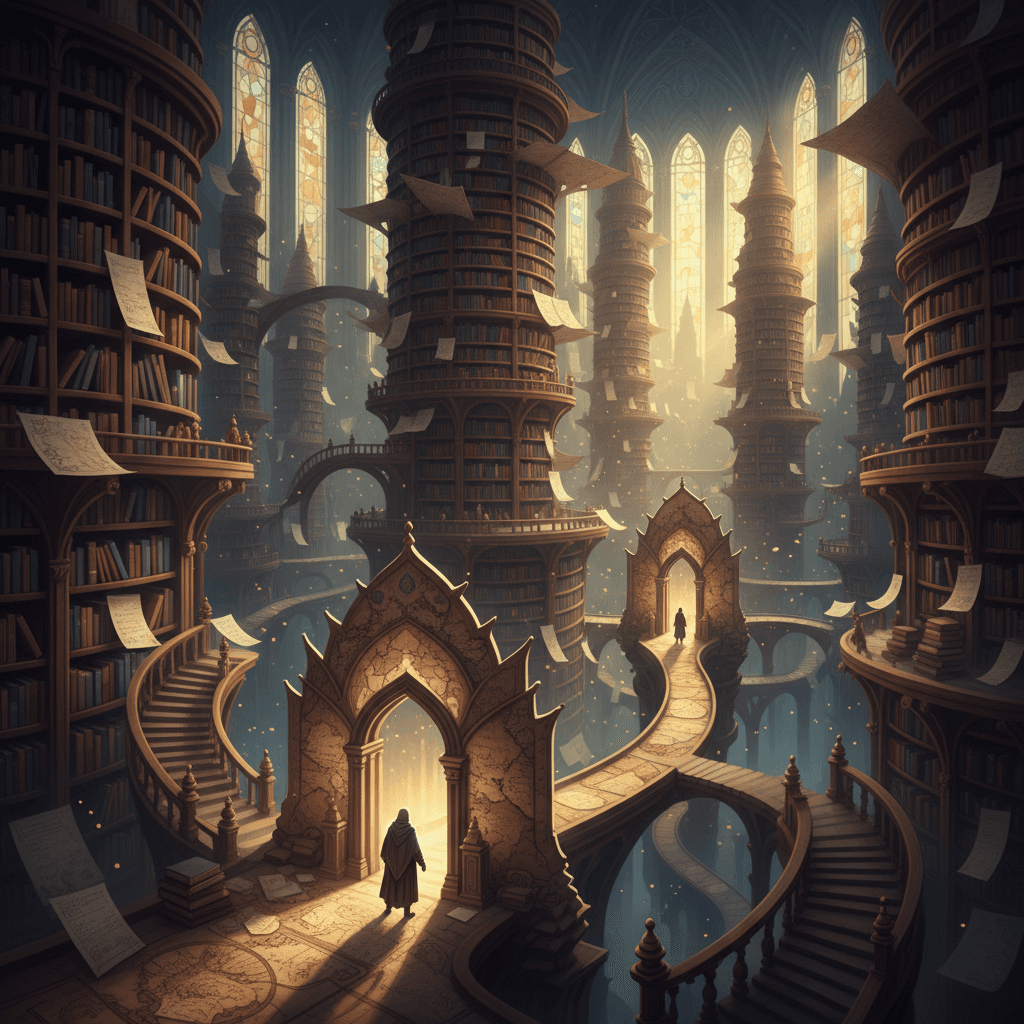
Build maps of your thoughts and then walk into the places they reveal. — Jorge Luis Borges
—What lingers after this line?
Thoughts as Cartography of the Inner World
Borges’s invitation to “build maps of your thoughts” suggests that our inner life is not a formless fog but a terrain that can be charted. Like a cartographer sketching coastlines and mountains, we can trace recurring ideas, fears, and desires, noticing how they connect. In Borges’s own stories, such as “The Garden of Forking Paths” (1941), thoughts form labyrinthine structures, hinting that mental maps are complex, branching patterns rather than simple lines. By turning vague impressions into something diagrammed and deliberate, we begin to see where we have actually been thinking, not just where we imagine ourselves to be.
From Abstract Ideas to Concrete Mental Maps
However, Borges does not stop at mere introspection; he invokes the deliberate act of mapping. This implies structure: labels, boundaries, and routes between concepts. Philosophers from Descartes onward tried to organize thought into clear and distinct ideas, but Borges’s metaphor is more flexible, closer to mind mapping or the “memory palace” technique described in Cicero’s *De Oratore* (55 BC). When we sketch relationships between our ideas—on paper, in diagrams, or in carefully ordered reflections—we convert fleeting notions into navigable spaces, enabling us to return, revise, and explore them with greater clarity.
Crossing the Threshold from Reflection to Action
The quote’s second imperative—“walk into the places they reveal”—shifts us from contemplation to engagement. It is not enough to chart our mental landscapes; we must inhabit them. This echoes William James’s claim in *The Principles of Psychology* (1890) that ideas gain real force when they lead to action. To “walk into” these places means to test the implications of our thoughts in lived experience: pursuing a long-imagined project, confronting a buried worry, or embodying a value we only admired from afar. The map becomes a call to journey, not just a decorative representation.
Imagination as a Portal to New Realities
Furthermore, Borges implies that our thought-maps disclose spaces that did not exist for us before we drew them. In tales like “The Library of Babel” (1941), imagined architectures become entire universes with their own rules, suggesting that imagination can precede and shape reality. When we carefully outline a future career, a work of art, or a new way of living, we are not merely daydreaming; we are constructing corridors we might later walk. Thus, the act of mapping imagination is also an act of quiet world-building, where speculative routes can harden into actual roads under our feet.
Ethical Responsibility for the Worlds We Enter
Yet entering the places our thoughts reveal involves responsibility. Some mental territories are nourishing—creativity, empathy, curiosity—while others resemble dangerous swamps of resentment or illusion. Nietzsche in *Beyond Good and Evil* (1886) warned that unchecked ideas can seduce us into destructive paths. Borges’s gentle command suggests discernment: if we know our map, we can choose which regions to traverse and which to merely observe from a distance. Walking consciously, we decide which imagined structures to instantiate in the world, shaping both our character and the shared spaces we inhabit with others.
Becoming the Explorer of Your Own Labyrinth
Ultimately, Borges’s metaphor recasts each of us as an explorer within a self-made labyrinth. Rather than being lost, we are invited to be deliberate: to draw, revise, and annotate our inner maps, then venture in with curiosity instead of fear. As we repeat this cycle—mapping, walking, and remapping—we slowly transform confusion into navigable complexity. In this way, our lives become a series of expeditions through evolving mental geographies, where every new insight redraws the chart and every step taken turns imagined pathways into inhabited ground.
One-minute reflection
Why might this line matter today, not tomorrow?
Related Quotes
6 selectedRest is a fine medicine. Let your mind go into strange, untouched places. — May Sarton
May Sarton
May Sarton’s line begins with a deceptively simple claim: rest heals. Yet she isn’t praising laziness or escape so much as naming rest as a deliberate remedy, like something prescribed.
Read full interpretation →To step into the unknown is often the only way to rediscover the known within. — Clarissa Pinkola Estés
Clarissa Pinkola Estés
This quote suggests that personal growth often requires leaving familiar territory and embracing uncertainty.
Read full interpretation →Map your own territory; the unknown becomes familiar through careful passage. — Jorge Luis Borges
Jorge Luis Borges
Borges’s invitation to “map your own territory” urges each person to become the cartographer of their life. Rather than inheriting second‑hand maps—social expectations, family scripts, or conventional success stories—he...
Read full interpretation →Claim the page of your life with honest strokes, and color it without apology. — Jorge Luis Borges
Jorge Luis Borges
Borges’ image of a “page” invites us to see life not as a fixed script but as something still being written. Rather than a completed book, our days resemble blank or half-filled pages, open to revision and fresh lines.
Read full interpretation →Every person who passes through our life is unique. They always leave a bit of themselves and take a bit of us with them. - Jorge Luis Borges
Jorge Luis Borges
This quote highlights the idea that every person we encounter in life impacts us in some way. There is an exchange of experiences, emotions, and memories that leaves a lasting imprint on both individuals.
Read full interpretation →One can’t choose their battlefield, but one can choose their weapons. — Jorge Luis Borges
Jorge Luis Borges
This quote highlights that life often presents us with challenges and situations that are beyond our control. We may not get to choose the circumstances we face, but we can decide how we respond to them.
Read full interpretation →More From Author
More from Jorge Luis Borges →Claim the page of your life with honest strokes, and color it without apology. — Jorge Luis Borges
Borges’ image of a “page” invites us to see life not as a fixed script but as something still being written. Rather than a completed book, our days resemble blank or half-filled pages, open to revision and fresh lines.
Read full interpretation →Map your own territory; the unknown becomes familiar through careful passage. — Jorge Luis Borges
Borges’s invitation to “map your own territory” urges each person to become the cartographer of their life. Rather than inheriting second‑hand maps—social expectations, family scripts, or conventional success stories—he...
Read full interpretation →Every person who passes through our life is unique. They always leave a bit of themselves and take a bit of us with them. - Jorge Luis Borges
This quote highlights the idea that every person we encounter in life impacts us in some way. There is an exchange of experiences, emotions, and memories that leaves a lasting imprint on both individuals.
Read full interpretation →One can’t choose their battlefield, but one can choose their weapons. — Jorge Luis Borges
This quote highlights that life often presents us with challenges and situations that are beyond our control. We may not get to choose the circumstances we face, but we can decide how we respond to them.
Read full interpretation →