
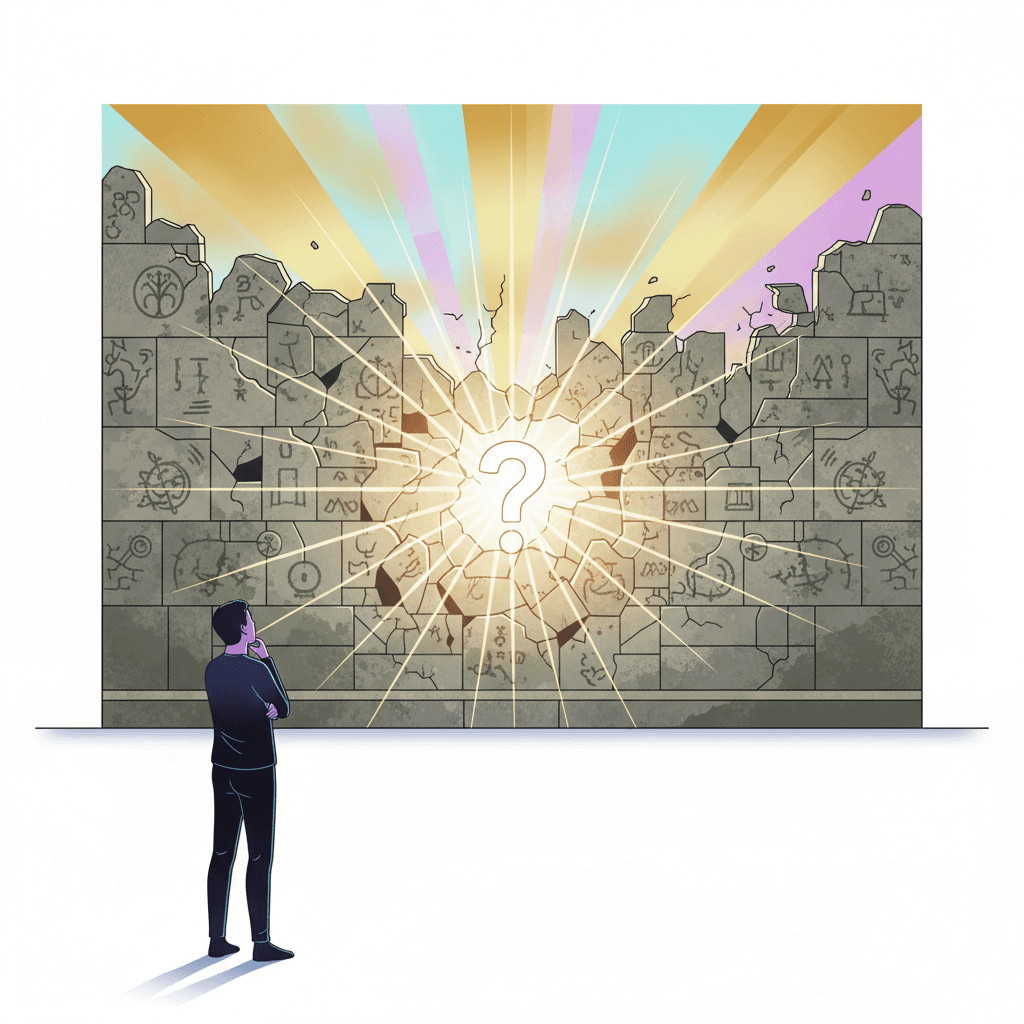
Challenge worn beliefs with fresh questions; revolution often begins with a single why. — Lu Xun
—What lingers after this line?
The Power Hidden in a Single Why
Lu Xun’s observation that revolution often begins with a single “why” highlights how profound change rarely starts with violence or manifestos but with curiosity. The simple act of questioning—why things are the way they are—can destabilize beliefs that once seemed immovable. Just as a hairline crack can eventually split a boulder, one honest question can widen into a deep fissure in outdated assumptions. Rather than presenting revolution as purely external or explosive, Lu Xun reframes it as an inner turning, a mental shift that precedes all outward action.
Challenging the Comfort of Worn Beliefs
Moving from the individual question to the collective mindset, “worn beliefs” suggest ideas so often repeated that they feel like common sense. These beliefs provide comfort and predictability, which is why they are so rarely examined. Yet history shows that many such certainties—like the divine right of kings or rigid social hierarchies—have crumbled once people dared to interrogate them. In this way, Lu Xun calls attention to our tendency to confuse familiarity with truth, urging us to inspect even the most ‘obvious’ assumptions we inherit from family, culture, or tradition.
Lu Xun’s Legacy of Intellectual Revolt
Lu Xun himself embodied the practice of asking disruptive questions. Writing during the early 20th century, in works like “Diary of a Madman” (1918), he probed the moral foundations of Chinese feudal society and exposed the cruelty beneath accepted norms. His essays and stories did not preach revolution in slogans; instead, they invited readers to see their world anew, to ask why oppression was tolerated and why reform seemed so distant. Through this literary strategy, he demonstrated that cultural and political upheaval begin with an internal rebellion against inherited ways of thinking.
From Questioning to Collective Transformation
Once an individual begins to question, the effect can spread. One person’s “why” invites another’s “why not,” and soon a chain reaction of inquiry forms. This dynamic appears in movements ranging from the Enlightenment, where philosophers challenged monarchy and dogma, to civil rights campaigns in the 20th century, where activists questioned racial segregation’s supposed inevitability. What starts as private doubt can evolve into public dialogue, then into organized resistance. Thus, Lu Xun’s phrase suggests a progression: from solitary skepticism, to shared critique, to the structural changes we recognize as revolution.
Cultivating a Habit of Radical Curiosity
Bringing this insight into everyday life, Lu Xun’s message encourages us to treat “why” not as a childish annoyance but as a disciplined habit. By regularly asking why a rule exists, why a custom persists, or why a story is told a certain way, we train ourselves to distinguish genuine wisdom from mere repetition. This radical curiosity does not guarantee immediate upheaval, but it does keep societies from stagnating. Over time, such questioning allows communities to shed beliefs that no longer serve them and to imagine alternatives that once seemed unthinkable.
One-minute reflection
What feeling does this quote bring up for you?
Related Quotes
6 selectedTurn doubt into questions that sharpen your aim. — Soren Kierkegaard
Soren Kierkegaard
Kierkegaard’s line reframes doubt from a final judgment into a starting ingredient. Instead of treating uncertainty as proof that you should stop, he suggests it can be worked—shaped into something useful.
Read full interpretation →It is not the answer that enlightens, but the question. — Eugene Ionesco
Eugene Ionesco
This quote highlights the transformative impact of posing meaningful questions. It suggests that enlightenment or understanding comes from the process of inquiry rather than the attainment of definitive answers.
Read full interpretation →To create, one must first question everything. — E. E. Cummings
E. E. Cummings
The quote highlights that creativity and invention require a willingness to challenge assumptions and traditions.
Read full interpretation →Courage is the heartbeat of every revolution. — Arundhati Roy
Arundhati Roy
Arundhati Roy’s statement positions courage as the central energy animating revolutions. Unlike mere recklessness, revolutionary courage entails a conscious decision to confront fear, endure risk, and persist in the face...
Read full interpretation →Value the small victories — they foment the greatest revolutions. — Isabel Allende
Isabel Allende
Isabel Allende’s statement underscores the often-overlooked power of incremental progress. Small victories, though modest in appearance, possess a unique ability to inspire momentum and build confidence.
Read full interpretation →Building a future means tearing down the present. — Mahmoud Darwish
Mahmoud Darwish
Mahmoud Darwish’s statement, 'Building a future means tearing down the present,' captures the sometimes unsettling truth that progress often requires letting go of existing structures. Just as a gardener clears old growt...
Read full interpretation →More From Author
More from Lu Xun →Speak softly to doubt, then reply in bold deeds. — Lu Xun
Lu Xun’s line divides maturity into two complementary acts: first, meeting doubt with softness; then, answering with bold deeds. The structure matters because it suggests doubt isn’t an enemy to be crushed immediately, b...
Read full interpretation →Rewrite the familiar into something that surprises you — Lu Xun
At the outset, Lu Xun’s invitation is less a slogan than a method: take what everyone thinks they know and tilt it until it pricks the skin. Russian Formalist Viktor Shklovsky called this defamiliarization, arguing in 'A...
Read full interpretation →A quiet choice today can reroute a lifetime. — Lu Xun
At first glance, a quiet choice seems trivial: a course to enroll in, a call returned, a page read before bed. Yet, as the quote suggests, such decisions can alter the slope of a life’s trajectory.
Read full interpretation →Begin with honest anger at injustice, then invent better ways forward. — Lu Xun
At the outset, Lu Xun’s injunction recognizes anger as a diagnostic tool rather than a destination. Honest anger names a harm and clarifies our values, shifting people from resignation to resolve.
Read full interpretation →