
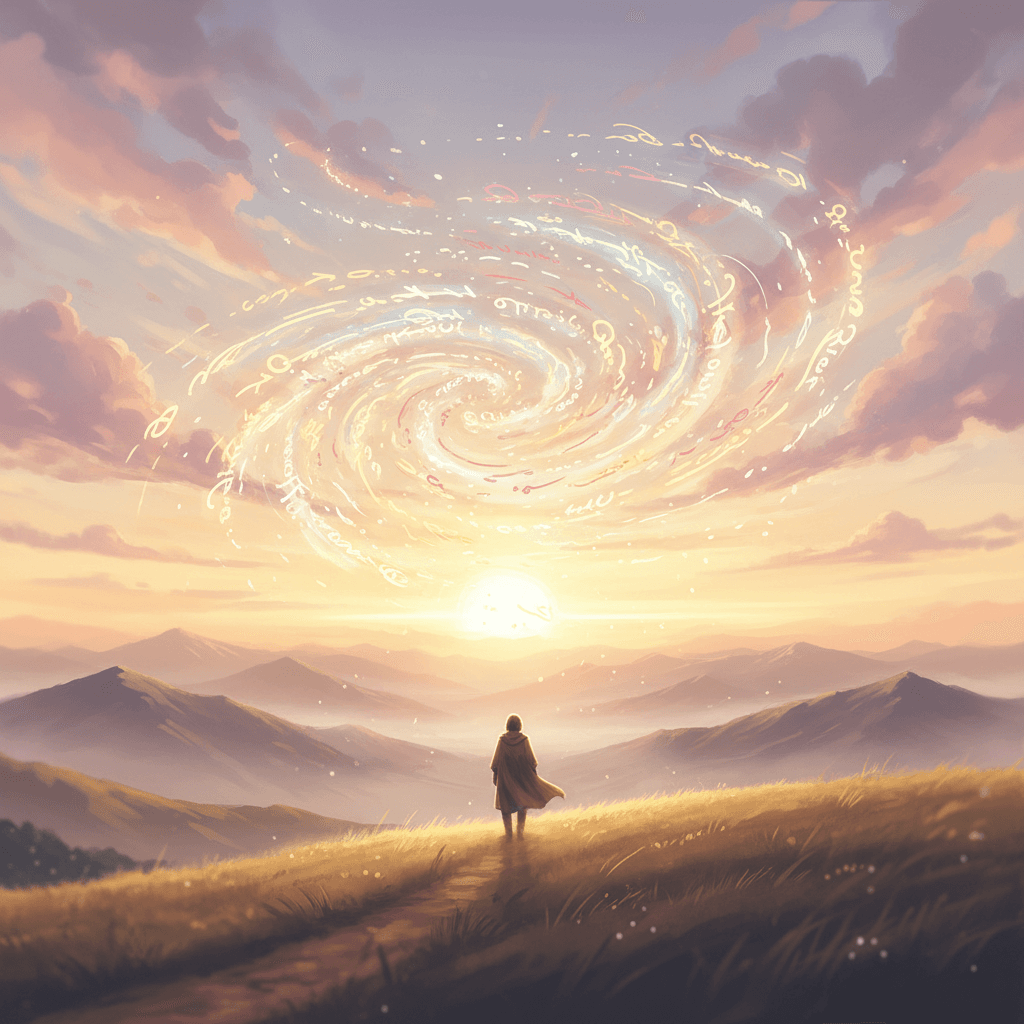
Write your intention on the wind and then walk toward it. — Pablo Neruda
—What lingers after this line?
Declaring a Wish to the Invisible
Neruda’s image of writing an intention on the wind suggests announcing our deepest aims to forces larger than ourselves. Unlike carving into stone, tracing words in air is ephemeral, hinting that our intentions need not be rigid to be real. Yet, by naming them—whispered in a room, spoken to a friend, or written in a journal—we invite the world to bear silent witness. This act resembles ancient rituals where sailors addressed the winds before a voyage, trusting that unseen currents could hear and respond. In the same spirit, Neruda implies that our first task is to clarify what we want and dare to let it leave the privacy of our thoughts, even if no one else hears it as clearly as we do.
Letting Go of Control While Staying Committed
However, to write on the wind is also to surrender perfect control. Wind can scatter, distort, or carry our words to unexpected places, just as life can redirect our plans. Rather than promising a straight path, Neruda acknowledges uncertainty and flux. This echoes the Stoic idea in Epictetus’ *Discourses* (c. 108 CE) that we command our choices but not outcomes. By entrusting our intention to the wind, we accept that timing, opportunity, and other people’s choices will shape what unfolds. Yet this letting go is not resignation; it is a strategic humility. We commit fully to the direction of our desire while admitting we cannot choreograph every step along the way.
The Quiet Power of a Single Direction
After this airy gesture, Neruda’s advice becomes disarmingly simple: walk toward it. The grandeur of poetic invocation yields to the modest act of putting one foot in front of the other. This shift mirrors how many great endeavors begin in miniature. Santiago in Coelho’s *The Alchemist* (1988) pursues a ‘personal legend’ not through grand leaps but through a series of ordinary choices guided by a persistent inner compass. In the same way, walking toward an intention suggests daily, almost unremarkable actions: one extra hour of study, one hard conversation, one application submitted. Over time, these small steps transform the distant line on the horizon into familiar ground beneath our feet.
Bridging Imagination and Action
Moreover, the pairing of wind and walking unites imagination with effort. The wind symbolizes inspiration—the sudden idea, the elusive dream, the sense that life could be otherwise. Walking represents discipline—the willingness to show up on days when inspiration is absent. Psychologist Angela Duckworth’s research on grit (2016) similarly describes success as sustained effort over time, anchored by a meaningful goal. Neruda’s line weaves these insights poetically: start by naming a future only your imagination can currently see, then convert that vision into movement. In doing so, you build a bridge between the invisible and the tangible, turning airy hopes into the slow architecture of a life.
A Compass Instead of a Contract
Crucially, Neruda does not say run, rush, or arrive; he only insists on walking. This emphasis on direction over speed reframes intention as a compass, not a contract. We are not bound to fulfill every detail exactly as envisioned; instead, we are guided by a stable north, even as the path zigzags. This view aligns with modern career and life design approaches, such as Bill Burnett and Dave Evans’ *Designing Your Life* (2016), which urge people to prototype their futures through iterative steps rather than fixed master plans. By holding our intentions lightly, like words on wind, yet advancing toward them steadily, we allow room for detours that may enrich the original dream.
Living as a Conversation With the Future
Ultimately, to write on the wind and walk toward it is to treat life as an ongoing conversation with the future. We speak our desires into an uncertain world, and then we listen, adjust, and respond with each step. Sometimes the wind seems to carry us forward; at other times it resists, forcing us to lean in more deliberately. Yet the dialogue persists as long as we keep moving. In this way, intention becomes less about rigidly achieving a single outcome and more about inhabiting a certain stance: open-hearted, forward-looking, and willing to be changed by the journey. Neruda’s line thus invites us not merely to dream, but to become the kind of person who keeps walking in the direction of their own whispered words.
One-minute reflection
What's one small action this suggests?
Related Quotes
6 selectedEverything that is created begins with a small, quiet intention. Do not fear the length of the road; just honor the focus you bring to the very next step. — Thich Nhat Hanh
Thich Nhat Hanh
At its heart, this quote suggests that meaningful creation rarely starts with spectacle; instead, it begins with an inward turning, a small and quiet intention. Thich Nhat Hanh’s broader teachings in Peace Is Every Step...
Read full interpretation →It is not the speed of the work, but the intention behind it that grants it value. — Rabindranath Tagore
Rabindranath Tagore
At first glance, Tagore’s statement challenges a modern habit of equating worth with speed. In many settings, quick results are praised as signs of competence, yet he redirects attention to the inner motive that shapes t...
Read full interpretation →Rise with the sun of your intentions and work until the horizon answers — Chinua Achebe
Chinua Achebe
Achebe’s line opens with a vivid image: rising “with the sun of your intentions.” Intention here isn’t a vague wish—it’s something bright, scheduled, and unavoidable, like sunrise itself. By pairing waking with purpose,...
Read full interpretation →We're all just walking each other home. — Ram Dass
Ram Dass
Ram Dass’s statement compresses an entire philosophy into a gentle image: life as a shared walk, and death as a kind of homecoming. Instead of framing existence as a solitary quest for achievement, it suggests that what...
Read full interpretation →It is good to have an end to journey toward; but it is the journey that matters, in the end. — Ursula K. Le Guin
Ursula K. Le Guin
Le Guin begins with what sounds like common sense: having an end point is useful. A destination can organize effort, give direction, and keep hope intact when the road is long.
Read full interpretation →A single clear intention can untangle a knot of days. — Carl Sagan
Carl Sagan
Carl Sagan’s image of a “knot” captures how time can feel when tasks, worries, and obligations twist together into one tight mass. Days stop reading like a sequence and start feeling like a tangle—unfinished conversation...
Read full interpretation →More From Author
More from Pablo Neruda →Let the rain kiss you. Let the rain beat upon your head with silver liquid drops. — Pablo Neruda
Neruda’s lines open as a gentle imperative: instead of bracing against bad weather, we are asked to welcome it. “Let the rain kiss you” reframes rain as a gesture offered to the body rather than an inconvenience imposed...
Read full interpretation →Build a bridge of resolve and walk across it one brave step at a time. — Pablo Neruda
Neruda’s image begins with a striking implication: resolve is not merely a feeling you wait for, but a structure you build. A bridge doesn’t appear because the river is intimidating; it exists because someone decided to...
Read full interpretation →Let each sunrise find you leaning toward action. — Pablo Neruda
Neruda’s line frames each sunrise as more than scenery; it’s a daily reset that gently pressures us to move. “Leaning” matters because it suggests a posture, not a perfect performance—an inclination toward doing, even be...
Read full interpretation →Make your hands busy with making—words, gardens, music—and life answers back. — Pablo Neruda
Neruda’s line frames creativity less as self-expression and more as initiation: when you keep your hands busy making, you open a channel through which the world can respond. The emphasis on “hands” matters, because it gr...
Read full interpretation →