
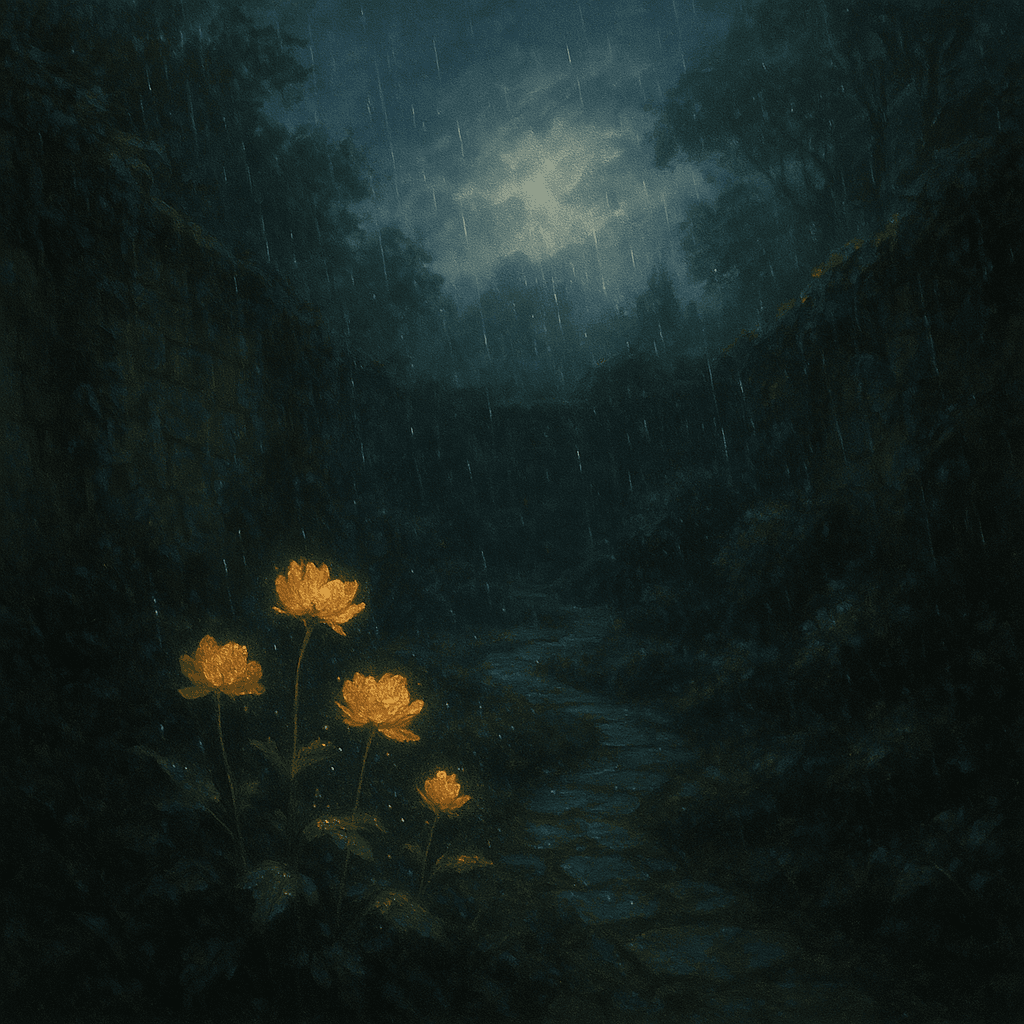
Cultivate a private garden of resolve that flowers in quiet storms. — Emily Dickinson
—What lingers after this line?
The Image of a Private Garden
Emily Dickinson’s line invites us first to imagine the self as a walled garden, hidden from public view. In her poetry and letters, she often retreated to private spaces—her room, her Amherst home—as sites of intense inner life. Here, the “private garden” symbolizes those inward places where thoughts, values, and convictions take root away from the noise of external expectations. By choosing a garden rather than a fortress, the quote suggests that true strength is organic and living, not rigid or militaristic. This strength must be tended, not merely erected; it grows slowly and requires patience. Thus, the metaphor gently shifts our attention from performative toughness to quiet, cultivated resilience.
Understanding ‘Resolve’ as a Living Thing
From this image of a garden, the phrase “garden of resolve” recasts determination as something that can blossom rather than harden. Instead of viewing resolve as a clenched jaw or an iron will, Dickinson hints at a firmness that remains supple and responsive, like a well-watered vine. Just as a gardener prunes, feeds, and protects plants, we can nurture our inner resolve through repeated choices, reflective habits, and small acts of courage. Over time, these practices weave into a root system that anchors us. Consequently, resolve is no longer a single dramatic stance but an accumulation of daily, almost invisible care for what we believe matters.
Why the Garden Must Be Private
The insistence on privacy shifts the focus from recognition to authenticity. A private garden is not planted for spectators; it flourishes whether or not anyone ever visits. Likewise, Dickinson—who published only a handful of poems during her lifetime—embodied the belief that one’s deepest commitments can remain largely unseen. In an age obsessed with sharing every struggle, the quote subtly challenges the idea that resolve must be demonstrated publicly to be real. By sheltering this garden from external judgment and comparison, we protect our motives from becoming entangled with applause or approval. In turn, our strength becomes less fragile, because it no longer depends on how others respond.
Flowers That Bloom in Quiet Storms
The final phrase, “that flowers in quiet storms,” introduces a paradox: storms are typically loud and violent, yet Dickinson calls them quiet. This juxtaposition suggests those inward tempests—anxiety, doubt, grief—that may barely disturb our outward routines. Many of the fiercest battles play out silently inside us, invisible to colleagues and strangers who see only composure. In this context, a garden of resolve does not eliminate storms; rather, it discovers a way to bloom within them. The flowers are the visible manifestations of internal work: small acts of kindness when we feel depleted, steady honesty when it would be easier to evade, or simple persistence when turning back seems tempting.
Cultivation as a Lifelong Practice
Because gardens never stay finished, the quote implies that cultivating resolve is an ongoing practice, not a one-time achievement. Seasons of drought, frost, and overgrowth all demand different responses from a careful gardener, just as changing circumstances require us to adapt our strategies without abandoning our core values. Journaling, contemplative reading, prayer or meditation, and honest conversation with trusted friends can function like watering and weeding—small, regular disciplines that keep the soil of the self responsive rather than hardened. Over years, such practices build a quiet fortitude. When the next “quiet storm” arrives, we may still feel its chill, yet we discover that something within us has learned to hold fast and, astonishingly, to flower.
The Ethical Dimension of Inner Strength
Finally, Dickinson’s metaphor suggests that the garden’s purpose extends beyond self-protection: flowers offer beauty, nourishment, and sometimes healing to others. Inner resolve, when wisely cultivated, allows us to act ethically even under pressure—refusing cruelty, choosing truth, or offering compassion when it is costly. Literature is filled with such figures: in Harper Lee’s *To Kill a Mockingbird* (1960), Atticus Finch’s quiet integrity does not prevent conflict but guides his actions within it. Similarly, our private garden of resolve becomes a source from which principled choices arise. In this way, the inward work of cultivation quietly reshapes the world beyond the garden walls.
One-minute reflection
Why might this line matter today, not tomorrow?
Related Quotes
6 selectedCourage doesn't always roar. Sometimes courage is the quiet voice at the end of the day saying, 'I will try again tomorrow.'
Unknown
This quote highlights the idea that courage is not always loud and conspicuous. It can manifest as a silent, inner strength that encourages persistence despite challenges and setbacks.
Read full interpretation →The spring that keeps running is more valuable than the jug which bottoms out each day. — Charlotte Joko Beck
Charlotte Joko Beck
At first glance, Charlotte Joko Beck’s image contrasts two simple things: a living spring and a finite jug. The spring matters more because it renews itself, while the jug, however useful, eventually runs dry.
Read full interpretation →The art of living well is knowing when to hold your focus and when to let the world fall away. True resilience is found in the stillness of a mind that knows its own direction. — Marcus Aurelius
Marcus Aurelius
At its core, this reflection presents living well as an act of disciplined attention. To ‘hold your focus’ is not merely to concentrate harder; rather, it means choosing what deserves the mind’s energy and refusing to be...
Read full interpretation →Your home should be the place where the day softens around the edges. — Unknown (removed per constraints) -> Let's use: "Home is not a place; it is a feeling of being able to handle whatever the world throws at you." — Cheryl Richardson
Cheryl Richardson
At first glance, Cheryl Richardson’s quote shifts the meaning of home away from geography and architecture. Home is no longer merely a house, apartment, or hometown; instead, it becomes an emotional condition—a steady in...
Read full interpretation →Sometimes the most radical act of courage is to simply slow down and refuse to be consumed by the urgency of the world. — Thich Nhat Hanh
Thich Nhat Hanh
At first glance, courage is often imagined as swift action, bold speech, or dramatic resistance. Yet Thich Nhat Hanh turns that assumption inside out by suggesting that bravery may lie in restraint: in slowing down when...
Read full interpretation →Only to the extent that we expose ourselves over and over to annihilation can that which is indestructible in us be found. — Pema Chödrön
Pema Chödrön
Pema Chödrön’s line hinges on an unsettling premise: what lasts in us is not discovered by protecting ourselves, but by repeatedly meeting what feels like our end. “Annihilation” here is less a literal destruction than t...
Read full interpretation →More From Author
More from Emily Dickinson →I know nothing in the world that has as much power as a word. Sometimes I write one, and I look at it, until it begins to shine. — Emily Dickinson
Emily Dickinson’s statement begins with a bold claim: among worldly things, few rival the power of a word. Rather than treating language as a neutral tool, she presents it as an active force that can move thought, alter...
Read full interpretation →The soul should always stand ajar, ready to welcome the roving experience. — Emily Dickinson
Emily Dickinson’s image of the soul standing “ajar” transforms inner life into a threshold rather than a fortress. Instead of sealing ourselves against surprise, she suggests that wisdom begins with a kind of deliberate...
Read full interpretation →Plant a question, harvest a path — Emily Dickinson
Emily Dickinson’s line, “Plant a question, harvest a path,” turns curiosity into agriculture: inquiry becomes a seed placed deliberately into the soil of experience. The image implies patience and faith, because planting...
Read full interpretation →Write the day you want to live into existence through honest action. — Emily Dickinson
Emily Dickinson’s line treats “the day you want to live” not as a wish but as something you can author. The verb “write” makes the future feel like a page that responds to a steady hand—shaped by choices, drafts, and rev...
Read full interpretation →