
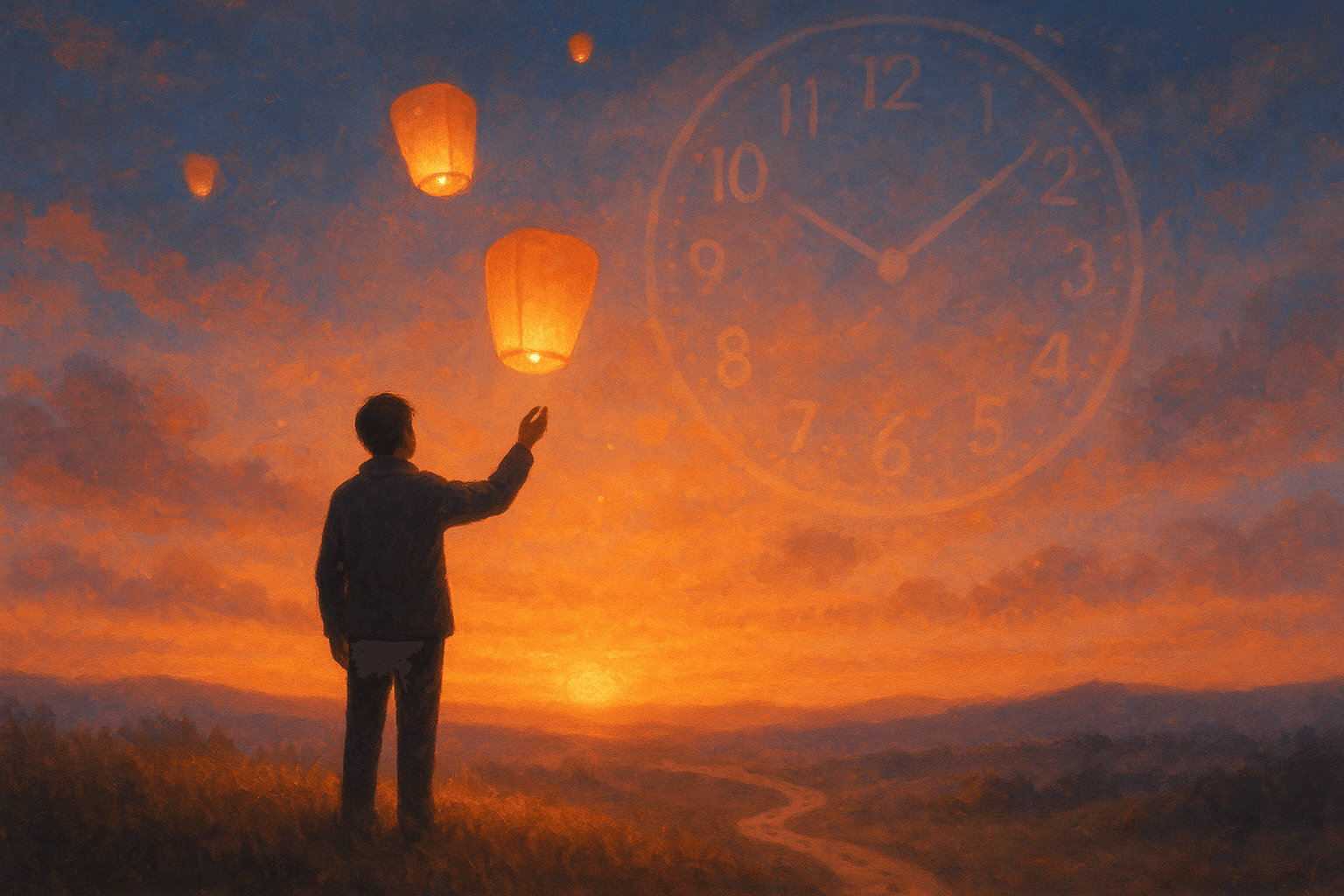
Measure days by deeds, not by hours. — Emily Dickinson
—What lingers after this line?
Time as More Than Passing Hours
Emily Dickinson’s line, “Measure days by deeds, not by hours,” shifts attention from the clock to the content of our lives. Instead of treating a day as a fixed unit marked by sunrise and sunset, she invites us to see it as a canvas whose value depends on what is painted upon it. In this way, hours become a neutral background, while actions, choices, and contributions provide the real measure of time well spent.
From Chronological Time to Lived Experience
Building on this, Dickinson implicitly contrasts chronological time with lived experience. Two people may share the same twenty-four hours, yet one might end the day with meaningful conversations, creative work, or quiet acts of care, while the other simply endures a routine blur. Much like Henri Bergson’s notion of “duration” in *Time and Free Will* (1889), the quote suggests that the inner richness of experience, rather than the ticking of a clock, determines the quality of a day.
The Ethics of Action and Responsibility
Furthermore, measuring days by deeds introduces a subtle ethical dimension. Deeds imply responsibility: what we do affects others and shapes our character. By focusing on actions instead of elapsed hours, Dickinson nudges us away from passive existence toward deliberate engagement. This echoes classical notions of virtue in Aristotle’s *Nicomachean Ethics*, where a good life is not defined by its length but by the quality of habitual actions cultivated over time.
Resisting Busyness and Empty Productivity
At the same time, her words offer a quiet critique of modern busyness. A schedule packed with appointments can still produce an empty day if nothing truly meaningful is accomplished. Conversely, a day with a single honest apology, a piece of careful writing, or a moment of genuine help may be richly ‘measured’ in Dickinson’s terms. In this sense, she distinguishes between frantic activity and purposeful deeds, urging a more discerning view of what counts as a productive life.
Practical Ways to Reframe a Day
Finally, Dickinson’s insight can reshape daily habits. Instead of asking, “Where did the time go?” we might end each day by asking, “What did I actually do that mattered?” Some keep a brief journal noting one meaningful deed—teaching a child, finishing a small creative project, or simply listening attentively to a friend. Over weeks, such reflections accumulate, revealing that a life marked by intentional deeds can feel expansive, even if its hours are limited.
One-minute reflection
What feeling does this quote bring up for you?
Related Quotes
6 selectedWrite the day you want to live into existence through honest action. — Emily Dickinson
Emily Dickinson
Emily Dickinson’s line treats “the day you want to live” not as a wish but as something you can author. The verb “write” makes the future feel like a page that responds to a steady hand—shaped by choices, drafts, and rev...
Read full interpretation →Clutter is not just the stuff on your floor; it's anything that stands between you and the life you want to be living. — Peter Walsh
Peter Walsh
At first glance, Peter Walsh’s quote seems to address physical mess, yet it quickly expands into something much broader. Clutter, in his view, is not merely a pile of objects on the floor; rather, it is any obstacle—mate...
Read full interpretation →Do the work of naming the highest, eulogy-worthy priorities in your life. Then do the work of putting them at the center of your life, every day. — Brooke McAlary
Brooke McAlary
Brooke McAlary’s quote begins with a difficult but clarifying task: identifying the priorities so important they would belong in your eulogy. In other words, she asks us to look beyond errands, ambitions, and social nois...
Read full interpretation →Instead of hustling to build a life that looks good, what if you slowed down and cultivated a life that feels good. — Erica Layne
Erica Layne
Erica Layne’s quote begins by challenging a familiar modern reflex: the urge to “hustle” toward a life that looks impressive from the outside. In doing so, she contrasts external validation with internal well-being, sugg...
Read full interpretation →Intentional living is the art of making our own choices before others' choices make us. — Richie Norton
Richie Norton
Richie Norton’s quote frames intentional living as an active rather than passive way of being. At its core, it argues that a meaningful life is shaped by deliberate decisions made in advance, not by drifting along with e...
Read full interpretation →Edit your life frequently and ruthlessly. It's your masterpiece after all. — Nathan W. Morris
Nathan W. Morris
Morris frames life not as a fixed identity but as an ongoing creation—something drafted, tested, and refined over time. By calling it a “masterpiece,” he implies both ownership and intention: you are not merely living th...
Read full interpretation →More From Author
More from Emily Dickinson →I know nothing in the world that has as much power as a word. Sometimes I write one, and I look at it, until it begins to shine. — Emily Dickinson
Emily Dickinson’s statement begins with a bold claim: among worldly things, few rival the power of a word. Rather than treating language as a neutral tool, she presents it as an active force that can move thought, alter...
Read full interpretation →The soul should always stand ajar, ready to welcome the roving experience. — Emily Dickinson
Emily Dickinson’s image of the soul standing “ajar” transforms inner life into a threshold rather than a fortress. Instead of sealing ourselves against surprise, she suggests that wisdom begins with a kind of deliberate...
Read full interpretation →Plant a question, harvest a path — Emily Dickinson
Emily Dickinson’s line, “Plant a question, harvest a path,” turns curiosity into agriculture: inquiry becomes a seed placed deliberately into the soil of experience. The image implies patience and faith, because planting...
Read full interpretation →Write the day you want to live into existence through honest action. — Emily Dickinson
Emily Dickinson’s line treats “the day you want to live” not as a wish but as something you can author. The verb “write” makes the future feel like a page that responds to a steady hand—shaped by choices, drafts, and rev...
Read full interpretation →