
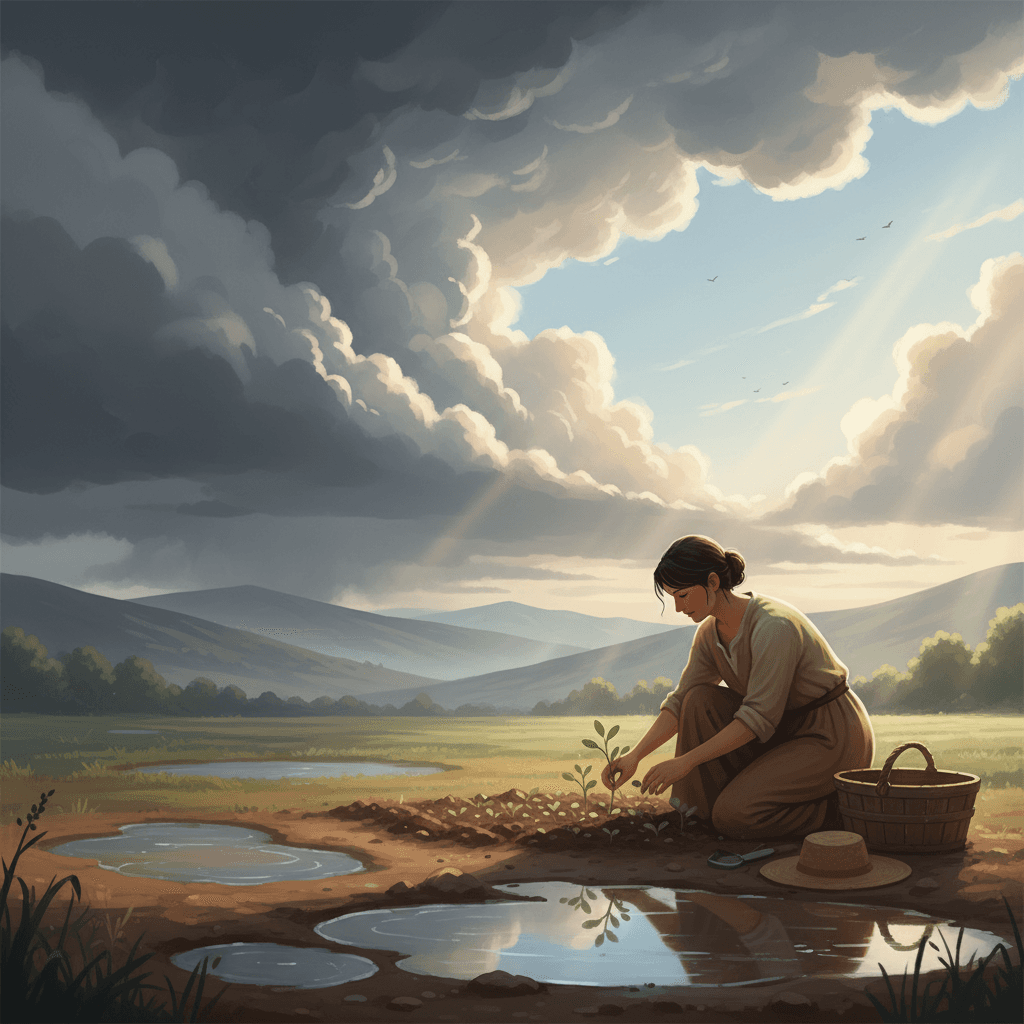
Keep a quiet steadiness; storms pass and the ground still needs tending. — Thich Nhat Hanh
—What lingers after this line?
The Wisdom Within the Metaphor
Thich Nhat Hanh’s line frames life as a field and our responsibilities as ongoing tending of the ground. The storms represent crises, conflicts, or emotional upheavals that feel all-consuming in the moment. Yet, just as weather changes, he reminds us that these disturbances are temporary. What endures is the soil of our daily life—our relationships, values, and small actions—which continues to require care. This metaphor gently redirects attention from the drama of the storm to the quieter work that sustains us over time.
Cultivating Inner Stillness Amid Turbulence
From this starting point, the teaching moves inward: tending the ground outside first requires steadiness inside. In works like “Peace Is Every Step” (1990), Thich Nhat Hanh describes mindful breathing as an anchor when emotions surge. Instead of being blown away by anger, fear, or anxiety, we learn to notice them as passing weather in the mind. This quiet steadiness is not suppression but clear awareness, allowing us to respond wisely rather than react impulsively when life becomes stormy.
Persistence of Daily Responsibilities
Yet inner calm alone is not enough; the quote insists that the ground still needs tending. Even after a crisis, children must be fed, work must be done, and communities must be maintained. In “The Miracle of Mindfulness” (1975), Thich Nhat Hanh stresses washing dishes fully, just as they are, as an example of honoring ordinary tasks. The point is that our responsibilities do not disappear when we are distressed. Instead, they offer a path to stability, providing structure and meaning as storms come and go.
Non-Drama as a Form of Courage
Moving further, the call to quiet steadiness challenges a culture that often glorifies intensity and spectacle. Remaining calm and consistent can seem passive, yet in Thich Nhat Hanh’s engaged Buddhism, this is a profound form of courage. During the Vietnam War, he advocated nonviolent action coupled with compassionate presence rather than retaliatory rage. Like farmers returning to their fields after heavy rain, such people choose rebuilding over revenge, demonstrating that resilience can be quietly heroic rather than loudly triumphant.
Applying the Teaching in Modern Life
Carrying this insight into daily living, the quote suggests practical shifts in how we handle personal storms—burnout at work, family conflict, political turmoil. Instead of abandoning routines, we can simplify and gently maintain them: a short walk, a regular bedtime, a single honest conversation each day. Over time, these small acts are like steady cultivation, restoring fertility to soil that has been battered. In this way, the teaching becomes not abstract wisdom but a guide to surviving upheaval without losing one’s sense of purpose or care.
Hope Rooted in Continuity
Ultimately, the image of storms passing and ground remaining offers a quiet form of hope. It recognizes suffering without promising instant relief, yet it trusts in the enduring nature of life’s foundations. Just as farmers know that no season is final, Thich Nhat Hanh suggests that no crisis defines the whole of our existence. By staying steady and tending what is in front of us—our body, our home, our community—we participate in renewal. Continuity itself becomes an act of faith that, after each storm, something can grow again.
Recommended Reading
As an Amazon Associate, we earn from qualifying purchases.
One-minute reflection
What feeling does this quote bring up for you?
Related Quotes
6 selectedIn the quiet of your own mind, you hold the power to reclaim your attention from the chaos of the world. — Thich Nhat Hanh
Thich Nhat Hanh
Thich Nhat Hanh’s words begin with a gentle but radical claim: the mind contains a quiet space that cannot be fully colonized by the world’s noise. Rather than portraying attention as something stolen forever by distract...
Read full interpretation →A single steady heartbeat can calm a thousand doubts. — Thich Nhat Hanh
Thich Nhat Hanh
Thich Nhat Hanh’s line begins with something almost ordinary—a heartbeat—yet treats it as a profound teacher. A single, steady beat implies continuity: life is here, now, and moving forward.
Read full interpretation →To find peace, you must stop trying to solve every problem at once. Sometimes the most productive thing you can do is simply breathe and be present. — Thich Nhat Hanh
Thich Nhat Hanh
At first glance, Thich Nhat Hanh’s insight challenges a habit many people mistake for responsibility: the need to solve every problem immediately. When the mind races from one worry to the next, it often creates more str...
Read full interpretation →The goal is not to be good at everything, but to be present for the things that matter most. — Thich Nhat Hanh
Thich Nhat Hanh
Thich Nhat Hanh’s quote gently redirects ambition. Rather than chasing excellence in every possible area, he suggests that a meaningful life depends on discernment: knowing what deserves our energy and then meeting it wi...
Read full interpretation →We have to be careful not to spend our lives anticipating the next thing. — Thich Nhat Hanh
Thich Nhat Hanh
Thich Nhat Hanh’s warning points to a quiet but pervasive habit: living in the mental future. Anticipation can feel productive—planning, improving, preparing—but it can also become a way of postponing life itself.
Read full interpretation →We are so obsessed with doing that we have no time and no room left for being. — Thich Nhat Hanh
Thich Nhat Hanh
Thich Nhat Hanh’s remark points to a modern dilemma: busyness can become so normal that it feels virtuous, even when it quietly erodes our inner life. When our days are packed with tasks, notifications, and goals, “doing...
Read full interpretation →More From Author
More from Thich Nhat Hanh →To be fully alive is to allow yourself the grace of slowing down. — Thich Nhat Hanh
Thich Nhat Hanh’s words begin with a gentle challenge to modern life: we often mistake speed for vitality, as though being busy proves that we are truly living. Yet his insight reverses that assumption.
Read full interpretation →In the quiet of your own mind, you hold the power to reclaim your attention from the chaos of the world. — Thich Nhat Hanh
Thich Nhat Hanh’s words begin with a gentle but radical claim: the mind contains a quiet space that cannot be fully colonized by the world’s noise. Rather than portraying attention as something stolen forever by distract...
Read full interpretation →To find peace, you must stop trying to solve every problem at once. Sometimes the most productive thing you can do is simply breathe and be present. — Thich Nhat Hanh
At first glance, Thich Nhat Hanh’s insight challenges a habit many people mistake for responsibility: the need to solve every problem immediately. When the mind races from one worry to the next, it often creates more str...
Read full interpretation →Gratitude is not merely an emotion; it is the practice of noticing the quiet light that persists, even when the world feels loud and uncertain. — Thich Nhat Hanh
At first glance, gratitude may seem like a simple emotional response to good fortune. Yet Thich Nhat Hanh reframes it as a discipline of attention, suggesting that thankfulness is less about waiting for ideal circumstanc...
Read full interpretation →