
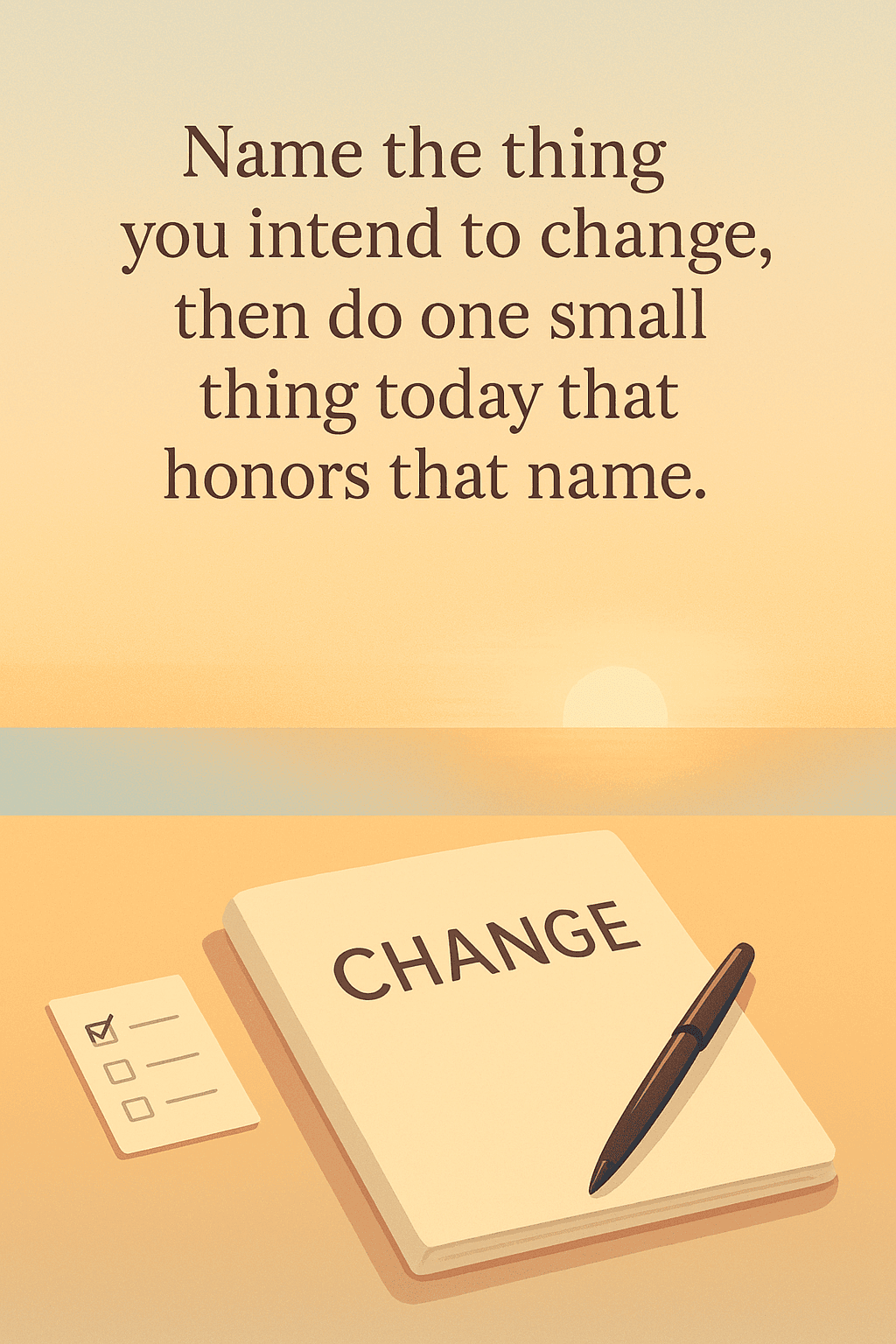
Name the thing you intend to change, then do one small thing today that honors that name. — Toni Morrison
—What lingers after this line?
The Power of Naming Our Intentions
Toni Morrison’s line urges us to begin change by naming it. To name something—whether a habit, a fear, or a dream—is to pull it out of the fog of vague dissatisfaction and into conscious focus. Much like in Genesis, where things come into being through being named, Morrison suggests that language is not just descriptive but generative. When we say, “I intend to change my relationship with work,” or “I intend to change how I care for my body,” we draw a boundary between what has been and what could be. This act of definition is the first quiet rebellion against inertia.
From Abstract Desire to Concrete Focus
Once a change is clearly named, its edges become visible, and so do the ways we might approach it. Vague wishes like “I want a better life” can paralyze because they are too large and undefined. By contrast, specifying “I intend to change my morning routine” narrows the field of action and reveals immediate next steps. This shift from abstraction to clarity resembles how writers outline a draft before composing, transforming a formless idea into a project with contours. Naming does not complete the change, but it turns a yearning into a focus that the mind can work with.
Honoring the Name Through Small Actions
Morrison’s second instruction—“do one small thing today that honors that name”—prevents us from getting trapped in ceremonial declarations that never touch daily life. Honoring the name means aligning behavior, however modest, with the intention we have spoken. If the name is “healing,” honoring it might be scheduling a therapy appointment or simply resting without guilt. If the name is “courage,” it might be sending a difficult email. In behavioral science, this echoes the idea of “micro-habits,” where tiny, consistent actions bridge the gap between who we are and who we hope to become (Fogg, *Tiny Habits*, 2019).
The Ethics of Consistency With Ourselves
By pairing naming with immediate action, Morrison also touches on integrity. Each time we name a change and then act in accordance with it, we teach ourselves that our words can be trusted. Conversely, repeatedly naming without acting erodes self-trust, much like broken promises in a relationship. The small deed becomes an ethical gesture toward oneself, a proof that our intentions are not mere performance. Philosopher Harry Frankfurt, in discussing ‘second-order desires’ in *The Importance of What We Care About* (1988), notes that we define ourselves by what we are willing to back with action. Morrison compresses this idea into a daily practice: let today’s behavior testify to what you claim to care about.
Building Momentum Through Daily Rituals
Moreover, Morrison’s emphasis on “today” anchors change in the present, rather than in an indefinitely postponed future. One small honoring action, repeated across days, accumulates into momentum. Over time, these gestures transform from deliberate efforts into identity: you are no longer someone who wants to write, but someone who writes; not someone who dreams of connection, but someone who calls, visits, and listens. This resembles the ‘compound effect’ described by Darren Hardy (2010), where small, consistent choices yield disproportionate results. In this light, Morrison’s quote is less a motivational slogan and more a ritual formula: name the direction, then let each day contribute a tangible, if humble, step along that path.
Reclaiming Agency in Overwhelming Times
Finally, the quote offers a way to reclaim agency when life feels unmanageable. Large-scale problems—personal, social, or political—can make individuals feel powerless. By inviting us to choose a name and take a single honoring action, Morrison restores a sense of scale we can work with. You may not be able to fix systemic injustice today, but you can name “justice” and, for example, learn about one issue, donate a small amount, or support a local effort. In this way, the practice does not trivialize big challenges; instead, it allows us to engage them without being crushed by their size. Change begins not in grand gestures, but in the quiet alignment between what we call important and what we actually do, today.
One-minute reflection
What feeling does this quote bring up for you?
Related Quotes
6 selectedGrowth often looks like slowing down, reassessing, and rebuilding with intention. — Erin Gregory
Erin Gregory
At first glance, growth is often imagined as constant acceleration—more output, faster decisions, visible momentum. Erin Gregory’s quote gently overturns that assumption by suggesting that real development may appear qui...
Read full interpretation →Your life does not get better by chance, it gets better by change. – Jim Rohn
Jim Rohn
This quote emphasizes the necessity of taking intentional action to improve one's life. Relying on chance alone is insufficient; active change is required.
Read full interpretation →Take action, every day, to create the life you want. — Oprah Winfrey, United States.
Oprah Winfrey, United States.
This quote emphasizes the importance of taking proactive steps daily towards achieving one's goals. It suggests that waiting for opportunities to come is not enough; one must actively create their path.
Read full interpretation →Take action, every day, in the direction of your dreams. — Paulo Coelho, Brazil.
Paulo Coelho, Brazil.
This quote emphasizes that progress towards one's dreams relies on consistent, daily efforts. Taking small steps every day accumulates to significant achievements over time.
Read full interpretation →Take action, every day, to make your dreams a reality. — Jack Canfield, United States.
Jack Canfield, United States.
This quote emphasizes that taking small, consistent actions on a daily basis is crucial in transforming dreams into reality. It suggests that progress is made through regular and persistent efforts.
Read full interpretation →Take action every day, and you will make progress every day. — Sheryl Sandberg
Sheryl Sandberg
This quote highlights the significance of taking consistent actions towards one's goals. Daily efforts, no matter how small, accumulate over time and contribute to overall progress.
Read full interpretation →More From Author
More from Toni Morrison →The building of the architecture of a novel - the craft of it - is something I never tire of. — Toni Morrison
At its core, Toni Morrison’s remark celebrates not merely storytelling, but the deliberate construction behind it. By speaking of the “architecture of a novel,” she shifts attention from inspiration alone to design, sugg...
Read full interpretation →The role of art has never been to escape reality, but to help us understand it. — Toni Morrison
At first glance, art is often treated as a refuge from hardship, a private world where pain can be softened or forgotten. Toni Morrison overturns that expectation by arguing that art’s deeper purpose is not avoidance but...
Read full interpretation →The ability to endure is the discipline of the soul. — Toni Morrison
Toni Morrison’s line shifts endurance from a mere survival trait into a deliberate inner practice: a discipline cultivated in the soul. Rather than glorifying pain for its own sake, she suggests that the capacity to cont...
Read full interpretation →You are your best thing. — Toni Morrison
Toni Morrison’s line, “You are your best thing,” quietly overturns a common habit: looking outward for proof of worth. Instead of treating love, status, or achievement as the final measure, the quote plants value inside...
Read full interpretation →