
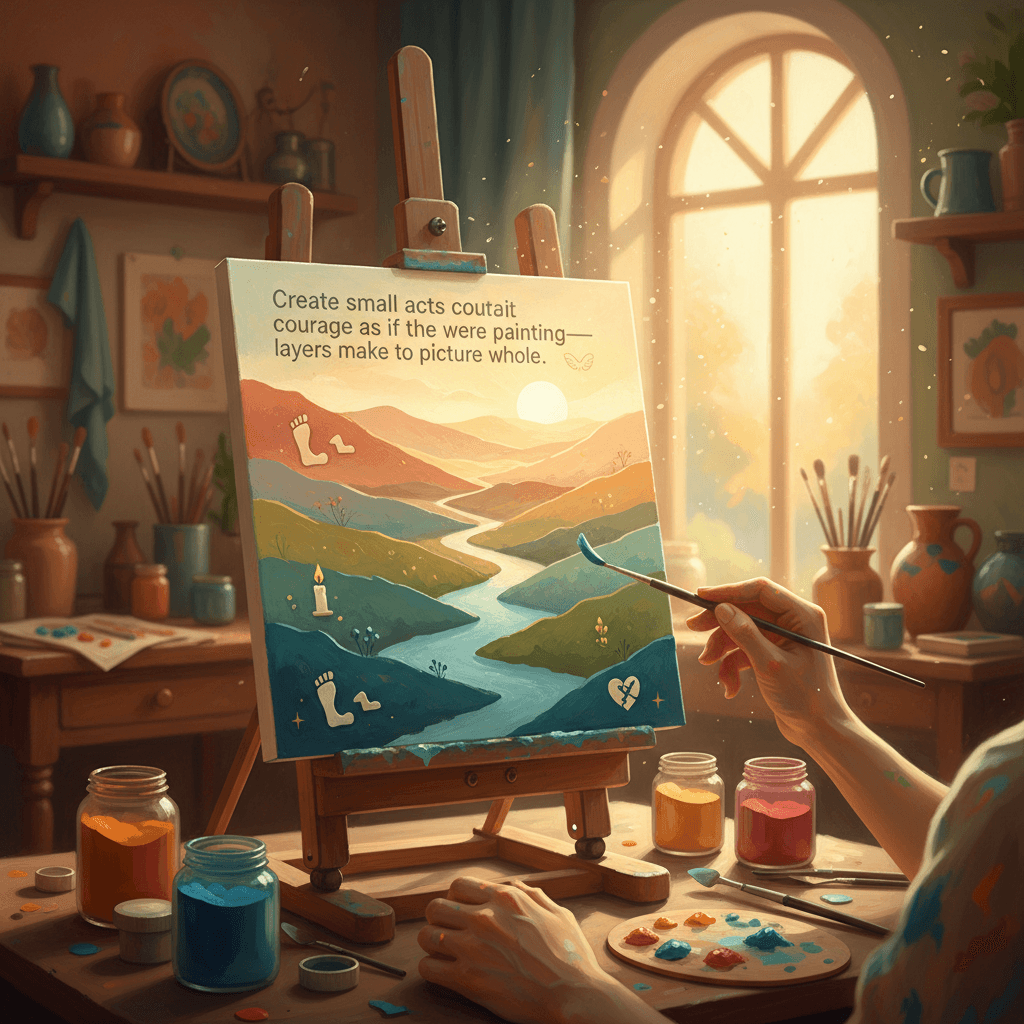
Create small acts of courage as if you were painting—layers make the picture whole. — Leonardo da Vinci
—What lingers after this line?
Courage as a Daily Practice
Da Vinci’s image begins by shrinking courage to a workable size: not a single dramatic leap, but a sequence of small acts. That framing matters because it removes the myth that bravery belongs only to heroes or crises; instead, it becomes a practice you can repeat. In this sense, speaking up once in a meeting, asking for help, or making a difficult phone call counts as a genuine stroke of courage. From there, the quote quietly suggests a shift in identity: you don’t wait to “become courageous” before acting—you act, and the repetition reshapes who you are. Each small choice becomes a building block, and the accumulation is what eventually looks like confidence.
Why the Painting Metaphor Fits
Next, the metaphor of painting emphasizes process over perfection. Paintings aren’t typically born in one pass; they emerge through underpainting, revisions, and subtle additions that only later reveal their purpose. Renaissance workshops, including those associated with da Vinci, relied on layering techniques—glazes, scumbles, and corrections—to achieve depth and lifelike realism. In the same way, courage gains depth when it’s built iteratively. A single bold gesture can be inspiring, but layered courage creates a more reliable structure—like tonal values in a portrait that make the final face feel three-dimensional rather than flat.
The Power of Tiny, Specific Actions
Then the quote points to a practical strategy: make courage concrete and small enough to do today. The “acts” are not abstract virtues but behaviors—apologizing without excuses, setting one boundary, or submitting work before it feels flawless. Because they’re manageable, these actions reduce the fear that often blocks change. Over time, tiny actions compound. Much like returning to a canvas day after day, the consistency matters more than the intensity. What once felt impossible gradually becomes familiar, and the threshold for what you can face expands almost without you noticing.
Layering Builds Resilience, Not Just Boldness
Moreover, layering implies that some strokes will be imperfect, even hidden. In painting, an early layer may be covered, yet it still contributes to the final structure; likewise, failed attempts at courage—an awkward conversation, a rejected application—aren’t wasted. They become the underlayers of resilience: evidence that you can survive discomfort and return again. This reframes setbacks as part of the composition rather than proof you should stop. The picture becomes “whole” not because every layer is beautiful, but because each one teaches the hand and steadies the eye for the next pass.
Seeing a Whole Life, Not a Single Moment
Finally, da Vinci’s line widens the lens: you are creating a picture, not performing a stunt. A whole life is the sum of decisions made in ordinary hours, and courage is often quiet—choosing integrity when no one is watching, beginning again after discouragement, or protecting what matters at a personal cost. When you view yourself as the painter, the goal becomes clearer: keep adding honest layers. In time, those small acts align into a coherent image—one that shows not just bravery in moments, but character shaped through steady, intentional creation.
Recommended Reading
As an Amazon Associate, we earn from qualifying purchases.
One-minute reflection
Where does this idea show up in your life right now?
Related Quotes
6 selectedThe way to develop self-confidence is to do the thing you fear and get a record of successful experiences behind you. — William Jennings Bryan
William Jennings Bryan
William Jennings Bryan’s statement reverses a common assumption: people often wait to feel confident before acting, yet he argues that confidence is actually built afterward. In this view, self-belief does not appear mag...
Read full interpretation →Even when you have doubts, take that step. Take chances. Mistakes are never just mistakes—they're lessons. — Lady Gaga
Lady Gaga
Lady Gaga’s quote begins with a striking premise: doubt does not have to disappear before action begins. In fact, she suggests that uncertainty is often the very condition under which courage becomes meaningful.
Read full interpretation →Emotional strength is not about suppressing feelings, but about having the courage to feel them. — Brené Brown
Brené Brown
At first glance, emotional strength is often mistaken for stoicism—the ability to remain untouched, unreadable, and perfectly controlled. Yet Brené Brown’s quote overturns that assumption by suggesting that true strength...
Read full interpretation →To know what you want to do and to do it is the same courage. — Søren Kierkegaard
Søren Kierkegaard
At first glance, Kierkegaard’s line seems to separate thought from action, yet it quickly reunites them under a single demand: courage. To know what one truly wants is not a passive discovery, because genuine self-knowle...
Read full interpretation →I have learned that if you must leave a place that you have lived in and loved, leave it any way except a slow way. — Beryl Markham
Beryl Markham
Beryl Markham’s line begins with hard-earned emotional clarity: leaving a beloved place hurts, but leaving it slowly can deepen the wound. Rather than allowing memory to settle into gratitude, a prolonged farewell turns...
Read full interpretation →Do not despise the small, incremental work; a mountain is only a collection of stones, placed one by one with care. — Maria Montessori
Maria Montessori
At its core, Maria Montessori’s statement restores dignity to work that appears modest or repetitive. She reminds us that progress rarely arrives as a single grand gesture; instead, it emerges through careful accumulatio...
Read full interpretation →More From Author
More from Leonardo da Vinci →It is easier to resist at the beginning than at the end. — Leonardo da Vinci
Leonardo da Vinci’s remark turns attention to a simple but powerful truth: the first moment of temptation, error, or excess is usually the easiest point at which to intervene. At the beginning, a habit is still weak, a d...
Read full interpretation →Observe, imagine, then act — invention begins when thought meets motion — Leonardo da Vinci
Leonardo’s sequence—observe, imagine, then act—reads like a practical recipe for invention rather than a lofty slogan. It starts with disciplined attention to the world, moves into the mind’s power to reshape what it has...
Read full interpretation →Seek progress over applause; mastery outlasts praise. — Leonardo da Vinci
Leonardo da Vinci’s dictum, “Seek progress over applause; mastery outlasts praise,” redirects attention from the crowd to the craft. Instead of chasing fleeting approval, he urges a quieter, steadier pursuit: becoming tr...
Read full interpretation →Turn the blank space into a map of your next brave decision. — Leonardo da Vinci
Leonardo da Vinci’s invitation to “turn the blank space into a map” begins with an often-overlooked truth: emptiness is not merely absence, but potential. A blank page, an unplanned year, or a paused career can feel inti...
Read full interpretation →