
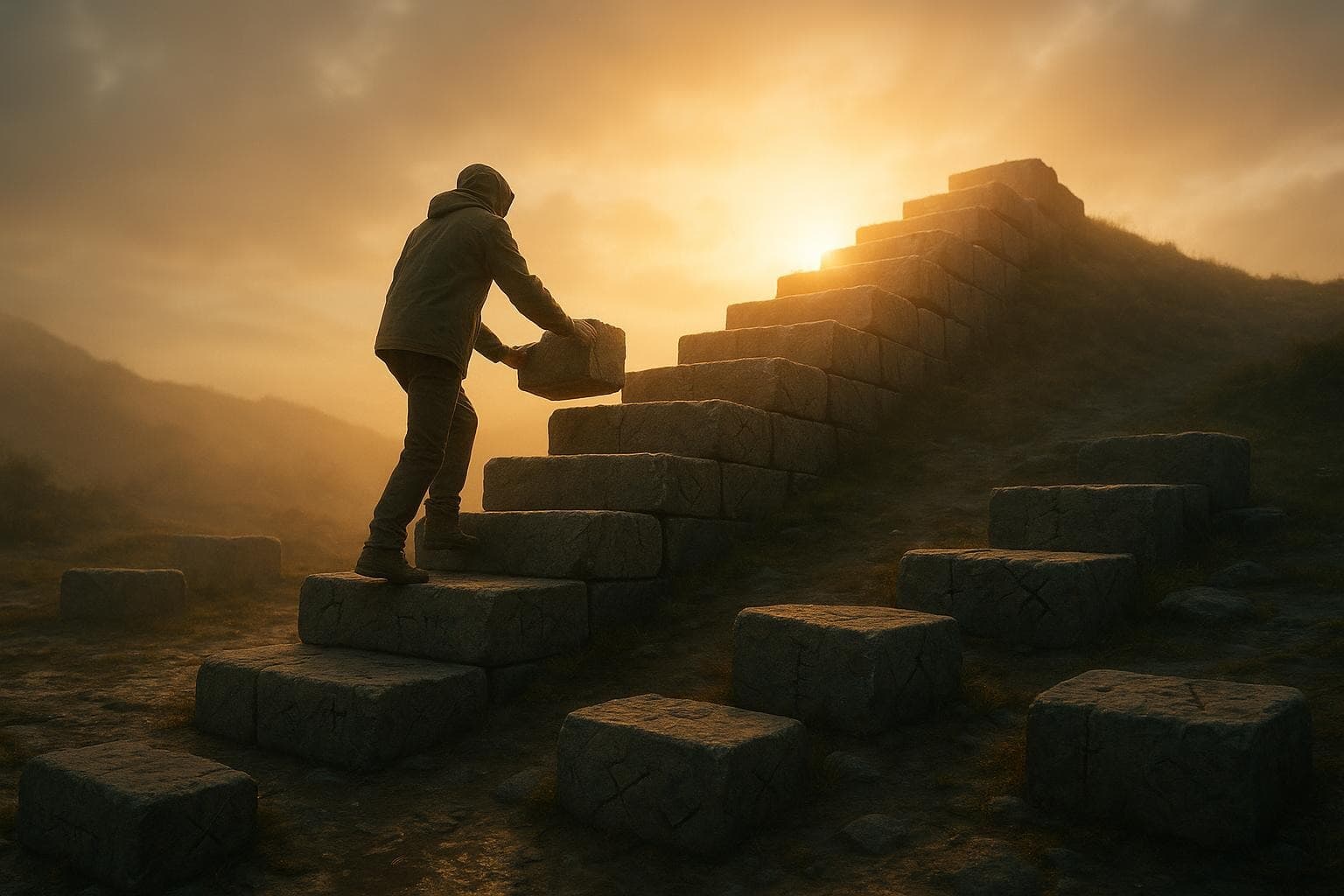
Collect your setbacks and stack them into a stairway upward. — Isabel Allende
—What lingers after this line?
Reframing Failure as Material
Isabel Allende’s line begins by denying setbacks the final word. Instead of treating disappointments as evidence of incapacity, she casts them as raw material—solid, stackable, and ultimately useful. The image is practical: a setback is not an abstract shame but a tangible block you can place somewhere. From there, the quote invites a subtle shift in identity. You are not the sum of what went wrong; you are the builder who decides what to do with it. That reframe doesn’t erase pain, but it changes the meaning of pain from “proof I can’t” to “something I can use.”
The Architecture of Resilience
Once failure becomes material, resilience becomes a kind of craft. A stairway is built one step at a time, and each step is modest; it doesn’t need to be heroic to be functional. In that sense, Allende suggests progress is less about sudden transformation and more about incremental assembly. This also implies structure: steps have to be arranged, not merely collected. Setbacks alone don’t guarantee growth; what matters is the order you impose—reflection, adjustment, and a next attempt that differs from the last. The stairway metaphor makes resilience feel teachable rather than mystical.
Learning Through Iteration
The quote’s quiet power lies in its endorsement of repetition. If you’re stacking setbacks, you’re still moving, still building, still in the project. This mirrors how many disciplines advance: scientists revise hypotheses, writers draft and cut, athletes analyze losses and retrain. Thomas Edison famously reframed his many unsuccessful attempts at creating a practical light bulb as finding ways that didn’t work, a story often cited as a cultural emblem of iteration. Whether perfectly reported or not, the anecdote persists because it captures Allende’s idea: each misstep can narrow the path toward a workable next step.
Agency After Disappointment
Allende’s wording—“collect” and “stack”—puts the emphasis on choice. Setbacks may be unavoidable, but interpretation is not predetermined. Collecting implies you don’t disown what happened; stacking implies you don’t stay underneath it. In other words, the quote argues for agency even when circumstances feel humiliating or unfair. This matters because disappointment often scatters attention: people either ruminate or numb out. By proposing a physical action in the mind—gather, then arrange—Allende offers a small ritual that turns emotional chaos into a plan. The plan may be simple, but it restores direction.
Meaning-Making and Narrative
A stairway is also a story: it has a “before” at the bottom and an “after” at the top. Setbacks, viewed in isolation, can feel random; stacked into a sequence, they become a narrative of becoming. This is why people often describe tough periods as formative only in retrospect—because the later step explains the earlier one. Viktor Frankl’s *Man’s Search for Meaning* (1946) argues that humans can endure extraordinary suffering when they can find meaning in it. Allende’s metaphor complements that idea by showing how meaning is constructed: not by denying the setback, but by placing it into a climb.
From Metaphor to Practice
The final implication is hopeful but not naive: an upward stairway doesn’t pretend the blocks were pleasant to acquire. It simply insists they can serve the ascent. Practically, that can look like keeping a “failure log” that records what happened, what you learned, and what you’ll try next, or turning a rejection into a revised portfolio and a new submission schedule. Over time, the accumulation becomes visible evidence of persistence. What once felt like a pile of defeats starts to resemble a structure—one you can stand on. And with each step, the original setback changes function: it no longer traps you; it lifts you.
One-minute reflection
What feeling does this quote bring up for you?
Related Quotes
6 selectedWe all have an unexpected reserve of strength inside that emerges when life puts us to the test. — Isabel Allende
Isabel Allende
Isabel Allende’s line begins with a quiet provocation: most people underestimate what they can carry. The “unexpected reserve” implies a kind of strength that isn’t visible in ordinary routines, because daily life rarely...
Read full interpretation →Resilience is not just enduring the storm; it is learning to harvest the rain to nourish the roots you've already planted. — Elizabeth Edwards
Elizabeth Edwards
At first glance, Elizabeth Edwards rejects the common image of resilience as simple endurance. To ‘endure the storm’ suggests gritting one’s teeth and waiting for suffering to pass, yet her metaphor quickly moves further...
Read full interpretation →Our resilience increases as we recognize the magnitude of what we have already accomplished. — Patricia O'Gorman
Patricia O'Gorman
Patricia O'Gorman’s insight begins with a simple but powerful shift in perspective: resilience is not built only in the present struggle, but also in the act of looking back. When people pause to see how much they have a...
Read full interpretation →Self-mastery rarely looks impressive. It simply holds. — James Clear
James Clear
James Clear’s observation begins by stripping self-mastery of glamour. It is not usually a heroic moment, a public triumph, or a dramatic display of willpower.
Read full interpretation →When I hear somebody sigh, 'Life is hard,' I am always tempted to ask, 'Compared to what?' — Sydney J. Harris
Sydney J. Harris
Sydney J. Harris’s remark begins with an ordinary expression of fatigue: “Life is hard.” Yet his response, “Compared to what?” quietly turns complaint into inquiry.
Read full interpretation →Don't fight the challenges. Just find a new way to stand. — Germany Kent
Germany Kent
Germany Kent’s words begin with a quiet reversal of instinct: instead of treating every challenge as an enemy to defeat, she invites us to reconsider our posture toward difficulty. The emphasis is not on surrender, but o...
Read full interpretation →More From Author
More from Isabel Allende →Show up, show up, show up, and after a while the muse shows up, too. — Isabel Allende
Isabel Allende flips a common fantasy about creativity: that inspiration arrives first and then the work can begin. Instead, she suggests the reverse—your presence at the page, desk, or craft is what summons the muse.
Read full interpretation →We all have an unexpected reserve of strength inside that emerges when life puts us to the test. — Isabel Allende
Isabel Allende’s line begins with a quiet provocation: most people underestimate what they can carry. The “unexpected reserve” implies a kind of strength that isn’t visible in ordinary routines, because daily life rarely...
Read full interpretation →Turn memory into fuel and sail toward the life you imagine — Isabel Allende
Isabel Allende’s line reframes memory not as a museum of what’s gone, but as stored energy—something that can propel you forward if you learn how to use it. Instead of asking you to forget the past, she invites you to co...
Read full interpretation →The one who seeks the truth runs the risk of finding it. - Isabel Allende
This quote highlights the idea that seeking the truth is a courageous and potentially perilous endeavor. It suggests that the journey to uncover the truth can lead to unexpected and sometimes unsettling discoveries.
Read full interpretation →