
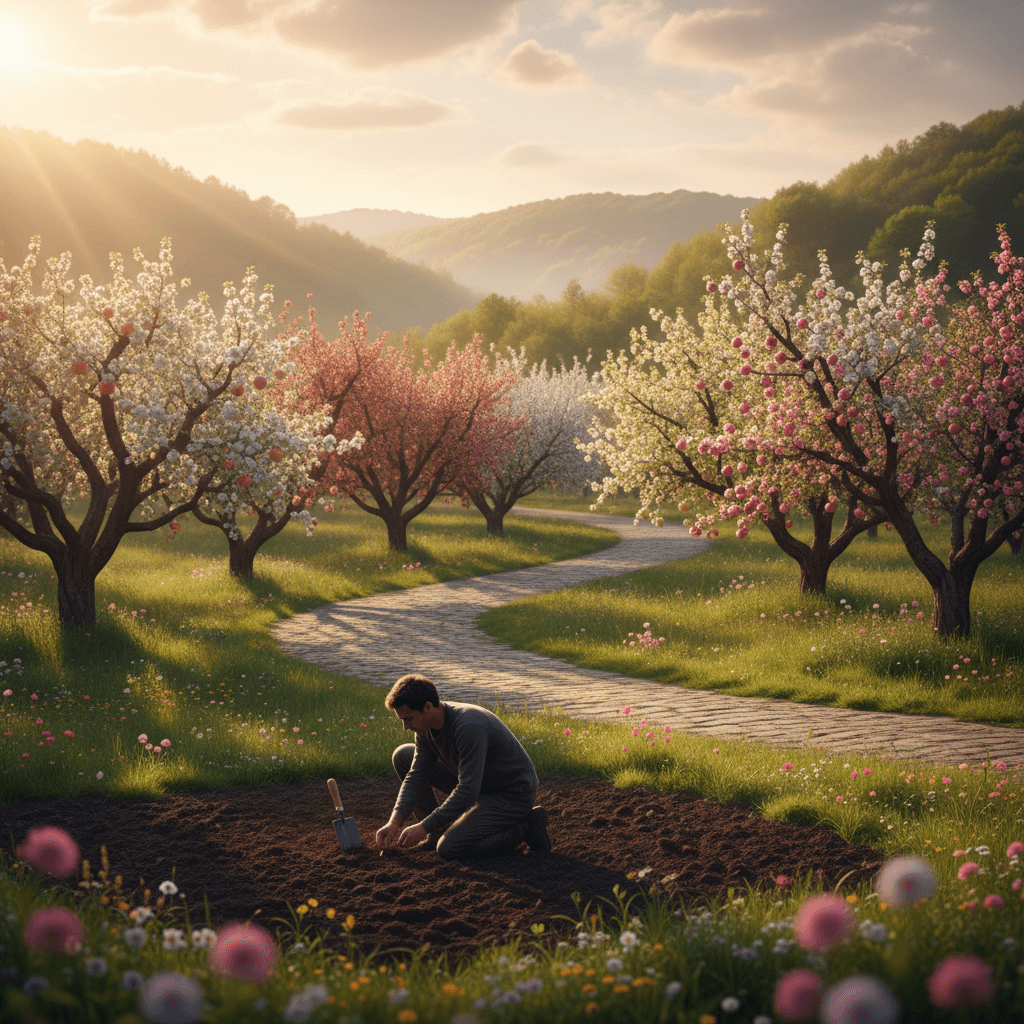
Plant hope like trees of fruit: their shade and harvest arrive long after the first seed. — Kahlil Gibran
—What lingers after this line?
Hope as a Long-Growing Seed
Gibran frames hope as something planted rather than simply felt, shifting it from a mood into a practice. A seed is small, even unimpressive, yet it carries a future that can’t be rushed into view. In the same way, hope begins as a modest decision—showing up, trying again, choosing patience when results are invisible. From there, the metaphor implies time as an essential ingredient. Just as soil, seasons, and steady care do most of the work out of sight, hope often matures quietly beneath daily life, gaining strength before it offers anything we can point to as proof.
Fruit Trees and the Discipline of Waiting
Extending the image, fruit trees teach that worthwhile outcomes require sustained attention without immediate payoff. You water before you taste; you prune before you enjoy shade. That delay is not failure but the normal rhythm of growth, and Gibran invites us to interpret slow progress as part of the promise rather than a contradiction of it. This perspective reframes impatience as a misunderstanding of the timeline. When we expect instant harvest, we can abandon the very work that would have made it possible. By contrast, planting hope means committing to processes—learning, healing, building trust—that mature on longer horizons.
Shade: Hope’s Quiet Kind of Protection
The mention of shade broadens hope beyond personal reward. Shade is comfort, refuge, and relief—often given to people who did not plant the tree. In that sense, hope becomes an ethical act: we nurture what can later shelter others, even if we never fully witness its impact. This naturally leads to the idea of legacy. A person who mentors a struggling student, starts a community garden, or funds a library wing may not see the complete transformation, yet their early labor can become someone else’s midday rest. Hope, then, is generosity projected into the future.
Harvest: Delayed Results and Real Nourishment
Harvest adds another layer: hope is not only soothing but sustaining. Fruit represents tangible outcomes—skills mastered, relationships repaired, opportunities earned—arriving after a long stretch of ordinary care. Gibran’s line suggests that the nourishment we seek is often produced by consistent, unglamorous habits rather than dramatic turning points. Because harvest is seasonal, it also implies cycles: there are times of abundance and times of apparent barrenness. Yet a mature tree can bear again, and so the patient cultivation of hope can yield repeated benefits, not just a single moment of payoff.
Resilience Through Invisible Growth
What makes this metaphor especially practical is its realism about unseen progress. In early stages, a seedling’s most important work happens underground, where roots spread before branches rise. Likewise, many human changes—recovering from grief, rebuilding confidence, learning to trust—start internally, with no immediate external evidence. Therefore, hope becomes a way to honor invisible growth without demanding constant confirmation. It asks us to keep tending the roots: rest, reflection, honest effort, and support from others. Over time, what was hidden begins to appear, and the world can finally see what has been forming all along.
Choosing the Planter’s Mindset
Ultimately, Gibran encourages a planter’s mindset: act now for benefits later. This doesn’t deny present hardship; it simply refuses to let the present have the final word. Planting hope can be as small as applying for one more job, making one appointment, practicing one skill, or offering one apology—the kinds of seeds that look minor today but can become enduring structure. And because trees are communal assets as much as personal ones, the quote closes with an implicit invitation to continuity. When we plant in faith, we join a long chain of caretakers, trusting that time and attention can convert a single seed into shade and harvest for many.
Recommended Reading
As an Amazon Associate, we earn from qualifying purchases.
One-minute reflection
Where does this idea show up in your life right now?
Related Quotes
6 selectedLet your hands shape hope like pottery — steady, patient, beautiful. — Kahlil Gibran
Kahlil Gibran
Gibran’s image begins by treating hope as a craft rather than a wish. Instead of arriving suddenly, hope is formed through deliberate effort—pressed, guided, and revised over time.
Read full interpretation →In the heart of every winter lives a throbbing spring, and behind every night comes a smiling dawn. - Khalil Gibran
Kahlil Gibran
This quote emphasizes the idea of hope and renewal. It suggests that even in the darkest and coldest times (winter), there is always the promise of rejuvenation and warmth (spring).
Read full interpretation →In the heart of every winter lives a throbbing spring, and behind every night comes a smiling dawn. - Khalil Gibran
Kahlil Gibran
This quote suggests that even in our darkest and most challenging times (winter and night), there is always the promise of better days ahead (spring and dawn). It emphasizes the cyclical nature of life and the certainty...
Read full interpretation →In the heart of every winter lives a throbbing spring, and behind every night, comes a smiling dawn. - Khalil Gibran
Kahlil Gibran
This quote emphasizes the natural cycles of the world, where harsh winters eventually give way to vibrant springs, and dark nights are always followed by bright mornings. It speaks to the inevitable rhythm and balance fo...
Read full interpretation →In the heart of every winter lives a throbbing spring, and behind every night comes a smiling dawn. - Khalil Gibran
Kahlil Gibran
This quote conveys a message of hope and the inevitability of renewal. It suggests that even in the darkest and coldest times, there is the promise of warmth and light to come.
Read full interpretation →In the heart of every winter lives a pulsating spring, and behind every night, comes a smiling dawn. - Khalil Gibran
Kahlil Gibran
This quote emphasizes that even during the darkest and coldest times in life, there is always a promise of renewal and hope, symbolized by spring and dawn. It reassures us that hardships are temporary and better times ar...
Read full interpretation →More From Author
More from Kahlil Gibran →March on. Do not tarry. To go forward is to move toward perfection. — Kahlil Gibran
Gibran’s opening imperative—“March on. Do not tarry.”—sets a tone of disciplined urgency.
Read full interpretation →There must be spaces in your togetherness, and let the winds of the heavens dance between you. — Kahlil Gibran
Gibran’s line opens with a gentle paradox: he speaks to people who are already “together,” yet insists that togetherness is healthiest when it includes room. Rather than portraying love as fusion, he frames it as a relat...
Read full interpretation →Our anxiety does not come from thinking about the future, but from wanting to control it. — Kahlil Gibran
Kahlil Gibran reframes anxiety as something more specific than mere anticipation. The future itself—uncertain, unfolding, and not yet real—doesn’t automatically distress us; rather, distress appears when we demand certai...
Read full interpretation →Work on the bright corner of your world and light will spread. — Kahlil Gibran
Kahlil Gibran’s line points to a deceptively simple strategy for change: begin with what is closest and most workable. “Your world” need not mean the entire planet; it can mean your desk, your household, your street, or...
Read full interpretation →