
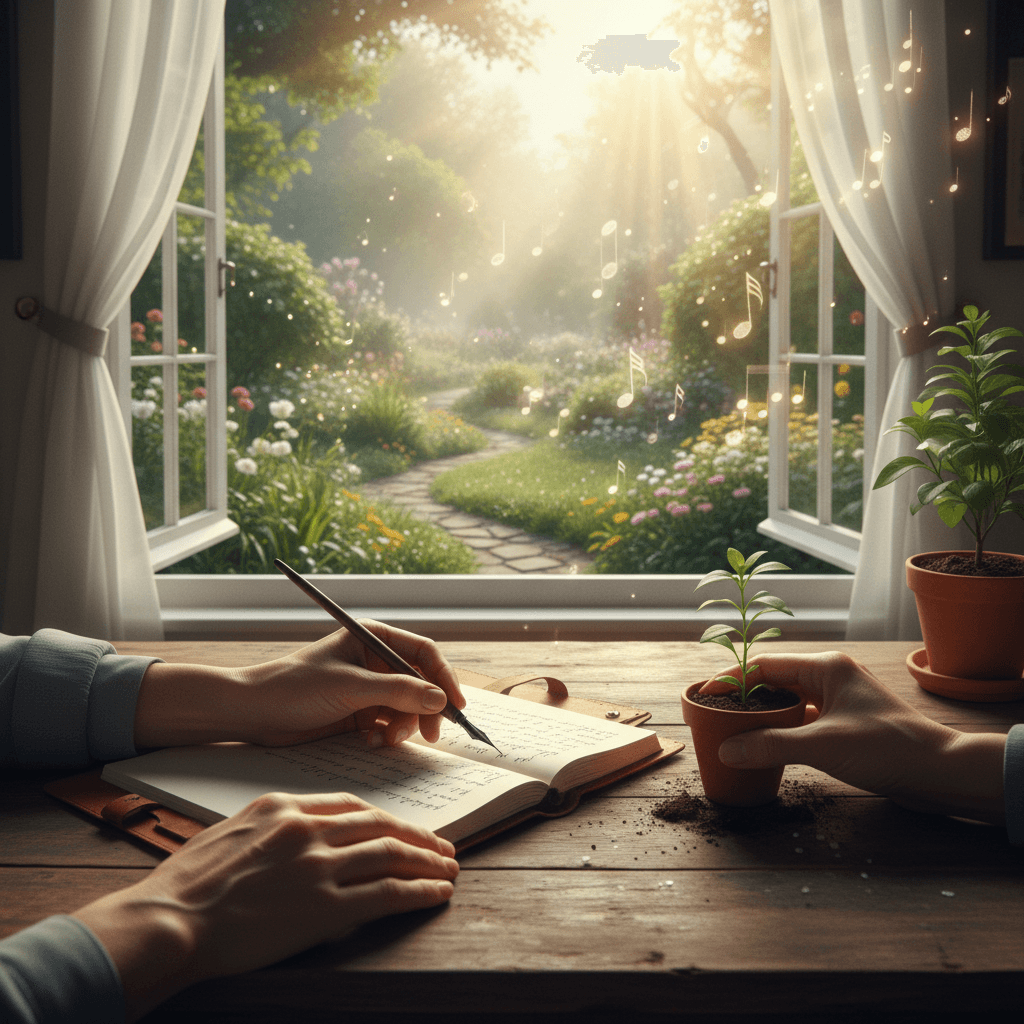
Make your hands busy with making—words, gardens, music—and life answers back. — Pablo Neruda
—What lingers after this line?
The Work of Making as an Invitation
Neruda’s line frames creativity less as self-expression and more as initiation: when you keep your hands busy making, you open a channel through which the world can respond. The emphasis on “hands” matters, because it grounds the idea in physical effort—writing, planting, practicing—rather than in abstract inspiration. In this view, life doesn’t “answer back” to passive wishing; it replies to engagement. From the start, the quote suggests a simple sequence: do the work first, and meaning follows. That order reverses the common hope that clarity arrives before action, proposing instead that action is what coaxes clarity into existence.
Words: Language as a Tool for Listening
Beginning with “words,” Neruda hints that writing is not merely speaking outward but also discovering what you didn’t know you felt. As you draft sentences, revise them, and search for the right rhythm, the page pushes back with constraints and surprises; the act of shaping language becomes a form of dialogue. Neruda’s own work, such as “Ode to a Large Tuna in the Market” from *Elemental Odes* (1954), often turns ordinary objects into partners in conversation, as if attention itself were a creative force. In practice, many people recognize this: you sit down to write a paragraph and end up realizing what you actually think. The “answer” is the unexpected insight that only arrived because the hands kept moving.
Gardens: Patience, Seasons, and Reciprocity
The garden image expands the idea from inner discovery to a living relationship with time. Gardening forces you to collaborate with conditions you can’t fully control—weather, soil, pests—so the response from life is tangible: a seed sprouts, a plant struggles, a harvest surprises you. That feedback loop turns effort into evidence, teaching through results rather than promises. Moreover, gardens make the quote’s reciprocity concrete. You give water and care, and life gives back growth, fragrance, and food, though never on a perfectly predictable schedule. In that way, the garden becomes a lesson in creative faith: you act consistently, and the world gradually reveals what your actions have made possible.
Music: Discipline That Creates Its Own Joy
When Neruda adds “music,” he points to an art where repetition is unavoidable and where progress often arrives subtly. Practicing scales or rehearsing with others can feel mechanical, yet over time the body learns, the ear sharpens, and suddenly a phrase sings. Here, life “answers back” as resonance—both literal sound and the emotional lift that comes when effort turns into fluency. This also highlights a deeper principle: creativity is not always a lightning bolt; it’s a routine that becomes meaningful through accumulation. Like a musician who plays daily and one day notices a new ease in the hands, the maker receives encouragement not as praise from the outside but as capability blooming from within.
Making as a Way Through Uncertainty
Linking these examples, the quote offers making as a practical response to doubt, grief, or aimlessness. When the mind loops, the hands can anchor you in a task small enough to begin yet rich enough to matter. A person who starts journaling after a difficult breakup, or who plants herbs on a windowsill during a stressful season, often finds that the work doesn’t erase pain but does produce motion—and motion invites new possibilities. Consequently, “life answers back” can mean that circumstances shift, but it can also mean you shift. The answer might be a calmer nervous system, a clearer decision, or a renewed sense of agency.
The Reply Life Gives: Meaning, Connection, and Change
Ultimately, Neruda suggests that making is how you participate in the world rather than merely interpret it. The reply you receive may arrive as a finished poem, a thriving bed of tomatoes, a melody that finally lands, or the unexpected meeting of another person drawn to what you’re building. In each case, creation becomes a social and existential bridge: what you make alters the environment, and the altered environment reshapes you. By ending with “life answers back,” the quote leaves the conversation open-ended. The point is not to control the response, but to begin speaking in the only language life reliably hears—steady, embodied effort.
One-minute reflection
What does this quote ask you to notice today?
Related Quotes
6 selectedI have found that if you love life, life will love you back. — Arthur Rubinstein
Arthur Rubinstein
At its heart, Arthur Rubinstein’s remark suggests that life answers the attitude we bring to it. To love life is not to deny pain or difficulty; rather, it is to meet experience with receptivity, gratitude, and enthusias...
Read full interpretation →When you are in the middle of a creative block, remember that the work is not the point; the point is the practice of showing up. — Twyla Tharp
Twyla Tharp
Twyla Tharp’s quote shifts attention away from the finished product and toward the habit that makes creation possible in the first place. In the middle of a creative block, it is easy to believe that nothing matters unle...
Read full interpretation →Everything we do should be a result of our gratitude for what has been done for us. — Anne Lamott
Anne Lamott
Anne Lamott’s statement frames gratitude not as a passing feeling but as a moral engine. At its core, the quote suggests that our choices should emerge from an awareness that much of what sustains us—care, opportunity, f...
Read full interpretation →We might think we are nurturing our garden, but of course it's our garden that is really nurturing us. — Jenny Uglow
Jenny Uglow
At first glance, Jenny Uglow’s remark seems to describe a simple exchange: we water, weed, and prune, and the garden flourishes. Yet her deeper point is a reversal of ownership and care.
Read full interpretation →Start with one honest gesture and the world will learn to answer. — Langston Hughes
Langston Hughes
Langston Hughes frames honesty not as a grand manifesto but as a single, deliberate gesture—something concrete enough to attempt today. The line implies that integrity is contagious: once it appears in the open, it chang...
Read full interpretation →Turn thought into practice; let your pages become pathways — Virginia Woolf
Virginia Woolf
Virginia Woolf’s line, “Turn thought into practice; let your pages become pathways,” urges us to treat ideas not as fragile abstractions but as beginnings of action. Thought, in this view, is a seed that withers if it re...
Read full interpretation →More From Author
More from Pablo Neruda →Let the rain kiss you. Let the rain beat upon your head with silver liquid drops. — Pablo Neruda
Neruda’s lines open as a gentle imperative: instead of bracing against bad weather, we are asked to welcome it. “Let the rain kiss you” reframes rain as a gesture offered to the body rather than an inconvenience imposed...
Read full interpretation →Build a bridge of resolve and walk across it one brave step at a time. — Pablo Neruda
Neruda’s image begins with a striking implication: resolve is not merely a feeling you wait for, but a structure you build. A bridge doesn’t appear because the river is intimidating; it exists because someone decided to...
Read full interpretation →Let each sunrise find you leaning toward action. — Pablo Neruda
Neruda’s line frames each sunrise as more than scenery; it’s a daily reset that gently pressures us to move. “Leaning” matters because it suggests a posture, not a perfect performance—an inclination toward doing, even be...
Read full interpretation →Dream with palms open; then reach and harvest what you imagined. — Pablo Neruda
Neruda’s “palms open” immediately frames dreaming as an act of receptivity rather than clenched desire. An open hand can receive rain, light, seeds, or help; it suggests humility and readiness, not possession.
Read full interpretation →