
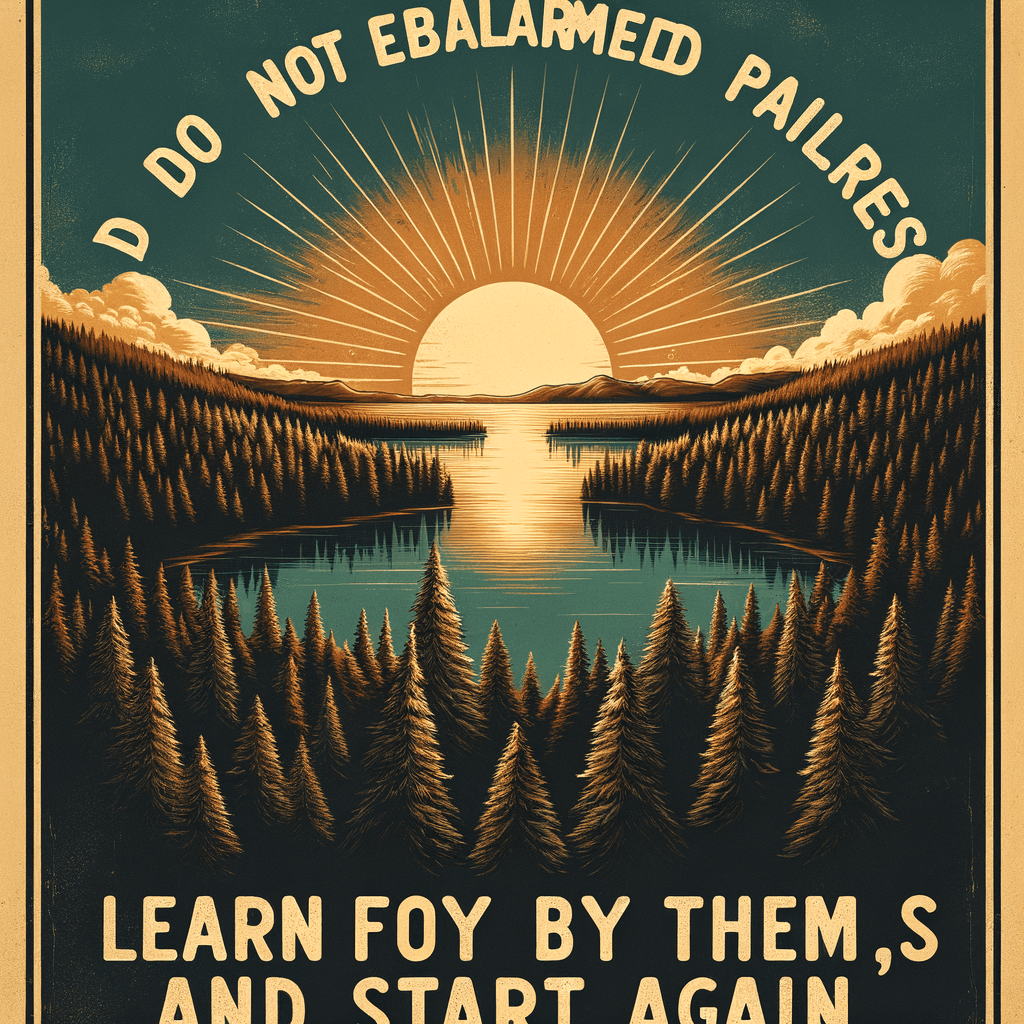
Do not be embarrassed by your failures, learn from them and start again. — Richard Branson
—What lingers after this line?
Productive Perspective on Failure
This quote emphasizes the importance of viewing failures as opportunities for learning and growth rather than sources of shame or embarrassment. By adopting this mindset, individuals can continually improve and refine their approaches.
Resilience and Perseverance
Richard Branson highlights the value of resilience, suggesting that bouncing back from setbacks with newfound knowledge and determination is crucial for long-term success.
Positive Mindset
The quote encourages maintaining a positive attitude in the face of failure. Rather than being disheartened, one should analyze what went wrong and use that information to make better decisions in the future.
Continual Improvement
It underscores the iterative process of achieving goals. Success is often the result of multiple attempts, each informed by the lessons learned from previous failures, thereby paving the way for eventual success.
Personal Growth
The statement also touches on personal development. Failing and learning from those experiences can lead to increased self-awareness, stronger character, and greater competence over time.
Vision of Richard Branson
Richard Branson, an entrepreneur and founder of the Virgin Group, is known for his adventurous spirit and innovative mindset. His quote reflects his belief that risk-taking and learning from failure are integral parts of the entrepreneurial journey.
One-minute reflection
What's one small action this suggests?
Related Quotes
6 selectedYou don't have to be perfect, just willing to start again. — Robert Downey Jr.
Robert Downey Jr.
At its core, Robert Downey Jr.’s remark replaces perfection with persistence. Rather than treating failure as a final verdict, it presents life as a series of returns—moments when a person chooses to begin again despite...
Read full interpretation →When I hear somebody sigh, 'Life is hard,' I am always tempted to ask, 'Compared to what?' — Sydney J. Harris
Sydney J. Harris
Sydney J. Harris’s remark begins with an ordinary expression of fatigue: “Life is hard.” Yet his response, “Compared to what?” quietly turns complaint into inquiry.
Read full interpretation →Don't fight the challenges. Just find a new way to stand. — Germany Kent
Germany Kent
Germany Kent’s words begin with a quiet reversal of instinct: instead of treating every challenge as an enemy to defeat, she invites us to reconsider our posture toward difficulty. The emphasis is not on surrender, but o...
Read full interpretation →Optimist: someone who figures that taking a step backward after taking a step forward is not a disaster, it's more like a cha-cha. — Robert Brault
Robert Brault
Robert Brault’s line begins with a witty redefinition: an optimist is not someone who denies backward motion, but someone who interprets it differently. Instead of treating a setback as proof of failure, the optimist see...
Read full interpretation →A mind grows by staying with difficulty long enough for the experience to change it. — Mary Catherine Bateson
Mary Catherine Bateson
Mary Catherine Bateson’s observation begins with a quiet but demanding truth: the mind does not grow merely by encountering difficulty, but by remaining with it. Challenge becomes transformative only when we resist the u...
Read full interpretation →When you are friends with your storm, you dance, instead of getting blown away. — Michael Bassey Johnson
Michael Bassey Johnson
Michael Bassey Johnson’s line begins with a striking reversal: the storm is not merely an enemy to survive, but a force one can learn to understand. In this sense, the storm may represent grief, fear, conflict, uncertain...
Read full interpretation →More From Author
More from Richard Branson →Screw it, let's do it. — Richard Branson
Richard Branson’s line, “Screw it, let’s do it,” sounds like a casual impulse, yet it distills a lifetime of entrepreneurial behavior into eight words. Rather than waiting for perfect conditions, Branson champions a bias...
Read full interpretation →Take action seriously, but don't forget to have fun while you're doing it. — Richard Branson
This quote emphasizes the importance of maintaining a balance between seriousness in work and the enjoyment of the journey. It suggests that success can be achieved without sacrificing joy.
Read full interpretation →If you are going to rise, you might as well be a hot air balloon. — Richard Branson
This quote encourages individuals to rise with purpose and enthusiasm. If one is set on succeeding or elevating themselves, they should do so in the most impressive and inspiring way possible, like a hot air balloon risi...
Read full interpretation →Growth begins when we start to think outside the box. — Richard Branson
The quote encourages individuals to break away from traditional frameworks and routines. True growth often comes from challenging the norm and exploring unconventional approaches.
Read full interpretation →