
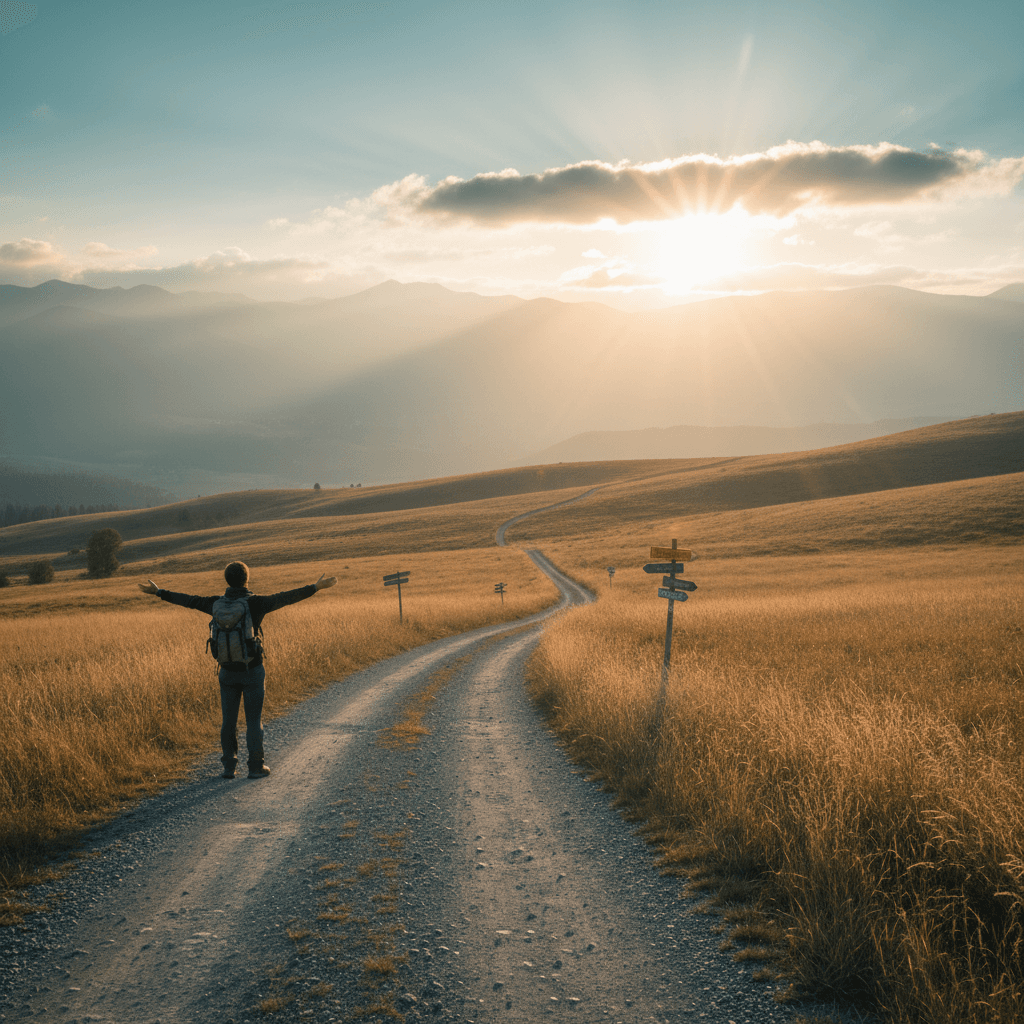
Face the stretch of life as an open road for discovery, not a wall to avoid. — Albert Camus
—What lingers after this line?
Reframing Life’s Horizon
Camus’ image hinges on a simple choice of metaphor: an “open road for discovery” versus a “wall to avoid.” The road suggests motion, curiosity, and an invitation to keep going even when the destination is unclear, while the wall implies fear, stoppage, and a life organized around what must not be faced. By urging us to “face the stretch of life,” he places agency back in our hands, as if the future is not a threat but a landscape that can be traveled. This reframing matters because it changes what we do with uncertainty. Instead of treating the unknown as evidence that we should retreat, Camus implies that not knowing is precisely the condition that makes discovery possible, turning anxiety into a kind of forward-looking attention.
Camus and the Courage of the Absurd
This road-versus-wall contrast also fits Camus’ broader philosophy of the absurd: we crave clear meaning, yet the world offers no final guarantees. In *The Myth of Sisyphus* (1942), he describes the task of living without appeal to certainty, refusing both despair and comforting illusions. Seen through that lens, the “wall” becomes the temptation to avoid life’s ambiguity—by shrinking our world, postponing decisions, or hiding behind rigid answers. By contrast, the “open road” represents revolt in Camus’ sense: continuing to live fully, eyes open, even when life cannot be neatly resolved. The discovery is not only of places or achievements, but of a way to inhabit uncertainty without being ruled by it.
Avoidance: When the Wall Wins
Avoidance often masquerades as prudence. Someone delays applying for a new role until they feel “ready,” stays in a stale relationship to avoid conflict, or never starts the creative project because failure might sting. Over time, the future begins to feel like a series of barriers, and a person’s life narrows into routes that minimize discomfort rather than expand possibility. Camus’ warning is subtle: walls are not always external; they are frequently constructed from habits of retreat. Once the wall metaphor takes hold, discovery looks reckless, and safety becomes the highest good. The cost, however, is that life’s “stretch” becomes something endured rather than explored.
Discovery as a Daily Practice
If we accept the road metaphor, discovery becomes less about grand adventures and more about daily choices to engage rather than sidestep. That might mean asking the harder question in a conversation, learning a skill with no guarantee of mastery, or visiting a neighborhood you’ve ignored because it feels unfamiliar. Each small step treats life as navigable terrain instead of an obstacle course. Notably, discovery here is active, not passive. Roads don’t carry us; we walk them. In that sense, Camus’ line implies discipline: openness is not mere optimism, but a repeated decision to meet experience directly, especially when it is inconvenient or unclear.
Risk, Fear, and the Price of Movement
A road includes risk—wrong turns, fatigue, weather—so Camus is not promising comfort. Rather, he suggests that the alternative is worse: a life structured around avoidance steadily replaces genuine fear with chronic dullness and a lingering sense of having missed something. The road may hurt, but it also keeps us in contact with reality, which is where meaning is made, even if meaning is never finalized. Here Camus aligns with a practical wisdom found in many traditions: courage is not the absence of fear, but the refusal to let fear dictate the boundaries of living. The wall is built from the demand to feel safe before moving; the road begins when we move while still afraid.
Living Forward Without Denying Limits
Finally, facing life as an open road does not deny limits—loss, failure, and mortality remain. In fact, Camus’ thought often becomes sharper precisely because he refuses comforting fantasies. The difference is how limits are interpreted: a wall says “stop,” while a road says “continue, with awareness.” Even grief can become part of discovery, revealing what we value and how we choose to carry it. In this closing sense, Camus’ line is an ethic of forward motion. It invites us to meet life’s length with curiosity and presence, not because the journey guarantees a tidy conclusion, but because the act of traveling—consciously, stubbornly, honestly—is itself a form of dignity.
One-minute reflection
Why might this line matter today, not tomorrow?
Related Quotes
6 selectedEmbrace the absurdity of fear and move toward what frightens you. — Albert Camus
Albert Camus
Camus’s line begins with a typically absurdist premise: fear is not merely an obstacle to be eliminated but a strange, unavoidable feature of being alive. To “embrace the absurdity” is to recognize that we can crave safe...
Read full interpretation →Choose action over despair; meaning grows where you dare to move. — Albert Camus
Albert Camus
Albert Camus is often associated with the idea of the absurd: the clash between our desire for meaning and a world that offers no clear answers. This quote distills his response to that clash.
Read full interpretation →Plant a question and water it with curiosity; answers will grow — Albert Camus
Albert Camus
Albert Camus’s metaphor invites us to imagine thought as a garden where questions are seeds and curiosity is the water that sustains them. Rather than treating answers as objects to be seized, he suggests that they emerg...
Read full interpretation →Confidence is not pretending you're fearless. It's walking straight into fear and realizing it doesn't own you. — Emma Watson
Emma Watson
At first glance, Emma Watson’s quote challenges a common misunderstanding: confidence is not the absence of fear. Many people imagine confident individuals as naturally bold, untouched by doubt or anxiety.
Read full interpretation →To be courageous is to act with the heart. — Molière
Molière
Molière’s line suggests that courage is not merely the absence of fear, but the decision to move despite it. By connecting courage with the heart, he frames bravery as an emotional and moral act rather than a simple disp...
Read full interpretation →The best people possess a feeling for beauty, the courage to take risks, the discipline to tell the truth, the capacity for sacrifice. — Ernest Hemingway
Ernest Hemingway
Hemingway’s line presents goodness not as politeness or success, but as a demanding inner code. The “best people” are those who combine sensitivity, bravery, honesty, and self-denial—qualities that do not always coexist...
Read full interpretation →More From Author
More from Albert Camus →You will never be able to experience everything. So, please, do poetical justice to your soul and simply experience yourself. — Albert Camus
Camus begins from a humbling truth: no person can live every possible life, see every landscape, or test every path. Because existence is finite, the dream of total experience becomes a source of restlessness rather than...
Read full interpretation →Peace is the only battle worth waging. — Albert Camus
At first glance, Camus frames peace through an apparent contradiction: a battle fought not for conquest, but to end the need for conquest itself. By calling peace the only struggle worth pursuing, he redirects human cour...
Read full interpretation →Sometimes carrying on, just carrying on, is the superhuman achievement. — Albert Camus
At first glance, Camus shifts the meaning of heroism away from grand victories and toward something far more ordinary: persistence. By saying that “just carrying on” can be a superhuman achievement, he honors the invisib...
Read full interpretation →In order to understand the world, one has to turn away from it on occasion. — Albert Camus
Camus’ line sounds contradictory at first: how can you understand the world by turning away from it? Yet the paradox points to a familiar truth—immersion can blur perception, while distance can sharpen it.
Read full interpretation →