
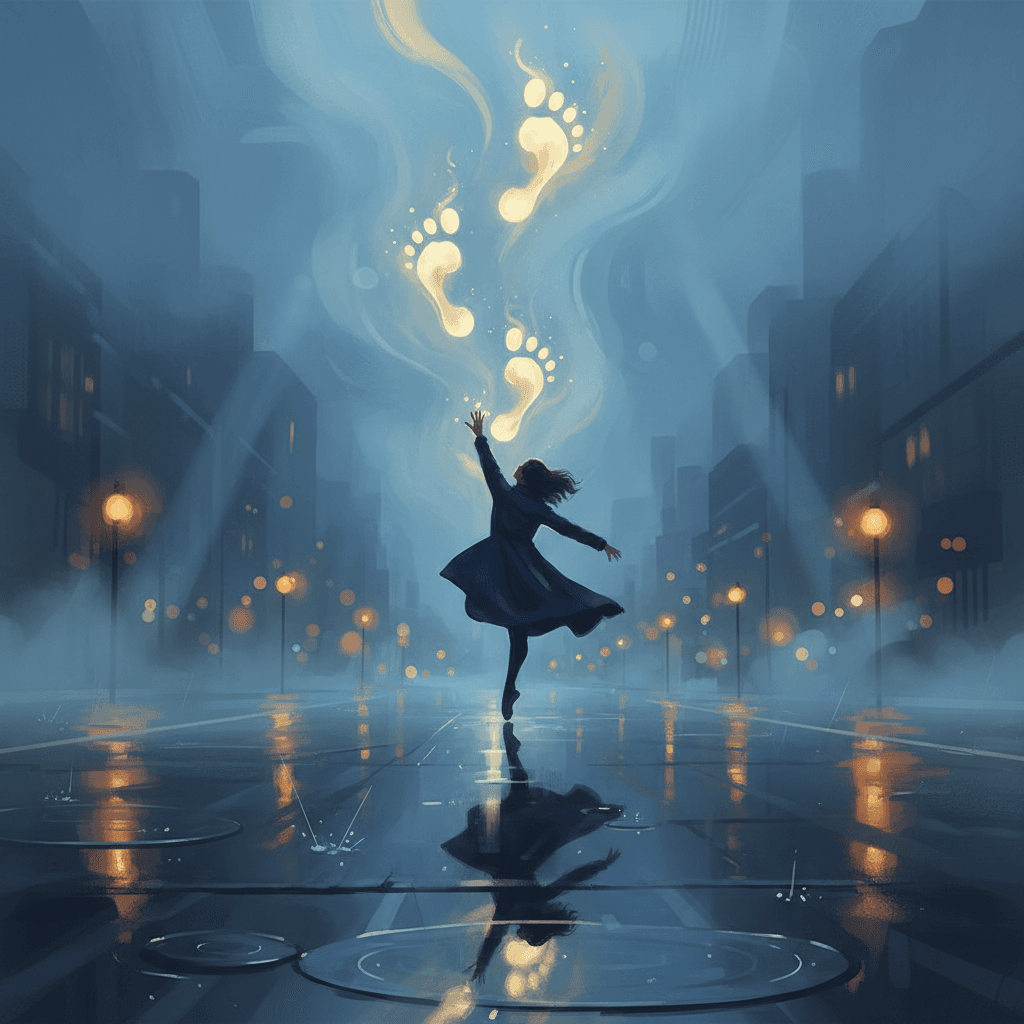
Dance with the unknown; it often teaches the steps you need next. — Haruki Murakami
—What lingers after this line?
An Invitation to Move Without a Map
Murakami’s line reframes uncertainty as a dance partner rather than a threat. Instead of waiting for perfect clarity, it suggests stepping forward while the music is still forming, trusting that motion itself reveals rhythm and direction. This idea is quietly radical because it values responsiveness over control. In that sense, the “unknown” stops being empty space and becomes a living environment—one that teaches through contact, missteps, and small adjustments rather than through advance instructions.
Why Action Creates Clarity
Building on that metaphor, the quote implies that understanding is often an outcome of action, not a prerequisite for it. Many people expect confidence to arrive before they begin, yet experience frequently works the other way: you begin, and confidence follows. This is why exploratory moves—sending the email, taking the class, drafting the first page—can be more informative than long deliberation. By “dancing,” you generate feedback, and that feedback becomes the next step you couldn’t have reasoned your way into beforehand.
Learning Through Friction and Missteps
Of course, dancing with the unknown also means accepting awkwardness. The quote quietly normalizes mistakes as part of the lesson: a wrong step is still a step that teaches timing, balance, and what doesn’t work. This echoes the pragmatic spirit of Samuel Beckett’s “Ever tried. Ever failed. No matter. Try again. Fail again. Fail better.” (from “Worstward Ho,” 1983), where progress is measured by refinement rather than perfection. The unknown teaches, but it often teaches by friction.
Creative Work and Murakami’s Own Method
Transitioning from general life advice to artistry, Murakami’s fiction often follows characters who enter surreal uncertainty and discover themselves through movement—walking, running, searching—rather than through explanation. In that light, the quote can be read as a description of a creative process: you write into the fog until the story shows you what it needs. Many artists describe similar dynamics, where the next idea arrives only after sustained engagement. The “steps you need next” are not hidden in advance; they emerge from the dance itself, like choreography improvised in real time.
Uncertainty as a Source of Growth
From here, the quote also aligns with psychological insights about learning and adaptation. Development often occurs at the edge of competence—where things are challenging enough to demand adjustment but not so overwhelming that you shut down entirely. That’s why the unknown can be such a potent teacher: it forces new strategies. When routines stop working, you become more attentive, more experimental, and more honest about what you actually value, because you can’t rely on habit to carry you.
How to Practice This Without Recklessness
Finally, “dance with the unknown” doesn’t require blind leaps; it can mean small, reversible experiments. You can take one deliberate step into uncertainty—test a concept, prototype a plan, have a difficult conversation—then listen closely to what happens next. In practical terms, the quote encourages a rhythm: act, observe, adjust. Over time, this turns uncertainty from a paralyzing void into a training ground, where each attempt—however imperfect—teaches you the next move you couldn’t see from the sidelines.
One-minute reflection
Why might this line matter today, not tomorrow?
Related Quotes
6 selectedLearning to love yourself is like learning to walk – essential, life-changing, and the only way to stand tall. — Vironika Tugaleva
Vironika Tugaleva
Vironika Tugaleva’s comparison begins with a simple but powerful truth: self-love is not a luxury, but a basic human necessity. Just as walking allows a child to move through the world with growing independence, learning...
Read full interpretation →Maturity of mind is the capacity to endure uncertainty. — John Finley
John Finley
John Finley’s statement reframes maturity as something deeper than confidence or quick judgment. Rather than treating uncertainty as a weakness, he presents the ability to endure it as a mark of inner strength.
Read full interpretation →The most gifted members of the human species are at their creative best when they cannot have their way, and must compensate for what they miss by realizing and cultivating their capacities. — Bryant H. McGill
Bryant H. McGill
Bryant H. McGill’s observation begins with a striking reversal: gifted people may not reach their highest potential when everything comes easily, but when something blocks their path.
Read full interpretation →A mind grows by staying with difficulty long enough for the experience to change it. — Mary Catherine Bateson
Mary Catherine Bateson
Mary Catherine Bateson’s observation begins with a quiet but demanding truth: the mind does not grow merely by encountering difficulty, but by remaining with it. Challenge becomes transformative only when we resist the u...
Read full interpretation →Consistency is a superpower. — Ryan Holiday
Ryan Holiday
Ryan Holiday’s line begins with a deceptively simple idea: greatness is rarely built through dramatic gestures. More often, it emerges from repeated actions that seem ordinary in isolation but become extraordinary over t...
Read full interpretation →Confidence is silent. Insecurities are loud. — Unknown (Wait—skip/replace with: True nobility is being superior to your former self. — Ernest Hemingway)
Ernest Hemingway
At its core, Hemingway’s line redefines nobility as an inward achievement rather than a social rank. Instead of measuring worth by wealth, pedigree, or dominance over others, it points to a quieter standard: becoming bet...
Read full interpretation →More From Author
More from Haruki Murakami →A magician is strong because he hurts more than others. He has learned to break the world that has tried to break him. — Haruki Murakami
Murakami’s line begins with a striking reversal: the magician is not powerful because he is untouched, but because he has suffered more deeply than others. In this view, strength does not emerge from comfort; rather, it...
Read full interpretation →You have to realize it's going to be a long process and that you'll work on things slowly, one at a time. — Haruki Murakami
Murakami’s observation begins with a quiet but demanding truth: worthwhile things rarely happen quickly. Whether one is writing a novel, learning a craft, or rebuilding a life, the process unfolds in stages that cannot b...
Read full interpretation →Movement is medicine for the soul; you don't need a destination, only the willingness to keep going. — Haruki Murakami
Murakami’s line begins with a simple but profound claim: movement itself can heal. Rather than treating motion as merely a way to arrive somewhere, he frames it as a restorative act for the inner life.
Read full interpretation →I'm not interested in being a 'perfect' person. I am interested in being a whole person. — Haruki Murakami
Murakami’s distinction begins by exposing how “perfect” often means polished, acceptable, and free of visible flaws. That standard is typically external—set by culture, family expectations, or the quiet pressure to appea...
Read full interpretation →