
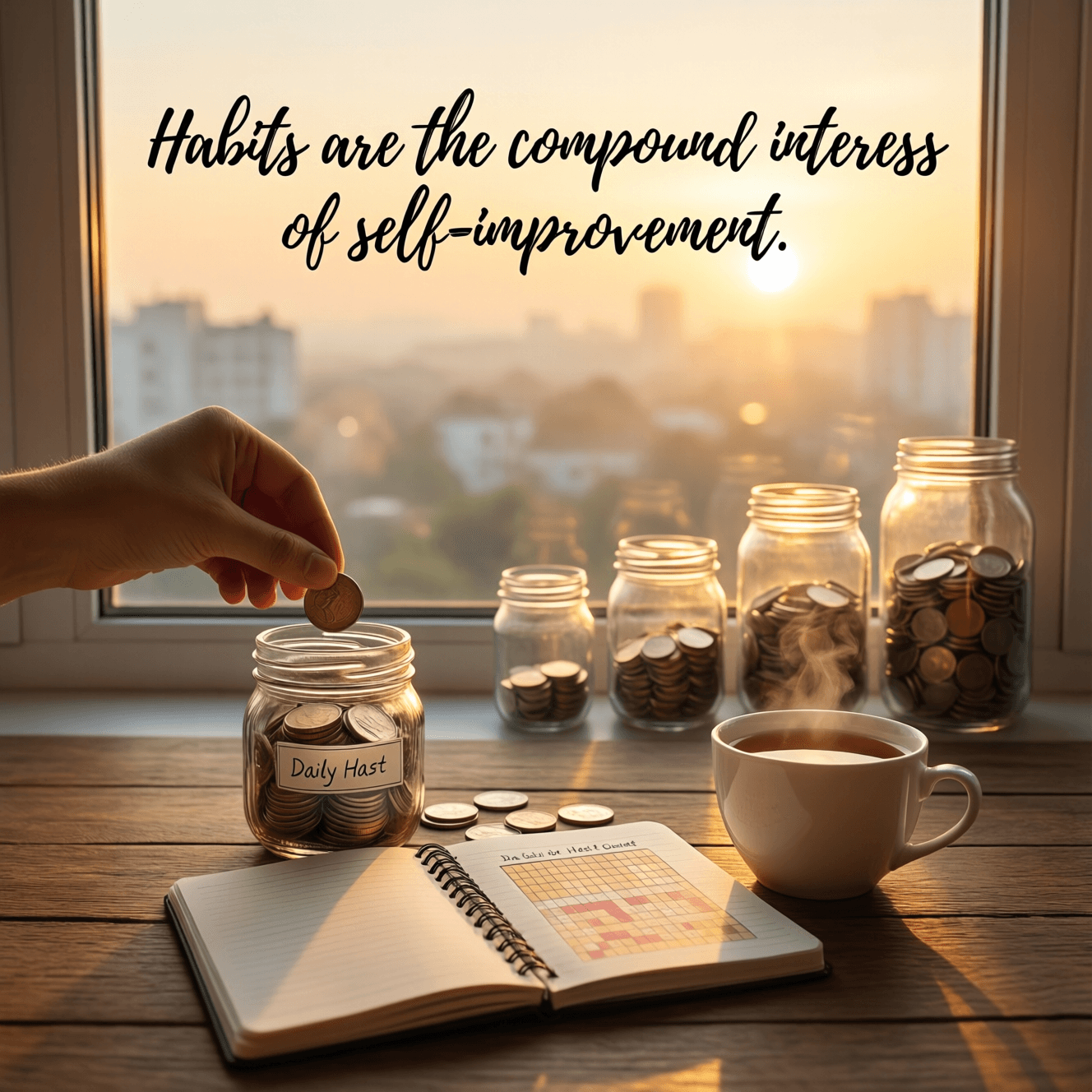
Habits are the compound interest of self-improvement. — James Clear
—What lingers after this line?
A Metaphor That Makes Change Visible
James Clear’s line reframes self-improvement through a financial lens: progress is rarely dramatic in a single moment, but it becomes unmistakable when it accumulates. Just as compound interest turns small deposits into meaningful wealth, small repeated behaviors quietly build capability, health, and confidence. This metaphor matters because it counters the common expectation of instant transformation. Instead of asking whether today’s effort feels impressive, the quote invites a more practical question: will this action, repeated, grow into something substantial?
Why Tiny Actions Outperform Big Bursts
Building on the compound-interest idea, Clear emphasizes that consistency beats intensity when the goal is lasting change. A short daily walk, ten minutes of reading, or one saved dollar may seem trivial, but repetition turns “small” into “certain.” Over time, the reliable habit becomes a platform you can expand. In contrast, sporadic surges of effort resemble one-time windfalls—exciting but hard to reproduce. The quote nudges us to design behaviors that are easy enough to repeat even on bad days, because repeatability is what creates the compounding effect.
The Hidden Phase: Progress You Can’t Yet See
Next comes the frustrating truth of compounding: the early returns look flat. In finance, interest growth is slow at first; likewise, the first weeks of practice often show little outward payoff. You study but don’t feel smarter, train but don’t look different, write but don’t feel fluent. However, that “invisible” phase is where the habit is laying groundwork—strengthening attention, skill, and identity. By the time results become obvious, the change has usually been happening for a while, just below the surface.
Identity as the Account Where Habits Deposit
From there, the quote connects naturally to a deeper layer of self-improvement: habits don’t only change outcomes, they change who you believe you are. Each repetition is like a deposit into an identity account—proof that you’re the kind of person who shows up, learns, trains, or saves. This is why missing once rarely ruins you, but quitting does. A single lapse is a small withdrawal; consistent action is repeated evidence. Over time, the compounded evidence reshapes self-image, which in turn makes the habit easier to sustain.
Good and Bad Habits Both Compound
Importantly, compounding is morally neutral: it amplifies whatever you feed it. The same logic that makes a daily page of reading powerful also makes daily mindless scrolling, skipping sleep, or chronic procrastination costly. The damage often feels minor in the moment precisely because compounding hides its early impact. Seen this way, the quote is both encouraging and cautionary. It suggests that the smallest routine is never “just” a routine; it’s a trajectory, and trajectories become destinations when repeated long enough.
Practical Leverage: Make Compounding Inevitable
Finally, the metaphor points to a simple strategy: remove friction from the habits you want and add friction to the ones you don’t. If the goal is to read, keep a book where you sit at night; if the goal is to save, automate transfers; if the goal is to exercise, lay out clothes in advance. By shaping the environment, you don’t rely on motivation to “earn interest.” You make the deposit easier, then let time do what it does best—multiply small, repeated actions into meaningful change.
One-minute reflection
What's one small action this suggests?
Related Quotes
6 selectedBuild systems that make good habits inevitable and watch effort become ease. — James Clear
James Clear
James Clear’s line shifts the spotlight from personal grit to structural design. Instead of glorifying willpower, he suggests that the smartest way to change behavior is to adjust the system around you so that good choic...
Read full interpretation →Small habits, stacked like bricks, build the architecture of a new life. — James Clear
James Clear
James Clear’s image of habits as bricks reframes change as construction rather than inspiration. Each small routine is a unit of structure; alignment matters as much as quantity.
Read full interpretation →If you want to master a habit, you must first master the art of showing up when you least want to. — James Clear
James Clear
At its heart, James Clear’s statement shifts attention away from talent or motivation and toward reliability. A habit is not truly formed when action feels easy; rather, it takes shape when a person follows through despi...
Read full interpretation →You do not need a massive transformation to change your life; you need a tiny, disciplined habit that you refuse to break. — James Clear
James Clear
James Clear’s line challenges a common cultural script: that meaningful change arrives through a dramatic overhaul—new job, new city, new body, new identity. Yet the excitement of a “massive transformation” often fades b...
Read full interpretation →Every action you take is a vote for the type of person you wish to become. — James Clear
James Clear
James Clear’s line reframes daily behavior as something more consequential than a to-do list: each action is a small ballot cast for the kind of person you are becoming. Instead of focusing only on outcomes—losing weight...
Read full interpretation →Every action you take is a vote for the type of person you wish to become. — James Clear
James Clear
James Clear’s line reframes behavior as identity-building: each choice is less about a single outcome and more about what it represents. A “vote” doesn’t permanently decide who you are, but it nudges the tally in a direc...
Read full interpretation →More From Author
More from James Clear →You cannot fully reset your life without adjusting your environment. — James Clear
James Clear’s observation begins with a simple but often overlooked truth: personal change is rarely just a matter of willpower. Our habits are shaped by the rooms we live in, the people we spend time with, the apps we o...
Read full interpretation →Consistency is the quiet answer to overwhelm. — James Clear
At first glance, James Clear’s line reframes overwhelm not as a dramatic crisis but as a condition that can be softened by steady action. Rather than calling for bursts of motivation, he points to consistency as a quiete...
Read full interpretation →Don't worry about being brilliant; just be consistent. The world is built by people who showed up even when they didn't feel like it. — James Clear
At its core, James Clear’s quote pushes back against the modern obsession with exceptional talent. Rather than glorifying brilliance, it elevates consistency—the humble act of returning to the work again and again.
Read full interpretation →Consistency is the quiet, daily hum of progress that eventually drowns out the noise of doubt and external expectations. — James Clear
At first glance, James Clear’s quote shifts attention away from dramatic breakthroughs and toward something far less glamorous: repetition. By calling consistency a “quiet, daily hum,” he suggests that meaningful progres...
Read full interpretation →