
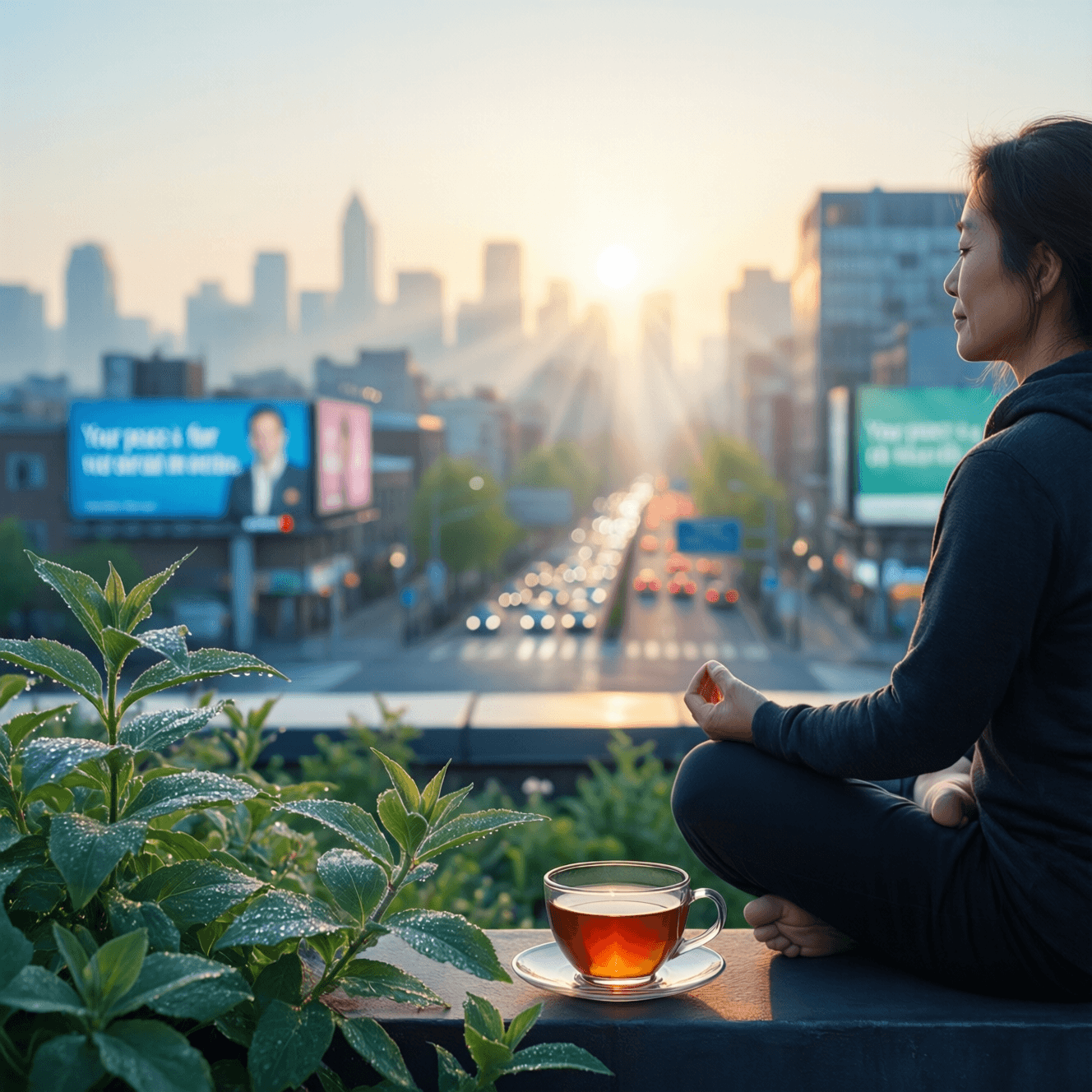
Your peace is a form of resistance in a world that demands your constant attention. — Unknown
—What lingers after this line?
A Quiet Defiance
The quote reframes peace as something more muscular than calmness: it becomes an act of refusal. In a culture that prizes speed, reaction, and perpetual engagement, choosing inner steadiness challenges the default expectation that you should always be available, informed, and responsive. From that starting point, “resistance” doesn’t necessarily mean loud protest; it can mean declining to let external noise dictate your nervous system. Peace, in this sense, is not passive withdrawal but a deliberate decision to remain self-directed when many forces compete to direct you.
The World That Demands Attention
To understand why peace can be resistance, it helps to see how attention is treated like a commodity. Platforms are built to maximize time-on-device, and even news cycles are optimized for urgency, novelty, and emotional arousal—conditions that keep people clicking, sharing, and checking. As this pressure intensifies, attention stops being a neutral mental resource and becomes a contested space. The quote suggests that constant alertness is not simply personal habit; it is also a social expectation shaped by systems that benefit when you are perpetually looking outward.
Attention as Power and Consent
Once attention is recognized as a scarce resource, it begins to resemble a form of consent: what you repeatedly attend to is what you effectively endorse with your life’s minutes. This idea echoes earlier critiques of distraction, such as Neil Postman’s Amusing Ourselves to Death (1985), which argued that public discourse can be reshaped by entertainment-driven formats. Consequently, reclaiming peace is partly a reclaiming of agency. If your attention determines your priorities, then protecting it—through quiet, focus, or rest—becomes a way of choosing your values rather than inheriting them.
The Nervous System as Battleground
The demand for constant attention isn’t only cognitive; it’s physiological. Continuous notifications, crisis headlines, and social comparison can keep the body in a low-grade state of vigilance, making calm feel unfamiliar or even unsafe. In that context, peace requires practice, not just preference. This is why resistance begins internally: slowing your breathing, limiting inputs, or creating silence can interrupt the stress loop that makes you easier to steer. With time, peace becomes less like an escape and more like a trained capacity to remain grounded amid provocation.
Boundaries as an Ethical Choice
Peace often depends on boundaries—turning off push alerts, refusing to argue on demand, or deciding that not every message deserves an immediate reply. These choices can look small, yet they directly contradict the social norm that accessibility equals virtue and that responsiveness is proof of care. Here the quote nudges a moral reframe: protecting your attention is not selfish but clarifying. By choosing when and how you engage, you preserve the ability to show up with intention rather than exhaustion, and that makes your eventual participation more meaningful.
From Private Calm to Public Impact
Finally, personal peace can ripple outward. People who are less reactive are harder to manipulate, harder to polarize, and more capable of sustained work—whether that’s caregiving, community building, or activism. In this way, peace becomes a foundation for endurance rather than an alternative to engagement. The quote ultimately implies a paradox: withdrawing attention from what constantly demands it can create more room for what truly deserves it. By defending your inner quiet, you don’t abandon the world; you meet it on your own terms.
One-minute reflection
Why might this line matter today, not tomorrow?
Related Quotes
6 selectedWhen the world is too loud, remember that your peace is a private revolution. — Unknown
Unknown
The quote begins with an image most people recognize: a world that feels “too loud.” This loudness isn’t only about decibels; it also points to informational overload, constant social comparison, and the pressure to reac...
Read full interpretation →The most modern way to live is not to do more, but to protect the peace you have already built. — Unknown
Unknown
The quote quietly challenges a common assumption: that progress is measured by acceleration. Instead, it proposes that the most contemporary lifestyle is not defined by constant upgrades—more tasks, more goals, more outp...
Read full interpretation →Quiet ambition is the new power move. You do not have to announce your progress to a crowd to make it count; your peace of mind is the loudest trophy. — Unknown
Unknown
The quote reframes success away from public recognition and toward private integrity. Instead of measuring achievement by applause, it suggests that what “counts” is the substance of your growth—skills built, habits chan...
Read full interpretation →The first sign of a settled mind is that it can stay in one place and spend time with itself.
Unknown
The quote frames mental steadiness not as constant happiness or unbroken focus, but as a quieter achievement: the ability to remain where you are without immediately needing an escape. A “settled mind” suggests inner ord...
Read full interpretation →If it costs you your peace, it is too expensive. — Unknown
Unknown
The quote frames peace as a kind of inner currency—finite, valuable, and easily spent. Instead of measuring cost only in money or effort, it asks you to calculate the hidden fees: anxiety, dread, resentment, and the cons...
Read full interpretation →A quiet life is not a small life. — Unknown
Unknown
The saying challenges a common assumption: that a life without constant activity, visibility, or outward achievement must be diminished. By pairing “quiet” with “not small,” it invites a redefinition of scale—one measure...
Read full interpretation →More From Author
More from Unknown →The language is the substrate. The architecture is the contract.
The line sets up a deliberate pairing: language lies beneath everything, while architecture governs everything above it. In other words, what you can express determines what you can build, and what you commit to structur...
Read full interpretation →A scroll is not a break; it is a trap disguised as rest. — Unknown
The quote begins by challenging a familiar story we tell ourselves: that a brief scroll is a harmless pause between tasks. On the surface, it looks like recovery—no effort, no decision, no commitment.
Read full interpretation →Don't let your ice cream melt while you're counting someone else's sprinkles. — Unknown
The quote uses ice cream as a simple stand-in for life’s fleeting pleasures: what you have is delicious, but it won’t last forever if you ignore it. Meanwhile, “counting someone else’s sprinkles” captures the habit of mo...
Read full interpretation →If your absence doesn't affect them, your presence never mattered. — Unknown
The quote frames absence as a revealing experiment: remove yourself, and the reaction—concern, curiosity, indifference—becomes a kind of data. If nothing changes when you’re gone, it suggests your role was never integrat...
Read full interpretation →