
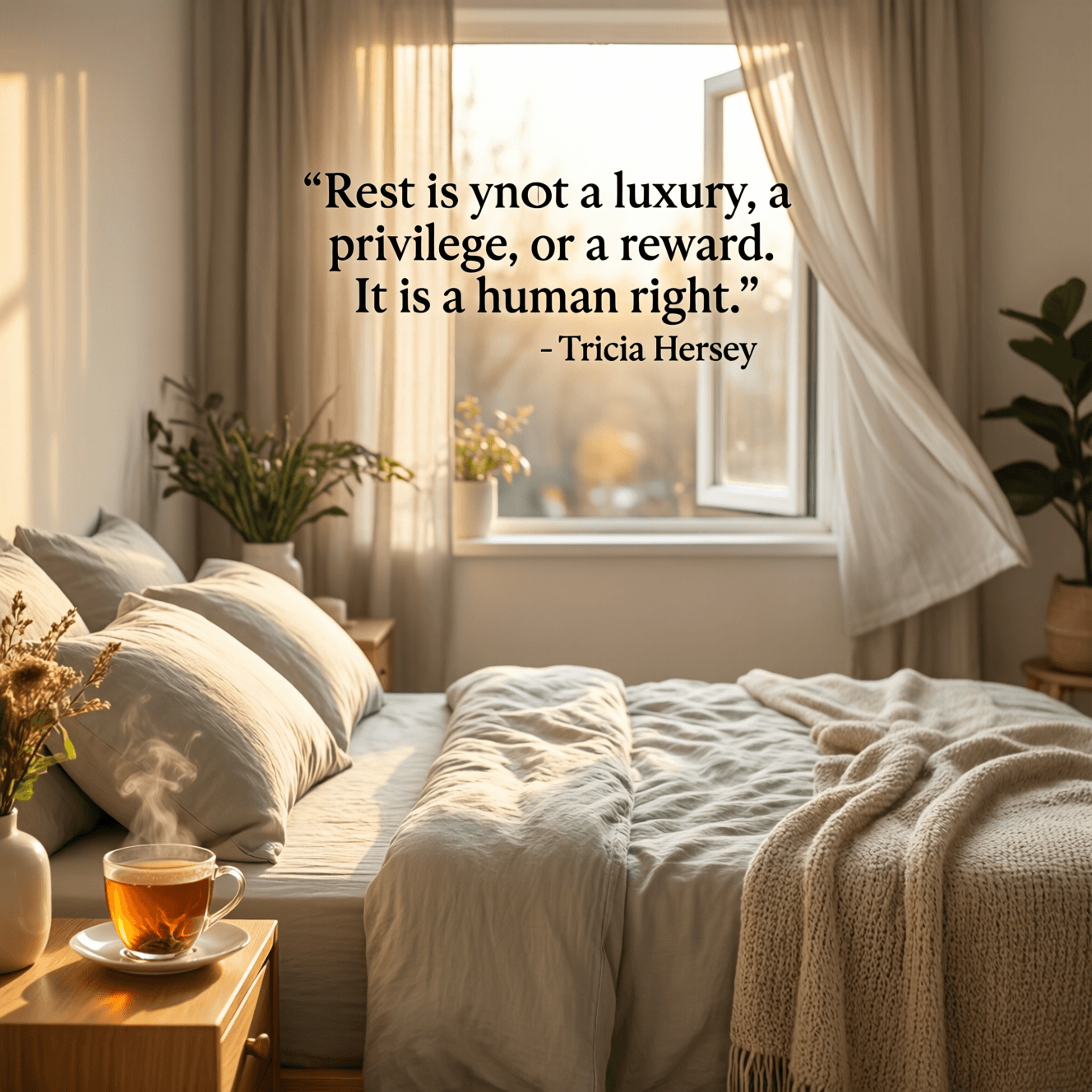
Rest is not a luxury, a privilege, or a reward. It is a human right. — Tricia Hersey
—What lingers after this line?
Reframing Rest Beyond Earned Time
Tricia Hersey’s statement begins by overturning a familiar assumption: that rest must be deserved. By rejecting the language of luxury, privilege, and reward, she challenges the cultural script that ties a person’s worth to output and frames downtime as something granted only after “enough” productivity. From there, her claim pushes the conversation into the moral realm. If rest is a human right, it is not contingent on performance, status, or approval; it is something owed to people simply because they are human. This reframing sets the foundation for seeing rest not as indulgence, but as a baseline condition for dignity.
Work Culture and the Myth of Constant Productivity
Once rest is treated as optional, societies tend to glorify exhaustion as evidence of virtue. The “always on” ethos—late-night emails, side hustles, and the celebration of burnout as ambition—turns fatigue into a badge while quietly normalizing harm. Hersey’s quote confronts this logic by implying that a culture that demands constant productivity is, at its core, a culture that withholds a right. In that light, rest becomes political as well as personal. The question shifts from “Have you done enough to take a break?” to “Why is the system built so that so many people cannot safely stop?”
Health, Safety, and the Body’s Limits
The argument for rest as a right gains urgency when viewed through the body. Sleep and recovery are not preferences; they are biological requirements. Chronic sleep deprivation is linked to impaired cognition, mood disruption, cardiovascular risk, and weakened immune function, and the World Health Organization and ILO have highlighted the health dangers associated with long working hours (WHO/ILO joint estimates, 2021). Seen this way, denying rest resembles denying other necessities that sustain life and function. Hersey’s framing insists that human limits are not failures to be optimized away, but realities that should shape humane schedules, expectations, and norms.
Equity: Who Gets to Rest and Who Doesn’t
Calling rest a human right also exposes how unevenly rest is distributed. Some people can take vacations, outsource chores, or recover from illness without fear of lost income, while others juggle multiple jobs, caregiving, and precarious employment where a day off can trigger cascading consequences. In practice, rest often tracks along lines of wealth, race, gender, disability, and immigration status. Therefore, Hersey’s statement functions as a critique of inequality. It suggests that rest should not be treated as a perk for the secure, but as something society must protect for those most likely to be deprived of it.
Rest as Dignity and Self-Possession
Beyond health and fairness, rest is about agency—having some control over one’s time and attention. When people are never permitted to pause, they are effectively denied the ability to reflect, to grieve, to create, or simply to exist without being evaluated. Hersey’s insistence that rest is a right defends the idea that a person is not merely a unit of labor. This is where the quote takes on a deeper ethical tone: rest safeguards the interior life. It preserves the space in which humans can be more than functional, more than useful, and more than measured by productivity alone.
From Principle to Practice: What Protecting Rest Looks Like
If rest is truly a right, then it requires more than personal “self-care” advice; it requires conditions that make rest possible. That can include limits on excessive work hours, paid sick leave, predictable scheduling, living wages, and norms that respect time off rather than penalize it. In other words, rights depend on enforceable structures, not just good intentions. At the same time, Hersey’s framing encourages individuals and communities to treat rest as non-negotiable rather than aspirational. By normalizing rest as legitimate and necessary, the culture begins to shift from admiration of exhaustion toward protection of human well-being.
One-minute reflection
What does this quote ask you to notice today?
Related Quotes
6 selectedRest is a form of resistance because it asserts our humanity. — Tricia Hersey
Tricia Hersey
Tricia Hersey’s claim begins with a reversal: what looks passive is recast as deliberate opposition. In cultures that equate worth with output, choosing to rest can function like a refusal to be measured only by producti...
Read full interpretation →Rest is not a reward for our productivity; it is a right for our existence. — Tricia Hersey
Tricia Hersey
Tricia Hersey’s statement flips a familiar cultural script: rest is often treated as something we earn only after proving our usefulness. By insisting it is “a right for our existence,” she places rest in the same moral...
Read full interpretation →Rest is not a reward; it is a requirement for our existence. — Tricia Hersey
Tricia Hersey
Tricia Hersey’s statement overturns a familiar cultural script: that rest is something we deserve only after producing enough. By insisting it is not a reward, she challenges the transactional mindset that turns sleep, s...
Read full interpretation →Rest is not a reward. It is a prerequisite for existence. — Tricia Hersey
Tricia Hersey
Tricia Hersey’s line overturns a familiar bargain: work hard, then you “deserve” rest. By rejecting rest-as-reward, she reframes it as something more basic than motivation or merit—something closer to air or water.
Read full interpretation →Rest is not a reward; it is a human right. — Tricia Hersey
Tricia Hersey
Tricia Hersey’s declaration draws a firm line between two competing worldviews: one that treats rest as something you earn, and another that sees it as inherent to being human. By saying rest is not a reward, she challen...
Read full interpretation →Rest is not a reward for work; it is the source of work. — Tricia Hersey
Tricia Hersey
Tricia Hersey’s line flips a deeply familiar script: instead of treating rest as something we earn after proving our worth, she frames it as the starting point that makes meaningful effort possible. In this view, work do...
Read full interpretation →More From Author
More from Tricia Hersey →We don't have to be everything. We don't have to know everything. There is space for the unknown. Stay here for a while. — Tricia Hersey
Tricia Hersey’s words begin by loosening a pressure many people carry every day: the demand to be everything at once. In a culture that praises mastery, productivity, and constant self-expansion, her statement offers a g...
Read full interpretation →There is massive knowledge and wisdom lying dormant in our exhausted and weary bodies and hearts. — Tricia Hersey
At first glance, Tricia Hersey’s line overturns a common assumption: that exhaustion only diminishes us. Instead, she suggests that weary bodies and hearts carry buried insight, as though fatigue is not merely a deficit...
Read full interpretation →You were not just born to center your entire existence around work and labor. You were born to exist, to dance, to create, to be. — Tricia Hersey
Tricia Hersey’s statement begins by breaking a common spell: the idea that a human life is primarily a productivity machine. By saying we were not born to center our existence on labor, she challenges the quiet assumptio...
Read full interpretation →Grind culture is violence and violence creates trauma. We have been traumatized deeply. — Tricia Hersey
Tricia Hersey’s claim hinges on a broadened definition of violence—one that includes the slow, cumulative harm of chronic overwork, deprivation, and coercive expectations. In this framing, violence is not only a sudden a...
Read full interpretation →