
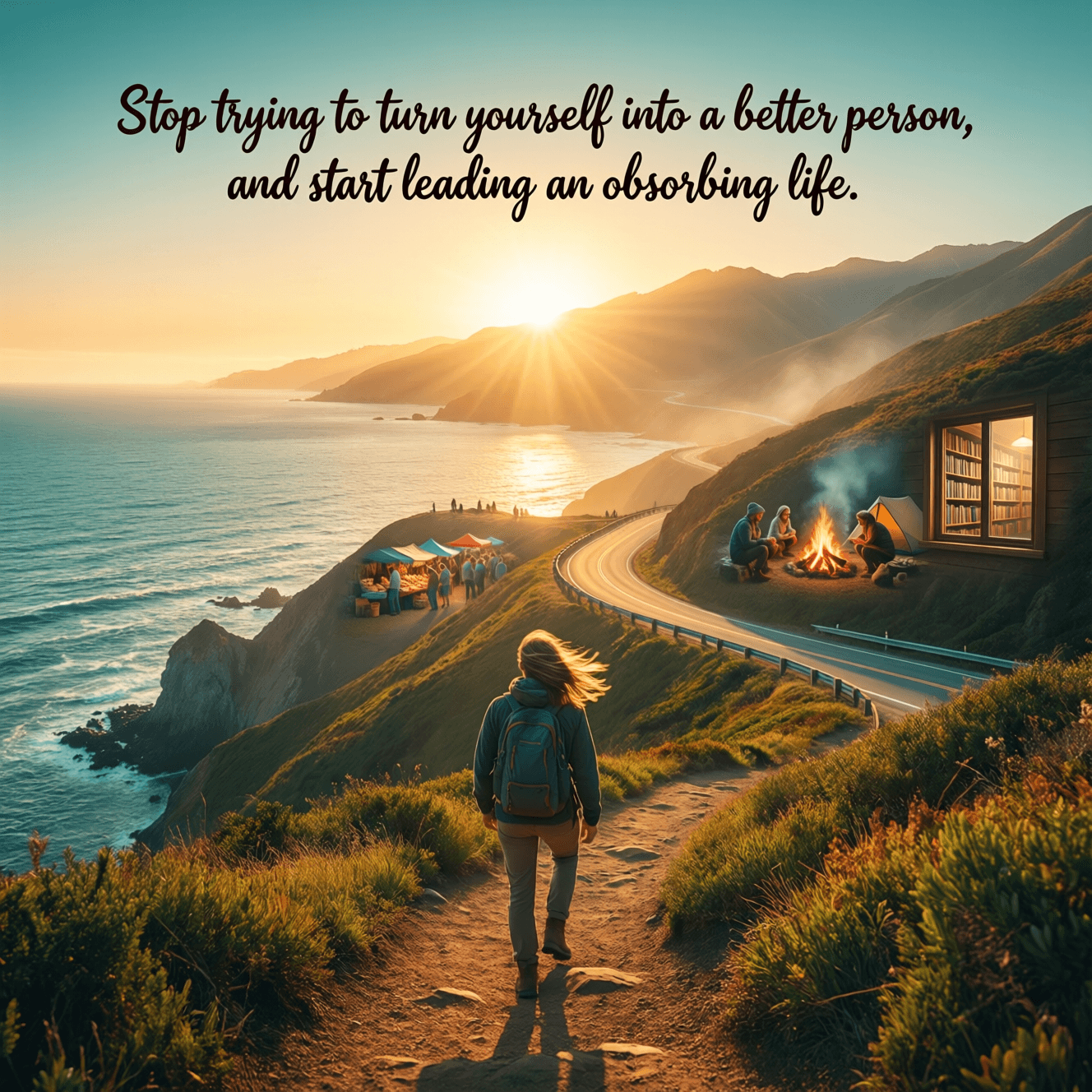
Stop trying to turn yourself into a better person, and start leading an absorbing life. — Oliver Burkeman
—What lingers after this line?
From Self-Improvement to Self-Absorption
Oliver Burkeman’s line challenges the modern reflex to treat life as a project of constant upgrades. The phrase “trying to turn yourself into a better person” points to a familiar cycle: measuring, refining, and correcting the self as though it were an inefficient system. Yet the twist is that this effort can become strangely self-centered, even when it sounds virtuous. From there, the alternative—“start leading an absorbing life”—suggests a shift of attention outward. Instead of orbiting around your own progress, you enter experiences that pull you beyond yourself, where meaning arises as a side effect of engagement rather than a reward for perfecting your character.
The Trap of Endless Optimization
What makes self-improvement so sticky is its promise of a future version of you who will finally be ready. Burkeman’s argument implies that readiness can become a mirage: there is always another habit to fix, another mindset to master, another fear to resolve before you “really” begin. In that sense, optimization turns into procrastination disguised as responsibility. Consequently, “absorbing” becomes a crucial word. Absorption is the opposite of constant self-monitoring; it describes attention so fully captured that you stop narrating your life and start inhabiting it. The irony is that many of the traits people chase—confidence, purpose, even kindness—often emerge more reliably when you are immersed in living than when you are auditing yourself.
Absorption as a Source of Meaning
An absorbing life is not necessarily glamorous; it is life experienced in full contact. This can look like learning a difficult skill, caring for someone, building something that might fail, or joining a community where you are needed. The point is that such commitments place demands on you that no amount of introspection can substitute. As a bridge between philosophy and psychology, this idea aligns with Mihaly Csikszentmihalyi’s research on “flow” (Flow: The Psychology of Optimal Experience, 1990), where deep engagement produces a sense of vitality and coherence. Burkeman’s emphasis is less on achieving peak states and more on choosing situations where attention naturally locks onto what matters.
Character as a Byproduct, Not a Blueprint
The quote also reframes moral growth. Rather than engineering virtue through constant self-scrutiny, it implies that character is shaped by what you do and what you repeatedly show up for. When you commit to projects, relationships, and responsibilities, you encounter friction—impatience, fear, selfishness—and you learn to work with it in real time. In other words, becoming “better” may happen most reliably while you are busy doing something that isn’t primarily about you. This echoes Aristotle’s Nicomachean Ethics (c. 350 BC), where virtues are cultivated through practice and habituation. Burkeman’s contribution is to warn that the modern fixation on self-construction can crowd out the very arenas where growth actually occurs.
Letting Go of the Self as a Problem
Behind the urge to improve is often the assumption that the self is a problem to solve. Burkeman’s sentence disrupts that assumption by implying that life is not a test you pass after sufficient preparation; it is something you participate in despite imperfection. When you wait to feel fully healed, fully disciplined, or fully confident, you make aliveness conditional. Therefore, the practical invitation is to relax the demand for inner completion and act anyway. This doesn’t deny therapy, reflection, or change; it simply refuses to let them become the gatekeepers of experience. The self becomes less of a fragile object needing constant maintenance and more of a companion you bring along into the world.
Choosing Commitments That Pull You Forward
If the goal is an absorbing life, the next question becomes what kinds of choices produce absorption. Burkeman’s framing favors commitments with real stakes: activities that require patience, collaboration, and the willingness to be mediocre for a while. They can be modest—volunteering weekly, joining a choir, apprenticing yourself to a craft—or substantial, like parenting, caregiving, or building a business. Over time, these commitments generate a narrative that is lived rather than designed. You stop asking, “Am I improving fast enough?” and start asking, “What am I part of?” In that transition, you may still grow into a better person—but now it is anchored in engagement, not obsession.
One-minute reflection
Where does this idea show up in your life right now?
Related Quotes
6 selectedYou cannot build a life of purpose on the foundations of other people's expectations. Stop optimizing your life for an audience and start orienting it toward your own values. — Oliver Burkeman
Oliver Burkeman
At its core, Burkeman’s quote exposes how easily a life can become a performance. Many people make choices about work, relationships, and success not because those choices feel meaningful, but because they appear admirab...
Read full interpretation →The present moment doesn't shout — it whispers. You only hear it when you're truly listening. — Elizabeth Lesser
Elizabeth Lesser
Elizabeth Lesser’s line begins with a striking contrast: the present moment does not demand attention through noise or spectacle. Instead, it whispers, suggesting that what is most real is often also most subtle.
Read full interpretation →We have outstretched our personal boundaries and forgotten that true happiness comes from living an authentic life fueled with a sense of purpose and balance. — Dr. Kathleen Hall
Dr. Kathleen Hall
Dr. Kathleen Hall’s observation begins with a modern dilemma: people often stretch themselves beyond their emotional, mental, and physical limits in pursuit of success, approval, or endless productivity.
Read full interpretation →We are so busy running toward our future that we rarely stop to notice that we are already standing in the middle of a life. — Pico Iyer
Pico Iyer
Pico Iyer begins with a familiar modern habit: the constant sprint toward what comes next. We organize our days around goals, promotions, milestones, and imagined better versions of ourselves, often assuming that real li...
Read full interpretation →Do not explain your philosophy. Embody it. — Epictetus
Epictetus
Epictetus compresses a whole ethical system into a command: stop talking about values as if they were ornaments of the mind, and start wearing them in conduct. Rather than asking for a polished defense of one’s philosoph...
Read full interpretation →The most important, the primordial relationship in your life is your relationship with the Now. — Eckhart Tolle
Eckhart Tolle
Eckhart Tolle’s line shifts the idea of “relationship” away from a person and toward a lived condition: the quality of attention you bring to this moment. In that framing, the Now isn’t a background setting—it’s the part...
Read full interpretation →More From Author
More from Oliver Burkeman →We don't need to do more; we need to do what matters with deeper presence and less noise. — Oliver Burkeman
Oliver Burkeman’s line begins by rejecting a familiar modern assumption: that value comes from doing more. Instead, it proposes a quieter and more demanding standard—doing what truly matters.
Read full interpretation →True security lies in the unrestrained embrace of insecurity — in the recognition that we never really stand on solid ground, and never can. — Oliver Burkeman
At first glance, Burkeman’s statement sounds self-contradictory: how can security come from insecurity? Yet his point is that much of human anxiety grows from the futile attempt to make life fully controllable.
Read full interpretation →You cannot build a life of purpose on the foundations of other people's expectations. Stop optimizing your life for an audience and start orienting it toward your own values. — Oliver Burkeman
At its core, Burkeman’s quote exposes how easily a life can become a performance. Many people make choices about work, relationships, and success not because those choices feel meaningful, but because they appear admirab...
Read full interpretation →Stop trying to become a better person and focus on leading a more absorbing life. — Oliver Burkeman
Oliver Burkeman’s line confronts a modern reflex: treating life as a perpetual upgrade project. “Becoming a better person” can sound noble, yet it often smuggles in an anxious assumption that you are not yet allowed to l...
Read full interpretation →