
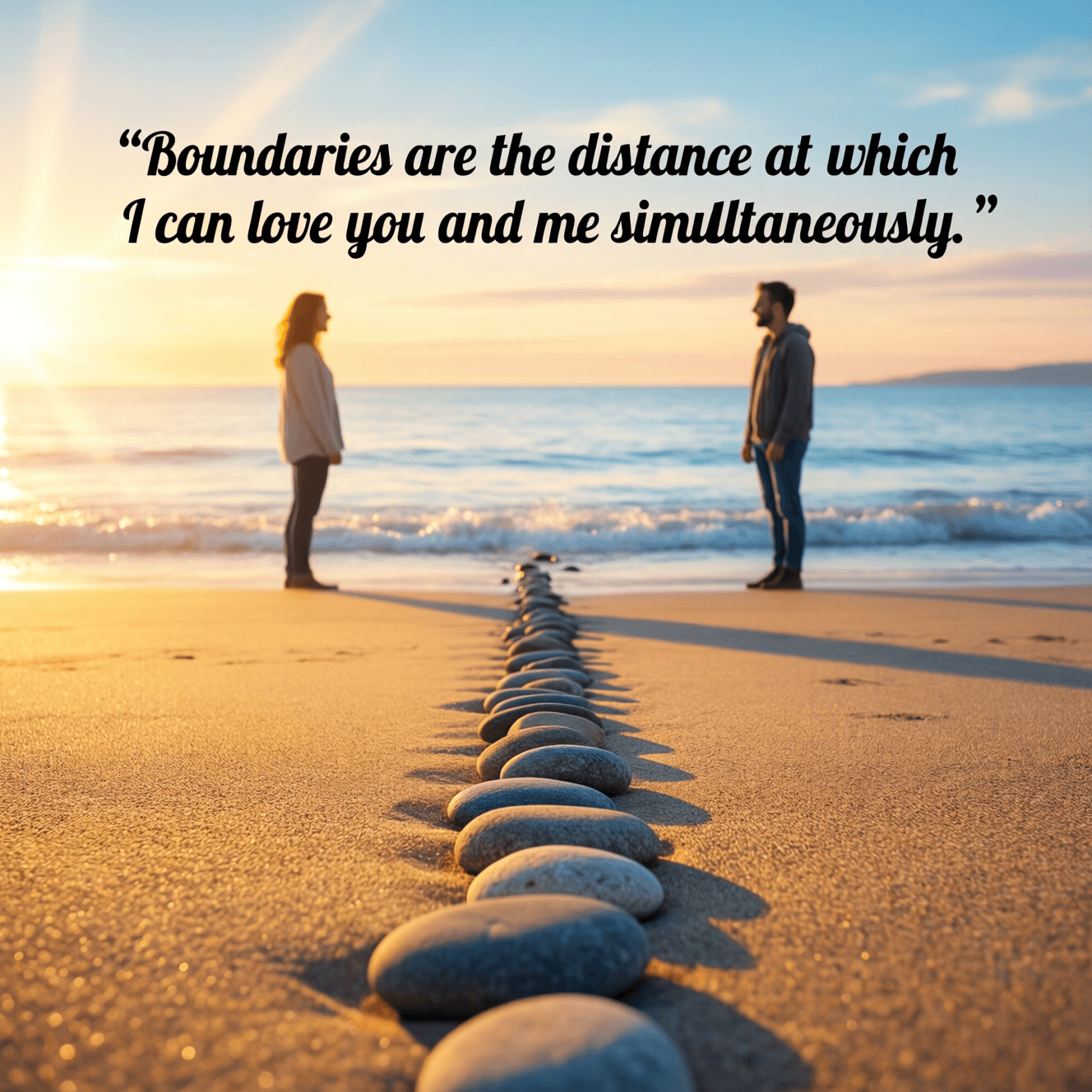
Boundaries are the distance at which I can love you and me simultaneously. — Prentis Hemphill
—What lingers after this line?
Redefining Boundaries as Care
Prentis Hemphill’s line reframes boundaries away from punishment or coldness and toward a practical form of care. Instead of asking, “How close can we be no matter what it costs?” it asks, “What kind of closeness lets love remain intact?” In that sense, a boundary is not a wall; it is a measured distance that keeps connection possible. This shift matters because many people learn to equate love with limitless access. Hemphill counters that love without limits can quietly become self-erasure, where one person’s needs, safety, or dignity is traded for harmony. Boundaries, then, become the conditions that allow love to stay honest rather than performative.
The “Simultaneously” at the Heart of the Quote
The key word is “simultaneously.” Hemphill isn’t choosing between loving another person and loving oneself; the quote insists on both at once. That makes boundaries less about separation and more about integration—aligning your actions with self-respect while staying relational. From there, a boundary becomes a test of sustainability. If closeness requires constant anxiety, resentment, or depletion, the love offered may be real but the structure is unstable. By contrast, when distance is adjusted so both people can breathe—emotionally and practically—affection is more likely to be generous rather than coerced.
Attachment, Autonomy, and Healthy Closeness
Seen through psychology, the quote echoes the tension between attachment and autonomy. John Bowlby’s attachment theory (Bowlby, 1969) emphasized the human need for secure connection, yet security also depends on not losing oneself inside the bond. When someone feels they must stay available at all times to be loved, closeness can start to resemble surveillance. In contrast, boundaries support secure attachment by making expectations explicit: what is okay, what isn’t, and what happens when limits are crossed. As a result, trust can deepen because love no longer relies on mind-reading or endurance; it relies on mutual clarity.
Resentment as a Boundary Signal
Often, resentment is the body’s way of reporting a boundary violation—sometimes by others, sometimes by ourselves. You may agree to something out of fear of conflict, then notice irritation building afterward. That irritation is not necessarily pettiness; it can be information that the “distance” has become too small to hold both people kindly. A simple anecdote captures this: someone routinely answers late-night crisis calls from a friend, then becomes short and withdrawn the next day. When they finally set a boundary—“I can talk until 9 p.m., and I’ll check in tomorrow”—the friendship may initially feel less intense, but it often becomes more stable because care is no longer financed by exhaustion.
Boundaries as Relational Agreements, Not Ultimatums
Because the quote centers love for “you and me,” boundaries are inherently relational: they describe what you will do to stay present, not merely what the other person must stop doing. This is why effective boundaries are usually stated as commitments (“I won’t stay in conversations where I’m being insulted”) rather than accusations (“You’re so disrespectful”). From that foundation, boundaries can invite collaboration. They clarify how to repair when harm happens and how to prevent repeat harm. In practice, this might look like naming a limit, offering an alternative, and following through—so love becomes a pattern of reliability rather than a vague intention.
Love Without Boundaries Becomes Self-Abandonment
Hemphill’s framing also highlights a common trap: confusing endurance with devotion. If love requires tolerating persistent disrespect, manipulation, or unsafe behavior, the relationship may still contain affection, but it is no longer a place where both people can be loved. In such cases, “distance” may need to increase significantly, even to the point of ending contact. This is not a contradiction of love; it is an insistence that love includes protection. By setting boundaries, a person refuses the false choice between closeness and integrity. The result is a clearer definition of love—one that makes room for tenderness, accountability, and a self that remains whole.
One-minute reflection
Where does this idea show up in your life right now?
Related Quotes
6 selectedBoundaries are the distance at which I can love you and me simultaneously. — Prentis Hemphill
Prentis Hemphill
Prentis Hemphill reframes boundaries from something cold or punitive into something relational: a measured distance that makes care possible. In this view, a boundary is not a wall meant to exile another person, but a li...
Read full interpretation →Boundaries are the distance at which I can love you and me simultaneously. — Prentis Hemphill
Prentis Hemphill
Prentis Hemphill’s line reframes boundaries as an act of care rather than a withdrawal: they mark the distance where love can include both the other person and the self. Instead of treating devotion as self-erasure, the...
Read full interpretation →Boundaries are the distance at which I can love you and me simultaneously. — Prentis Hemphill
Prentis Hemphill
Prentis Hemphill’s line treats boundaries not as walls but as a measured distance—an intentional space that makes connection possible without self-erasure. In this framing, love is not proven by limitless access or const...
Read full interpretation →Boundaries are the distance at which I can love you and me simultaneously. — Prentis Hemphill
Prentis Hemphill
Prentis Hemphill reframes boundaries not as walls but as a measured distance—close enough to stay connected, far enough to remain intact. In that sense, the quote argues that love is not proven by limitless access; it is...
Read full interpretation →Boundaries are the distance at which I can love you and me simultaneously. — Prentis Hemphill
Prentis Hemphill
Prentis Hemphill’s line reframes boundaries as an expression of love rather than a barrier to it. Instead of choosing between caring for someone else and protecting your own well-being, the quote suggests a third option:...
Read full interpretation →Boundaries are the distance at which I can love you and me simultaneously. — Prentis Hemphill
Prentis Hemphill
Prentis Hemphill’s line challenges the common belief that boundaries are walls meant to keep people out. Instead, it frames boundaries as the precise space that makes care sustainable—close enough to remain connected, ye...
Read full interpretation →More From Author
More from Prentis Hemphill →The most loving thing I ever did was say no to things that were killing me slowly. — Prentis Hemphill
At first glance, Hemphill’s line sounds simple, yet it redefines love as an act of protection rather than mere tenderness. Saying no becomes the deepest form of care when a person recognizes that certain habits, relation...
Read full interpretation →Boundaries are the distance at which I can love you and me simultaneously. — Prentis Hemphill
Prentis Hemphill reframes boundaries not as walls but as a measurable “distance” that lets care remain mutual rather than consuming. In this view, love is not proven by self-erasure; it is sustained by enough space for t...
Read full interpretation →Boundaries are the distance at which I can love you and me simultaneously. — Prentis Hemphill
Prentis Hemphill’s line treats boundaries not as walls but as a measured distance—an intentional space that makes connection possible without self-erasure. In this framing, love is not proven by limitless access or const...
Read full interpretation →Boundaries are the distance at which I can love you and me simultaneously. — Prentis Hemphill
Prentis Hemphill’s line reframes boundaries as an act of care rather than a withdrawal: they mark the distance where love can include both the other person and the self. Instead of treating devotion as self-erasure, the...
Read full interpretation →