
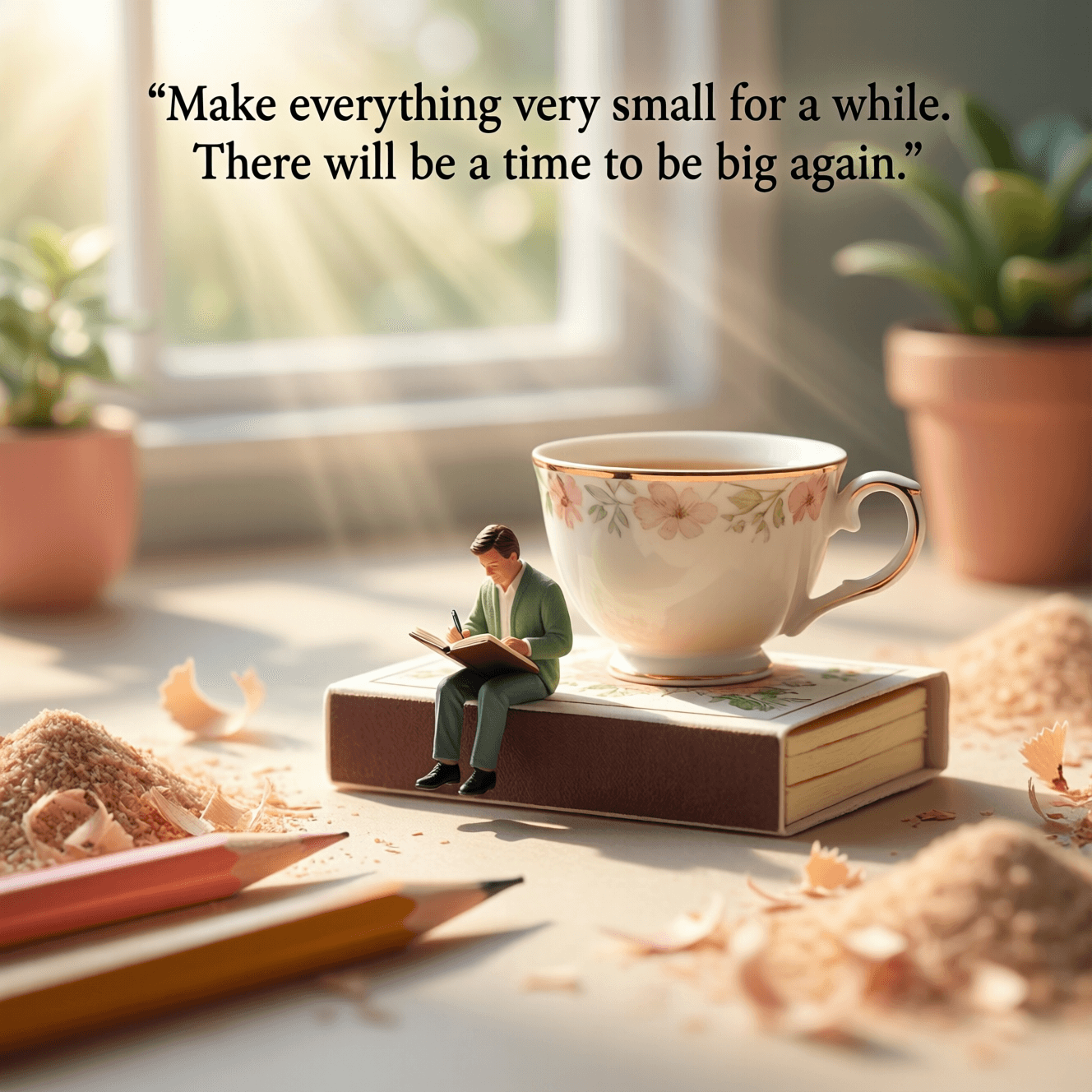
Make everything very small for a while. There will be a time to be big again. — Emma Gannon
—What lingers after this line?
A Permission Slip to Scale Down
Emma Gannon’s line reads like a quiet permission slip: step away from expansion, visibility, and constant output, and let life become smaller on purpose. The phrasing “for a while” is crucial because it frames smallness not as failure, but as a season—temporary, chosen, and potentially wise. From there, the quote nudges a shift in values. Instead of equating growth with worth, it suggests that restraint can be a form of strength, especially when the world keeps insisting that bigger is always better.
Small as Strategy, Not Retreat
Although “make everything very small” can sound like hiding, it can also mean refining. A smaller life might involve fewer commitments, narrower goals, or a tighter circle—not out of fear, but to protect energy and attention. In that sense, smallness becomes a strategy: reduce the surface area where demands can attach. This is where the quote quietly turns pragmatic. By choosing limits, you create conditions where the essentials—health, craft, relationships, rest—can actually receive sustained care rather than leftover time.
The Cycles of Growth and Dormancy
The second sentence—“There will be a time to be big again”—introduces a cyclical view of ambition. Like winter fields that look empty but are restoring the soil, a period of scaling down can prepare the ground for later expansion. Rather than forcing momentum, the quote suggests trusting timing. This rhythm appears across disciplines: athletes cycle training loads to avoid injury, and businesses deliberately pause initiatives to stabilize operations. In each case, the pause isn’t the opposite of progress; it’s part of how progress becomes sustainable.
Attention as a Finite Resource
Once you accept smallness as a season, the real currency becomes attention. In a crowded digital culture, “big” often means being constantly reachable, constantly publishing, constantly reacting. Gannon’s advice implies that reclaiming attention may require shrinking your inputs—less noise, fewer platforms, fewer obligations. Consequently, smallness can function like a filter: it limits distraction so that whatever remains can be done with more presence. The payoff isn’t only productivity; it’s the feeling of being inside your own life again.
Identity Beyond Constant Output
Another layer sits beneath the practical: many people fear becoming smaller because they fear becoming less. If identity is tied to performance or visibility, shrinking commitments can feel like disappearing. Yet the quote gently separates being from broadcasting, implying you can reduce what you do without reducing who you are. That distinction matters because it reframes rest and privacy as legitimate states, not gaps to apologize for. Over time, this can loosen the grip of external validation and make future growth feel like a choice rather than a compulsion.
Returning to Bigness with Intention
Finally, the promise of “big again” points to a different kind of expansion—one that arrives after recalibration. When you’ve made life smaller, you can notice what you actually miss and what you don’t, which makes the next phase of growth more selective. Bigness, then, becomes something you enter with clearer boundaries. In practical terms, that might mean saying yes to one meaningful project instead of ten mediocre ones, or rebuilding visibility around work that aligns with your values. The quote ends not with retreat, but with a patient confidence that growth can return—cleaner, steadier, and more yours.
One-minute reflection
What does this quote ask you to notice today?
Related Quotes
6 selectedWe need to build a pause into our decision making and be more considered—from goods, media, marketing and messages, to unwanted advice and opinions. — Brooke McAlary
Brooke McAlary
Brooke McAlary’s quote begins with a simple but powerful premise: many poor decisions are not the result of ignorance, but of speed. By urging us to build a pause into decision making, she highlights the value of interru...
Read full interpretation →There will be a time when you can be big again. For now, make everything small. — Emma Gannon
Emma Gannon
Emma Gannon’s line reads like a gentle permission slip: if you can’t be “big” right now—ambitious, expansive, endlessly productive—you’re not failing, you’re adapting. By framing bigness as something that returns in seas...
Read full interpretation →When your body says stop, listen. There will be a time when you can be big again. — Emma Gannon
Emma Gannon
Emma Gannon’s line begins with a simple premise: the body communicates limits long before the mind fully accepts them. “When your body says stop, listen” reframes fatigue, pain, brain fog, or irritability as meaningful s...
Read full interpretation →Make everything very small. There will be a time when you can be big again. — Emma Gannon
Emma Gannon
Emma Gannon’s line reads like a gentle directive: reduce your footprint, your pace, and your expectations—intentionally. Rather than framing smallness as failure, it treats it as a chosen posture for a particular season,...
Read full interpretation →When your body says stop, it isn't a failure; it is a vital instruction. Recovery is not a reward for your exhaustion; it is the foundation of your existence. — Emma Gannon
Emma Gannon
Emma Gannon’s line begins by overturning a familiar assumption: that stopping is synonymous with weakness. Instead, when the body signals “enough,” it’s offering data—pain, fatigue, brain fog, irritability—meant to prote...
Read full interpretation →If you want to build something that lasts, you must be willing to do the small, quiet things that no one sees for a long, long time. — James Clear
James Clear
At its core, James Clear’s quote argues that durability is rarely created in dramatic moments. Instead, anything built to last—a skill, a business, a relationship, or a body of work—rests on repeated actions that seem to...
Read full interpretation →More From Author
More from Emma Gannon →When your body says stop, it isn't a failure; it is a vital instruction. Recovery is not a reward for your exhaustion; it is the foundation of your existence. — Emma Gannon
Emma Gannon’s line begins by overturning a familiar assumption: that stopping is synonymous with weakness. Instead, when the body signals “enough,” it’s offering data—pain, fatigue, brain fog, irritability—meant to prote...
Read full interpretation →When your body says stop, listen. There will be a time when you can be big again. — Emma Gannon
Emma Gannon’s line begins with a simple premise: the body communicates limits long before the mind fully accepts them. “When your body says stop, listen” reframes fatigue, pain, brain fog, or irritability as meaningful s...
Read full interpretation →There will be a time when you can be big again. For now, make everything small. — Emma Gannon
Emma Gannon’s line reads like a gentle permission slip: if you can’t be “big” right now—ambitious, expansive, endlessly productive—you’re not failing, you’re adapting. By framing bigness as something that returns in seas...
Read full interpretation →Make everything very small. There will be a time when you can be big again. — Emma Gannon
Emma Gannon’s line reads like a gentle directive: reduce your footprint, your pace, and your expectations—intentionally. Rather than framing smallness as failure, it treats it as a chosen posture for a particular season,...
Read full interpretation →