
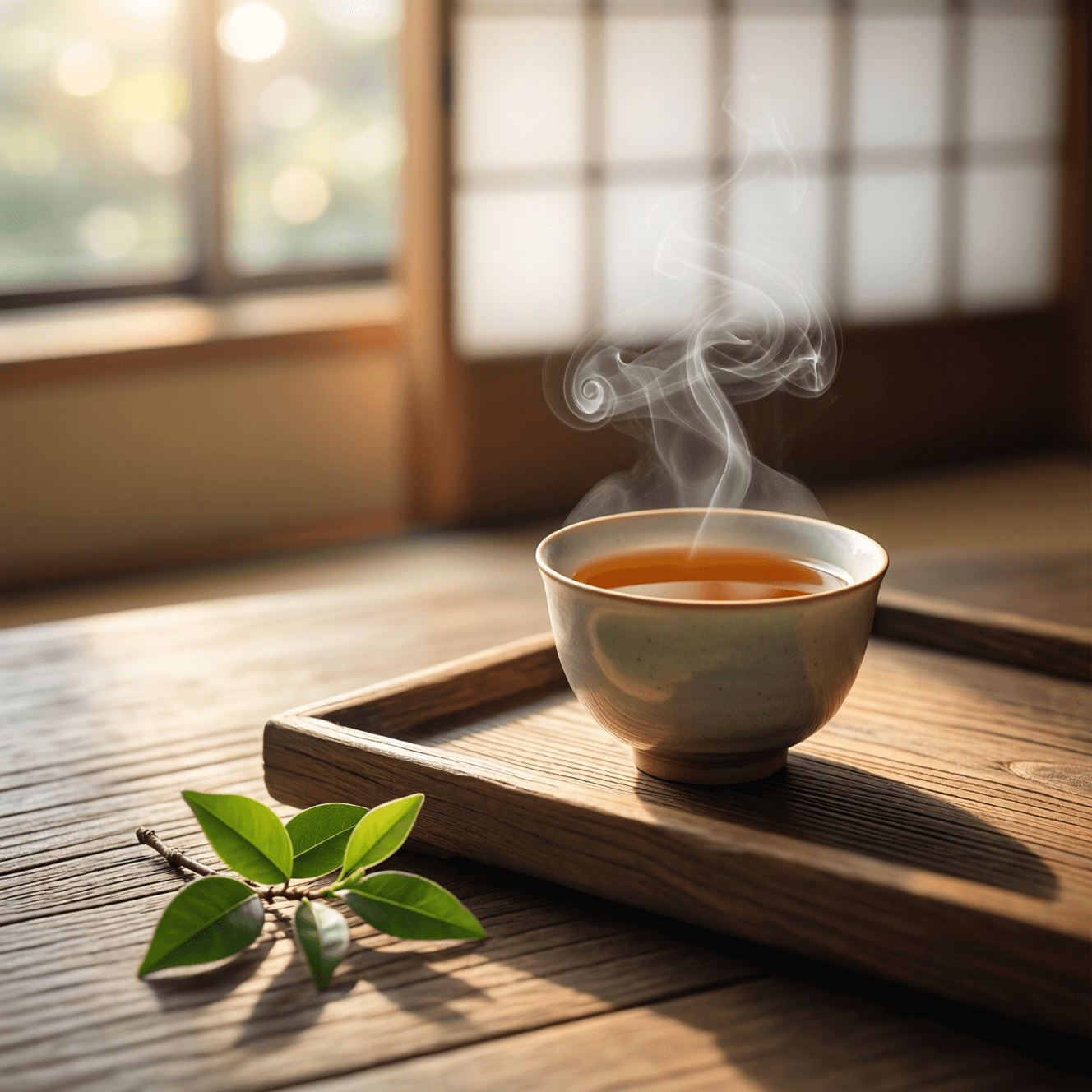
Drink your tea slowly and reverently, as if it is the axis of the world. — Thich Nhat Hanh
—What lingers after this line?
A Cup as a Spiritual Center
Thich Nhat Hanh’s invitation to drink tea “slowly and reverently” turns an ordinary act into a meditation. By calling tea “the axis of the world,” he suggests that the present moment—however small—can become the stable center around which everything else turns. This isn’t exaggeration for poetic effect so much as a practical instruction: when attention is wholehearted, a single cup can anchor a scattered mind. In that way, the “axis” is not the tea itself, but the quality of awareness we bring to it.
Mindfulness Made Concrete
Building on that center point, the quote offers a simple doorway into mindfulness: slow down, feel the warmth, notice the aroma, recognize the act of drinking. Thich Nhat Hanh repeatedly emphasized such everyday practices as accessible paths to presence, as in *Peace Is Every Step* (1991), where he frames routine actions as opportunities to return to the here and now. Because tea is sensory and familiar, it becomes an ideal training ground. Rather than striving for a special state of mind, you practice by inhabiting what’s already in your hands.
Reverence Without Religion
From there, “reverently” adds an ethical and emotional tone: treat the moment as worthy of care. This kind of reverence doesn’t require formal belief; it can simply mean refusing to rush, consume, and discard experience as if it were disposable. In many contemplative traditions, reverence is a way of interrupting habit. When you honor a cup of tea, you rehearse honoring life more broadly—your body, your time, and the people and conditions that make the cup possible.
The Hidden Web Behind a Simple Cup
Once attention slows, the tea starts to reveal its connections: leaves grown in soil and sun, hands that harvested and transported them, water drawn and heated, a vessel shaped by craft. Thich Nhat Hanh often described this interdependence as “interbeing,” a theme central to *The Heart of Understanding* (1988). Seen this way, the “axis of the world” points to relationship rather than isolation. The cup becomes a small meeting place for countless causes and conditions—an everyday lesson in how nothing exists alone.
A Gentle Antidote to Speed and Distraction
In a culture that rewards haste, tea-drinking becomes a quiet rebellion. The instruction to sip slowly pushes back against multitasking and the constant pull of notifications, reminding you that life is not only what you accomplish but what you actually experience. This is why the practice can feel surprisingly restorative: it reclaims agency over attention. Instead of being dragged from stimulus to stimulus, you choose one simple object and let it organize your mind—like an axis stabilizing a spinning wheel.
Carrying the Axis Into the Rest of the Day
Finally, the point is not to make tea sacred and everything else ordinary, but to learn a transferable skill. If tea can be the axis of the world for five minutes, then washing dishes, walking to a bus stop, or listening to a friend can also become a center. Over time, these small centers accumulate into a different way of living—less driven by urgency, more guided by presence. The cup is merely the beginning, teaching that the world steadies when we return, again and again, to what is right here.
One-minute reflection
Why might this line matter today, not tomorrow?
Related Quotes
6 selectedYour presence is the most precious gift you can give to another. — Thich Nhat Hanh
Thich Nhat Hanh
Thich Nhat Hanh’s line shifts the idea of “gift” away from objects and toward attention. A present can be wrapped, but presence is offered moment by moment, and it cannot be replaced once time passes.
Read full interpretation →The most precious gift we can offer others is our presence. — Thich Nhat Hanh
Thich Nhat Hanh
Thich Nhat Hanh’s line quietly overturns a common assumption: that giving is mainly about objects, money, or impressive gestures. Instead, he points to something less tangible but more foundational—showing up with full a...
Read full interpretation →Breathe, notice, and let compassion guide the work your hands undertake. — Thich Nhat Hanh
Thich Nhat Hanh
Thich Nhat Hanh distills mindful living into a simple arc: breathe, notice, then let compassion shape what you do. We begin with the breath, the body’s steady metronome.
Read full interpretation →To infuse life with meaning, one must first breathe purpose into each moment. — Thich Nhat Hanh
Thich Nhat Hanh
Thich Nhat Hanh’s quote invites us to consider meaning not as an external gift, but as something cultivated through intentional presence. By urging us to 'breathe purpose into each moment,' he suggests that the search fo...
Read full interpretation →The present moment doesn't shout — it whispers. You only hear it when you're truly listening. — Elizabeth Lesser
Elizabeth Lesser
Elizabeth Lesser’s line begins with a striking contrast: the present moment does not demand attention through noise or spectacle. Instead, it whispers, suggesting that what is most real is often also most subtle.
Read full interpretation →We are so busy running toward our future that we rarely stop to notice that we are already standing in the middle of a life. — Pico Iyer
Pico Iyer
Pico Iyer begins with a familiar modern habit: the constant sprint toward what comes next. We organize our days around goals, promotions, milestones, and imagined better versions of ourselves, often assuming that real li...
Read full interpretation →More From Author
More from Thich Nhat Hanh →If we are facing in the right direction, all we have to do is keep walking. — Thích Nhất Hạnh
Thích Nhất Hạnh’s words begin with a simple but profound premise: progress depends first on direction, not speed. If a person is turned toward compassion, clarity, healing, or truth, then each modest step becomes meaning...
Read full interpretation →You must love in such a way that the person you love feels free. — Thich Nhat Hanh
At its core, Thich Nhat Hanh’s statement redefines love as an act of care that does not confine. To love someone so that they feel free means offering affection without turning it into control, guilt, or dependence.
Read full interpretation →We are not islands; we are threads in a tapestry. To pull away from the weave is to lose the very texture that makes life hold together. — Thich Nhat Hanh
At its core, Thich Nhat Hanh’s image of threads in a tapestry rejects the fantasy of total self-sufficiency. A single thread may exist on its own, yet it gains meaning, strength, and beauty only through its relation to o...
Read full interpretation →When you learn how to suffer, you suffer far less. Resilience is not about avoiding the fire; it is about becoming fireproof. — Thich Nhat Hanh
At first glance, Thich Nhat Hanh’s quote appears paradoxical: how could learning to suffer make suffering lighter? Yet his point is that pain intensifies when we resist it, fear it, or treat it as a personal failure.
Read full interpretation →