
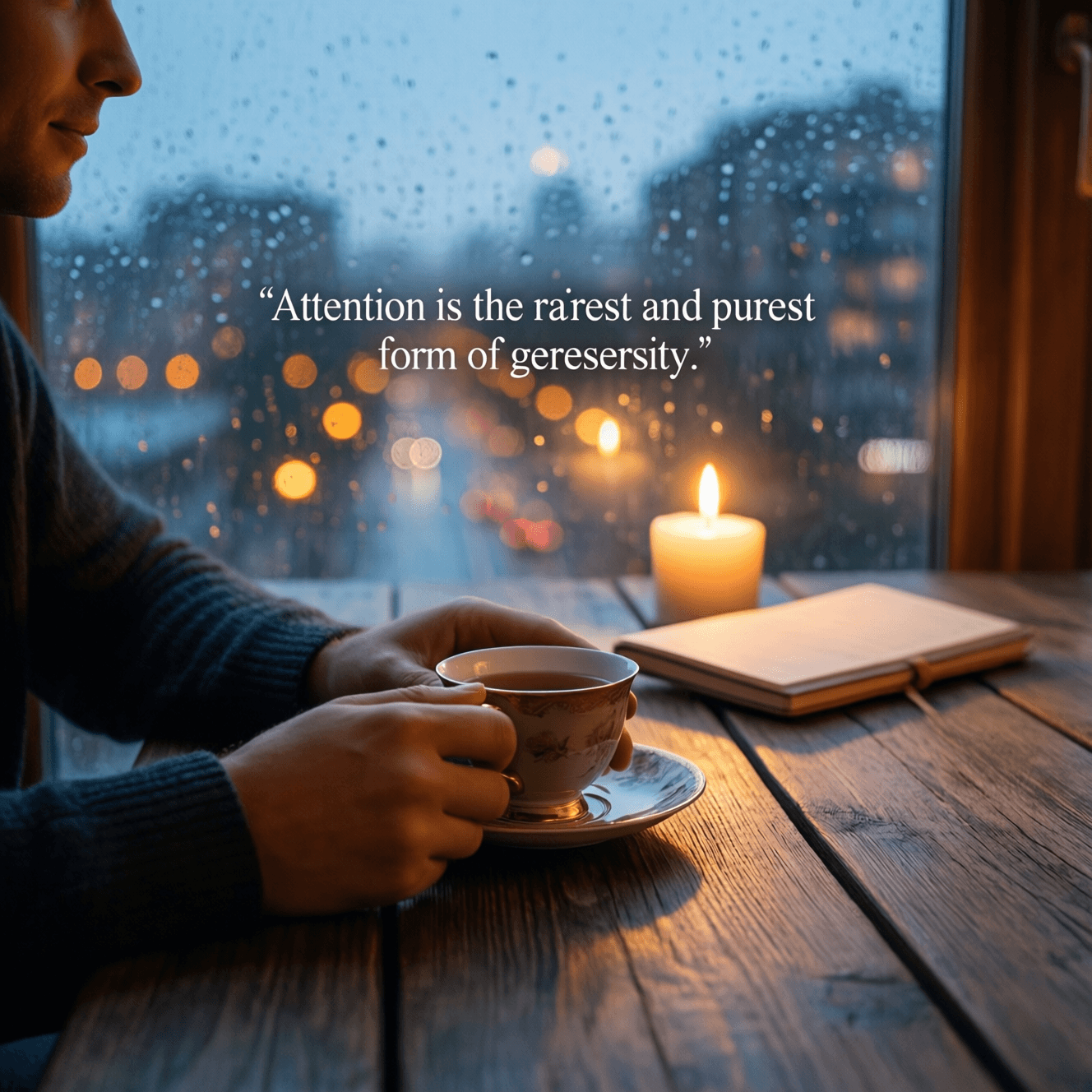
Attention is the rarest and purest form of generosity. — Simone Weil
—What lingers after this line?
Why Weil Elevates Attention
Simone Weil’s claim reframes generosity away from what we give and toward how we meet another person. Attention, in her sense, is not mere noticing but a deliberate, receptive presence—an offering of mind and time without immediately trying to control, fix, or benefit from what we see. In that way, attention becomes rarer than money or praise because it cannot be faked for long; it requires real inner consent. From the outset, her wording also suggests purity: attention is generous precisely because it can be given without ownership. Unlike gifts that may create obligation or status, attentive presence can be quietly sustaining, leaving the recipient more free rather than more indebted.
Rarity in an Economy of Distraction
If attention is generous, it is also scarce, and modern life makes its scarcity visible. Competing notifications, fragmented schedules, and performance-driven communication turn listening into a hurried transaction. Weil’s sentence cuts through that climate by implying that what people most lack is not information, but the experience of being truly received. This scarcity is not only technological; it is also psychological. Because attention demands that we pause our self-preoccupation, it can feel costly. Yet precisely because it costs us—our impatience, our need to be the center—it becomes a meaningful kind of giving.
Attention as Respect for Reality
Moving deeper, Weil ties attention to truthfulness: to attend is to let something be real in front of us, rather than forcing it to fit our assumptions. In her essay “Reflections on the Right Use of School Studies with a View to the Love of God” (1942), she describes attention as a disciplined openness, a kind of waiting that refuses to substitute quick answers for honest perception. Seen this way, attention is generosity toward reality itself. It grants people, problems, and experiences the dignity of being encountered on their own terms, which is why it can feel healing: it replaces being judged or managed with being understood.
The Moral Dimension of Listening
From respect, the idea naturally shifts to ethics. Weil’s broader work on affliction and obligation argues that suffering often includes invisibility—being reduced to a case, a burden, or a stereotype. Attention counters that reduction by restoring personhood through patient recognition. In everyday life, this looks less like grand moral heroism and more like quiet acts: letting someone finish a thought without interruption, asking one more question instead of offering one more opinion, or noticing the emotion under the words. Such listening can be morally significant because it resists the impulse to treat others as instruments for our comfort or self-image.
Generosity Without Control
Unlike many forms of helping, attention doesn’t automatically impose a solution. This is part of its purity: it can be offered even when we are powerless to change outcomes. A friend sitting beside someone in grief may have nothing useful to say; nevertheless, sustained presence can communicate, “You are not alone, and your pain is not an inconvenience.” That restraint also protects the other’s agency. By not rushing to fix, attention allows people to arrive at their own meanings and decisions. In that sense, it is generosity that strengthens rather than replaces another person’s inner life.
Practicing Attention as a Daily Discipline
Finally, Weil’s sentence reads like both an observation and an invitation: if attention is rare, it can be cultivated. Small practices—single-tasking, putting the phone out of reach during conversations, repeating back what you heard before responding—train the capacity to remain present without drifting toward performance or impatience. Over time, these habits turn Weil’s idea into a way of living. Attention becomes a stable posture: meeting people and moments with enough stillness to perceive them clearly, and enough care to let that perception be a gift.
One-minute reflection
What does this quote ask you to notice today?
Related Quotes
6 selectedTo pay attention is the most basic and profound form of love we can offer ourselves and our work. — Simone Weil
Simone Weil
Simone Weil condenses a demanding ethic into a single sentence: attention is not merely a mental skill, but an act of love. To pay attention to ourselves means noticing our fatigue, motives, fears, and hopes without rush...
Read full interpretation →Attention is the rarest and purest form of generosity. — Simone Weil
Simone Weil
Simone Weil’s line reframes generosity away from money or favors and toward a quieter offering: the deliberate act of noticing another person. Attention is not merely looking; it is a willingness to be present, to let so...
Read full interpretation →Attention is the rarest and purest form of generosity. — Simone Weil
Simone Weil
Simone Weil’s claim reframes generosity away from money or favors and toward something more intimate: the deliberate offering of one’s mind. To pay attention is to give another person the scarce resource of presence—time...
Read full interpretation →The capacity for delight is the gift of paying attention. — Julia Cameron
Julia Cameron
Julia Cameron’s line suggests that delight is not merely something that happens to us; it is something we become able to receive. By paying attention, we open a door that ordinary haste keeps shut.
Read full interpretation →The greatest luxury in a modern world is not things, but the ability to disconnect and reclaim your own attention. — Cal Newport
Cal Newport
At first glance, Newport’s statement overturns the traditional idea of luxury as something material. Instead of wealth being measured by rare objects, he suggests it is now measured by the freedom to step away from noise...
Read full interpretation →The more you can increase your focus of time and attention, the more capable you will be of managing your world. — Esther Dyson
Esther Dyson
Esther Dyson’s quote begins with a simple but powerful premise: the quality of our lives is shaped by where we place our attention. The more deliberately we focus our time and mental energy, the less we are pushed around...
Read full interpretation →More From Author
More from Simone Weil →The beauty of the world is that it is a craft, not a product. — Simone Weil
Simone Weil’s remark shifts our attention from the world as a finished object to the world as a living act of making. A product suggests completion, closure, and fixed utility, whereas a craft implies care, patience, rev...
Read full interpretation →Humility is attentive patience. — Simone Weil
At first glance, Simone Weil’s remark seems to redefine humility altogether. Rather than treating it as self-deprecation or mere politeness, she presents it as a disciplined way of being: patient, watchful, and receptive...
Read full interpretation →To pay attention is the most basic and profound form of love we can offer ourselves and our work. — Simone Weil
Simone Weil condenses a demanding ethic into a single sentence: attention is not merely a mental skill, but an act of love. To pay attention to ourselves means noticing our fatigue, motives, fears, and hopes without rush...
Read full interpretation →There is a quiet power in doing one thing well, day after day, until the repetition transforms into grace. — Simone Weil
At first glance, Simone Weil’s line honors a modest kind of excellence: not brilliance displayed all at once, but a patient devotion to doing one thing well. The phrase “quiet power” suggests that true mastery often arri...
Read full interpretation →